2024-T3 Alclad sheet
Damage-tolerant aluminium skin with a pure-aluminium cladding for corrosion protection. Common on bonded metal panels and floor skins.



Aircraft honeycomb is a lightweight cellular core, most often 5052 or 5056 aluminium foil or aramid paper, bonded between thin skins to make sandwich panels that are very stiff for their weight. It is used in floors, interiors, control surfaces, fairings, engine nacelles and secondary structure. This guide explains the core materials, how core is specified, which facings suit which parts, and the tests and standards that govern aerospace use.
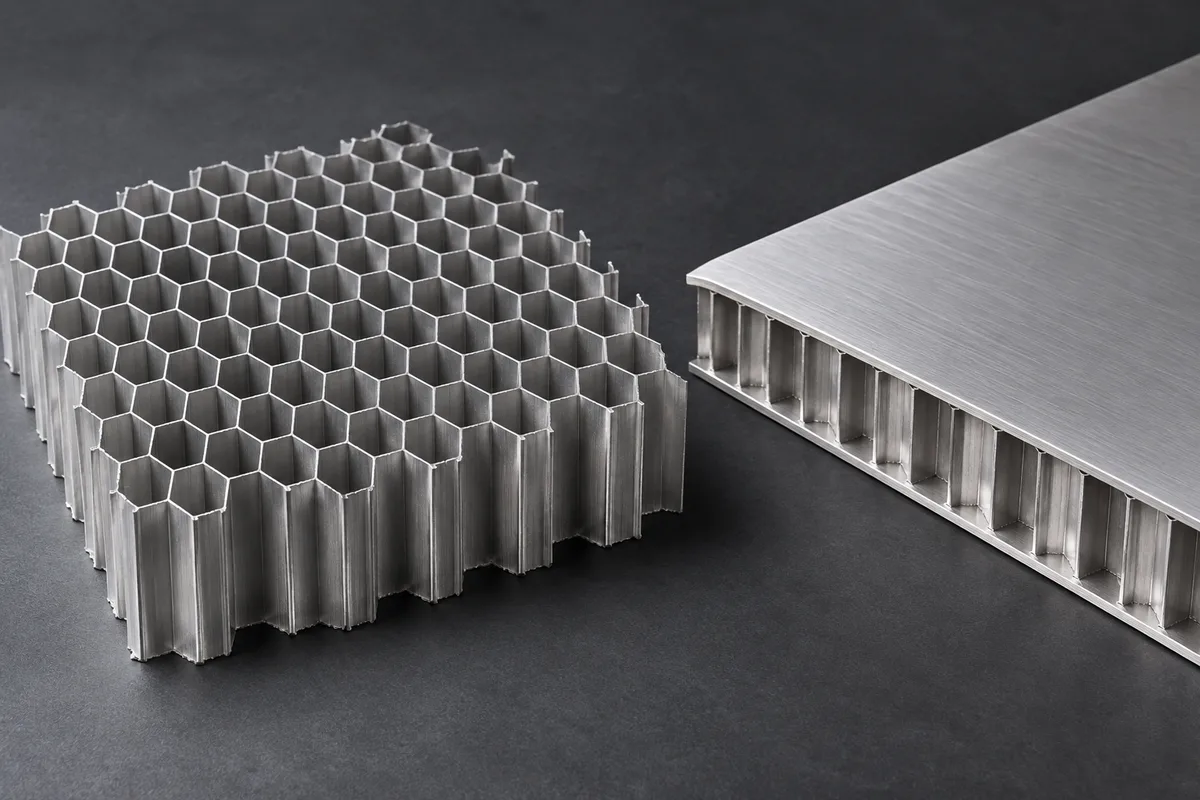
A sandwich panel works like an I-beam. The two skins carry bending loads in tension and compression, and the core holds them apart and carries shear. Doubling the core thickness of a panel roughly increases its bending stiffness about seven-fold while adding only a few per cent to its weight, which is why honeycomb is everywhere in aircraft that must save every kilogram.
Honeycomb is the most efficient core geometry because its thin cell walls run perpendicular to the skins. They resist crushing and shear far better than foam of the same density, and the open cells keep weight very low: typical aerospace cores weigh 30 – 130 kg/m³, compared with 2,700 kg/m³ for solid aluminium. Aluminium honeycomb also absorbs energy predictably as it crushes, which is used in crash-energy absorbers and landing-gear components.
Sandwich panels have been used on aircraft since the 1940s. Today they are found in cabin floors, sidewalls and ceilings, galleys and lavatories, overhead bins, cargo liners, trailing-edge flaps and spoilers, rudders and elevators, wing-to-body fairings, radomes, helicopter rotor blades and engine nacelle acoustic liners.
| Core material | Strength / stiffness | Temperature | Typical aircraft use |
|---|---|---|---|
| 5052 aluminium | High; the aerospace workhorse | Usable to about 175 °C | Floor panels, flaps, spoilers, fairings, secondary structure |
| 5056 aluminium | Higher than 5052 at the same density (more magnesium) | Similar to 5052 | Highly loaded panels, control surfaces, energy absorbers |
| 3003 aluminium | Lower; commercial grade | Similar | Ground equipment, tooling, non-flight panels |
| Aramid (meta-aramid paper) | Lower stiffness, very tough, does not dent permanently | To about 180 °C | Cabin interiors, fairings, radomes (electrically transparent) |
| Fibreglass honeycomb | Moderate; good dielectric properties | Higher, depending on resin | Radomes, antenna covers, high-temperature parts |
| Titanium / steel honeycomb | Very high, heavy | Several hundred °C | Engine and exhaust structures, abradable seals |
Aluminium core gives the highest shear strength and stiffness per unit weight and conducts heat well, so it dominates structural panels. Aramid core is preferred inside the cabin because it does not corrode, is less prone to permanent denting, and is used in panels that must pass the strict fire, smoke and toxicity requirements. Many interior panels pair aramid core with glass or carbon facings, while floor panels in aircraft and helicopters often pair aluminium core with aluminium or composite skins.
Aerospace core is described by a short designation that gives cell size, alloy, foil thickness and density. For example, 1/8-5052-.001 4.5 means 1/8 inch (3.2 mm) cells, 5052 alloy foil 0.001 inch (25 µm) thick, giving a nominal density of 4.5 lb/ft³ (about 72 kg/m³).
| Parameter | Common range | Effect |
|---|---|---|
| Cell size | 1/16 in (1.6 mm) to 3/8 in (9.5 mm); larger for non-structural core | Smaller cells support thin skins better (less dimpling) but cost more |
| Foil thickness | 0.0007 – 0.004 in (18 – 102 µm) | Thicker foil raises density, strength and stiffness |
| Density | About 1.6 – 12 lb/ft³ (26 – 192 kg/m³) | Shear and compression strength rise roughly in proportion to density |
| Ribbon direction (L) | Direction of the continuous foil ribbon | Core is stronger and stiffer in L than in the transverse W direction |
| Perforation | Perforated or non-perforated foil | Perforated core vents trapped air and volatiles during curing |
| Form | Expanded blocks, slices, machined or contoured parts, over-expanded (OX) core | OX core bends more easily around curved parts |
As an indication of scale, one manufacturer publishes typical values for 1/8-inch, 3.1 lb/ft³ 5056 core of about 2.4 MPa stabilised compressive strength, 1.8 MPa shear in the L direction and 1.1 MPa in the W direction at room temperature. These are typical figures, not design minimums. Design values come from AMS-C-7438 or the qualified supplier specification for the exact core you buy, and core properties drop at elevated temperature.
Damage-tolerant aluminium skin with a pure-aluminium cladding for corrosion protection. Common on bonded metal panels and floor skins.
Higher strength than 2024 for skins that see high bending or point loads, such as heavy-duty floor areas.
Lower cost, good corrosion resistance and formability; used for ground-support, interior and less critical panels.
Very stiff and light; widely used on modern interior panels, floors and control surfaces with aramid or aluminium core.
Low cost and electrically transparent; the standard interior skin with phenolic resin for fire performance.
For hot zones near engines and exhausts, usually with metallic core brazed or bonded to the skins.
Metal facings are bonded to aluminium core with structural film adhesives, typically modified epoxies cured at 120 °C or 175 °C, after the skins are prepared by phosphoric acid anodising or a similar treatment that gives a durable bond. Mixing aluminium core with carbon skins needs a glass-fibre or adhesive isolation layer to prevent galvanic corrosion.
| Area | Typical construction | Main requirement |
|---|---|---|
| Cabin floor panels | Aluminium or CFRP skins on aluminium or aramid core; denser core inserts under seat tracks | Stiffness, indentation and impact resistance |
| Sidewalls, ceilings, bins, galleys | Glass/phenolic or carbon skins on aramid core | Fire, smoke and heat-release limits; low weight |
| Cargo liners | Glass or aramid laminate panels | Fire containment and puncture resistance |
| Flaps, spoilers, rudders, elevators | Aluminium or composite skins on aluminium core | Stiffness, fatigue and moisture resistance |
| Fairings and access panels | Composite skins on aramid or aluminium core | Aerodynamic shape and low weight |
| Engine nacelle acoustic liners | Perforated skin on aluminium or metallic core | Noise attenuation, temperature resistance |
| Helicopter floors and blades | Aluminium core with aluminium or composite skins | Stiffness, vibration and crash energy absorption |
| Energy absorbers | Pre-crushed aluminium honeycomb blocks | Predictable crush force |
A typical bonded floor panel has two thin aluminium or carbon skins, a 10 mm core, and local high-density inserts or potted areas where seat tracks, fasteners and fittings pass through. Because inserts concentrate load, panel designers specify potting compound, insert type and edge closeouts as carefully as the core itself.
| Standard | Covers |
|---|---|
| AMS-C-7438 | Aluminium honeycomb core for sandwich construction (5052 and 5056), including minimum properties |
| ASTM C365 | Flatwise compressive properties of sandwich cores |
| ASTM C273 | Shear properties of sandwich core materials (plate shear test) |
| ASTM C297 | Flatwise tensile strength of sandwich constructions (skin-to-core bond) |
| ASTM C393 / D7249 | Core shear and facing properties by beam flexure |
| ASTM D1781 | Climbing drum peel for adhesives (skin-to-core peel) |
| 14 CFR 25.853 and Appendix F | Flammability, heat release and smoke requirements for transport aircraft interiors |
| AMS-QQ-A-250 / AMS 4037, AMS 4045 | Aluminium facing sheet in 2024 and 7075 |
Aircraft programmes add their own material and process specifications on top of these, and panels for flight use are made only from qualified materials by approved processes. When ordering core for a qualified part, quote the airframe or customer specification as well as AMS-C-7438, and ask for the certificate of conformance with lot test results.
5052 is the standard aerospace core alloy. 5056 contains more magnesium and gives higher strength at the same density, so it is chosen for more highly loaded panels. 3003 core is a commercial grade for non-flight uses.
It describes 1/8 inch cells made from 5052 foil 0.001 inch thick, giving a nominal core density of 4.5 lb/ft³ (about 72 kg/m³).
Aluminium core is stronger and stiffer for its weight and suits structural panels. Aramid core is tougher, does not corrode, resists permanent denting and is the usual choice for cabin interiors and radomes.
AMS-C-7438 (formerly MIL-C-7438) covers 5052 and 5056 aluminium core for sandwich construction. Aircraft programmes usually add their own material specifications.
L is the ribbon direction, along the continuous foil sheets; W is perpendicular to it. Core is stronger and stiffer in shear in the L direction, so it is aligned with the main load path.
Yes. We supply aluminium honeycomb core and aluminium facing sheet such as 2024, 7075, 6061 and 5052, with mill certificates, to panel makers worldwide.
Send the core designation, sizes, specification and facing requirements. We will reply with availability, certification and a delivered price.





