6061-T4
Solution treated and naturally aged. Used where profiles will be stretch-bent, hydroformed or crimped before final ageing to T6.



6061 extrusions give vehicle engineers a strong, weldable and corrosion-resistant structural section that machines cleanly and accepts anodising or paint. They are used for sub-frame members, cross-car beams, battery-tray frames, drive-shaft tubes, roof and cargo systems and commercial-vehicle bodies. Metline supplies 6061 profiles and tubes to drawing in T4, T5 and T6, cut, machined, bent and finished as needed, to customers worldwide.
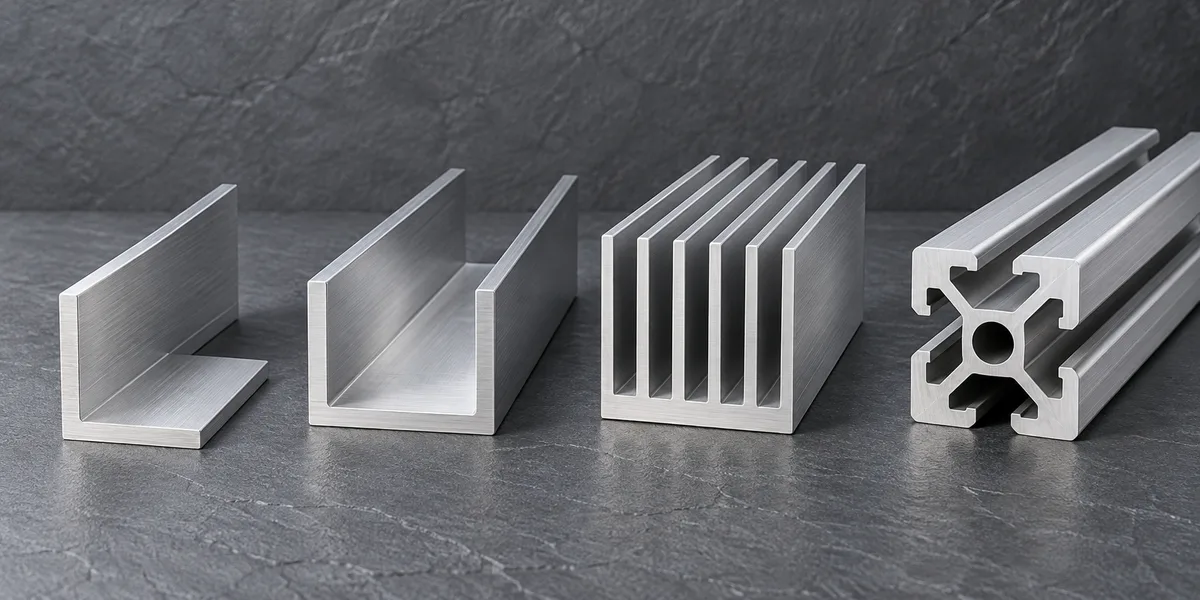
Extrusion lets designers place material exactly where it carries load: multi-cell hollows for stiffness, thick flanges for bolted joints, integrated screw bosses and channels for wiring or coolant. 6061 is the most widely specified heat-treatable alloy for such sections outside Europe, because it combines a guaranteed T6 yield of 240 MPa with good weldability, machinability and corrosion resistance.
Compared with the lean alloys 6060 and 6063, 6061 is roughly 40 – 60 % stronger, but it extrudes more slowly and is less suited to very thin walls or bright decorative finishes. Compared with 6082, its European counterpart, 6061 has very similar strength; the choice often depends on the region and the standards in use.
In passenger cars, 6061 profiles are common in sub-frames, seat structures, steering-column and cross-car beams, and battery-tray frames. In commercial vehicles they form truck-body frames, tail-lift structures and trailer rails. 6061-T6 tube is also a long-established material for lightweight drive shafts.
Composition follows the Aluminum Association registration and EN 573-3 (EN AW-6061). Extruders may target narrower bands within these limits to balance extrusion speed against strength.
| Element | Minimum | Maximum | Role |
|---|---|---|---|
| Silicon (Si) | 0.40 | 0.80 | Forms Mg2Si with magnesium |
| Iron (Fe) | — | 0.70 | Impurity |
| Copper (Cu) | 0.15 | 0.40 | Adds strength; slightly lowers corrosion resistance |
| Manganese (Mn) | — | 0.15 | Grain control |
| Magnesium (Mg) | 0.80 | 1.20 | Main strengthening element |
| Chromium (Cr) | 0.04 | 0.35 | Controls grain structure, improves stress-corrosion resistance |
| Zinc (Zn) | — | 0.25 | Impurity |
| Titanium (Ti) | — | 0.15 | Grain refiner |
| Others, each / total | — | 0.05 / 0.15 | |
| Aluminium (Al) | Remainder |
Minimum values below are from ASTM B221 and EN 755-2 for extruded profiles. Typical values for T6 are about 310 MPa tensile and 275 MPa yield.
| Temper | Wall thickness (mm) | Rm min (MPa) | Rp0.2 min (MPa) | Elongation min (%) | Typical hardness (HBW) |
|---|---|---|---|---|---|
| T4 | ≤ 25 | 180 | 110 | 15 – 16 | 65 |
| T6 | ≤ 5 | 260 | 240 | 8 | 95 |
| T6 | > 5 – 25 | 260 | 240 | 10 | 95 |
| T5 (press-quenched) | thin walls, by agreement | agreed per order | agreed per order | agreed | 80 – 90 |
6061-T5 is not a tabulated temper in EN 755-2; when ordered, properties are agreed with the extruder. Some trade tables quote T5 with 19 % elongation, which is not a realistic minimum for an aged 6061 section.
Solution treated and naturally aged. Used where profiles will be stretch-bent, hydroformed or crimped before final ageing to T6.
Cooled on the press and artificially aged. Lower cost, suitable for thin sections where press quenching achieves enough strength.
Separately solution treated (or fully press-quenched with water) and aged. The standard structural temper for frames and sub-frames.
T6 stretched to straighten and relieve stress, with minor straightening allowed. Preferred for bar and profiles that will be heavily machined.
Section feasibility depends on wall thickness, cavity layout and circumscribing circle; send the drawing for review.
| System | Designation | Profile standard |
|---|---|---|
| Aluminum Association / ASTM | 6061 | ASTM B221 (profiles), ASTM B241 / B429 (tube and pipe) |
| UNS | A96061 | — |
| European | EN AW-6061 / AlMg1SiCu | EN 755-2 (properties), EN 755-9 (tolerances) |
| Japan | A6061 | JIS H4100 |
| ISO | AlMg1SiCu | ISO 6362 |
| India | 65032 | IS 733 |
Automotive buyers usually add their own drawing tolerances, crush or bend test requirements and PPAP documentation to the base standard.
| Part | Typical temper | Why 6061 |
|---|---|---|
| Sub-frame and cradle members | T6 | Strength, weldability and fatigue performance |
| Battery-tray side rails and cross-members | T6 | Stiff multi-cell sections, friction-stir weldable |
| Cross-car beams and steering-column supports | T6 | Stiffness at low weight, machinable mounting points |
| Drive-shaft tubes | T6 | High specific stiffness raises critical speed |
| Truck-body frames, tail lifts and trailer rails | T6 | Corrosion resistance and weldability |
| Roof racks, tow systems and cargo management | T6 | Strength and good anodised finish |
Cylinder heads, crankcases and intake manifolds are castings and are not made from 6061 profiles. Radiators and condensers use 1xxx and 3xxx brazing alloys rather than 6061.
| Property | 6061-T6 | 6063-T6 | 6005A-T6 | 6082-T6 |
|---|---|---|---|---|
| Rp0.2 min, thin wall | 240 MPa | 170 MPa | 225 MPa | 250 MPa |
| Extrudability | Fair–good | Excellent | Good | Fair |
| Anodised appearance | Good | Excellent | Good | Fair |
| Weldability | Good | Good | Good | Good |
| Typical market | Americas, Asia | Global, decorative | Europe, rail and battery trays | Europe, structural |
6005A is worth considering for complex thin-walled hollows such as battery-tray rails: it extrudes more easily than 6061 with only slightly lower strength. 6082 is the European default for highly loaded structural sections.
ASTM B221 and EN 755-2 both require 260 MPa tensile and 240 MPa yield strength for 6061-T6 profiles, with minimum elongation of 8 – 10 % depending on wall thickness.
Not necessarily. T5 relies on cooling at the press, which may not fully quench thicker walls, so its properties are agreed per order. Specify T6 when you need the tabulated minimums.
They are near-equivalents in strength. 6082 is more common in Europe and slightly stronger in thick sections; 6061 is standard in the Americas and much of Asia. Choose the alloy that matches your design standard and supply chain.
Yes. 6061 is welded by MIG, TIG and friction-stir welding. Friction-stir welding is common for tray floors because it limits strength loss and distortion.
Yes. For tight radii, bend in T4 and age to T6 afterwards. T6 profiles can be stretch- or rotary-bent to more generous radii.
Yes. Metline ships 6061 extrusions worldwide with EN 10204 3.1 certificates and export packing on EXW, FOB, CIF or DAP terms.
Send the drawing, temper, finish and annual volume. Our team will reply with feasibility, tolerances and delivered pricing.





