HVAC and refrigeration
Condenser and evaporator headers (D-shaped and round), connecting tubes and refrigerant lines. 4343/3003 is the default for brazed coils; 7072 cladding helps in coastal installations.



High-frequency welded (HFW) aluminium pipe is roll-formed from strip and joined along one longitudinal seam by induction or contact welding, without filler metal. Made from plain 3xxx alloys or from strip clad with a brazing or sacrificial layer, it is the standard tube for radiators, condensers, oil coolers, HVAC headers and battery cooling, because it combines thin, uniform walls, shaped sections and low cost per metre.
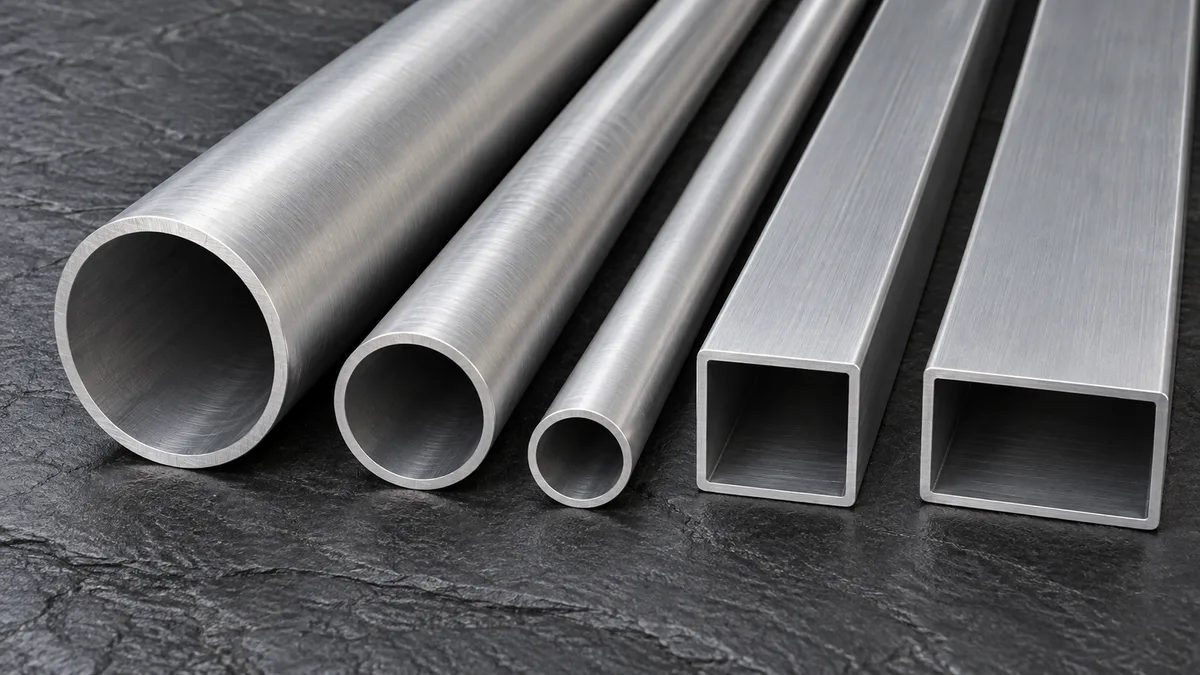
An HFW tube begins as a slit coil of aluminium strip. Forming rolls gradually curl the strip into a tube, and a high-frequency current, induced by a coil or fed through sliding contacts, heats the two abutting edges to forging temperature in a fraction of a second. Squeeze rolls then press the edges together and the joint forms in the solid state, with molten or oxidised metal expelled as a small bead that is trimmed off.
Because the heat is concentrated in a very narrow band at the seam, the rest of the strip keeps its original temper and the heat-affected zone is narrow. Peer-reviewed metallographic studies of HF-welded aluminium tube report a sound joint with a deformed zone only a fraction of a millimetre wide. The process runs continuously, so long lengths and high volumes are economical, and the wall thickness is as uniform as the rolled strip it came from.
The most important advantage for thermal engineers is that the strip can be clad before forming. A thin layer of aluminium-silicon filler on the outside lets the tube be brazed to fins and headers in one furnace pass, and a zinc-bearing layer can protect the core sacrificially. Seamless extruded tube cannot carry such a layer in the same way.
| Shape | Typical size range in the market | Typical material | Main uses |
|---|---|---|---|
| Round | OD about 8 – 60 mm, wall 0.3 – 3 mm | 3003, 3105, 4343/3003 | Refrigerant lines, round headers, manifolds, appliance tubing |
| D-shaped header | About 15 × 12 mm to 44 × 19 mm | 4343/3003 | Condenser and evaporator headers with a flat side for tube slots |
| Oval / flat-oval | Major axis about 18 – 35 mm, minor 4 – 10 mm | 4343/3003, 4045/3003, 3005 | Radiator and heater cores, charge-air coolers |
| Flat (folded or welded) | About 16 – 34 mm wide, 2 mm high, wall 0.25 – 0.4 mm | 4343/3003, 7072/3003 | Radiator tubes, condenser tubes |
| Rectangular | About 15 × 30 mm to 15 × 64 mm, wall 0.8 – 3 mm | 3005, 4343/3003 | Intercoolers, oil coolers, modular coolers |
| Multi-chamber / with turbulator | Flat sections with internal webs or dimples | 4343/3003, 4047/3003, 7072/3003 | Battery cold plates, high-pressure oil coolers, evaporators |
Size ranges describe what HFW lines commonly produce; final dimensions and tolerances are agreed per drawing. For multi-port extruded tube see microchannel tube.
Choose a single alloy when the tube will be mechanically joined, welded or used as a simple conduit. Choose clad strip when the tube will be brazed into an assembly or must survive a corrosive environment. The core provides strength; the cladding, usually 5 – 15 % of the thickness on one or both sides, provides the function.
| Material | Composition idea | Best for |
|---|---|---|
| 3003 | Al-1.2Mn, non-heat-treatable | General tubing, headers, ducts; good corrosion resistance and formability |
| 3005 | Al-Mn with a little Mg | Slightly stronger tubes and headers where pressure or vibration is higher |
| 3105 | Al-Mn-Mg | Larger or load-bearing sections; good strength in thin gauge |
| 4343 / 3003 | Al-7.5Si filler on 3003 core | The general-purpose brazing tube for controlled-atmosphere (flux) brazing |
| 4045 / 3003 | Al-10Si filler, lower melting range | Better filler flow into joints; headers and connecting tubes |
| 4047 / 3003 or 3005 | Al-12Si near-eutectic filler, melts about 577 °C | Maximum fluidity, large fillets, complex joints |
| 4004 / 3003 | Al-Si filler with about 1.5 % Mg | Vacuum brazing, where Mg acts as the oxide getter in place of flux |
| 7072 / 3003 | Al-1Zn sacrificial layer | Water-side or air-side corrosion protection; marine and coastal coolers |
| 7072 / 3003 / 4343 | Three-layer: sacrificial, core, filler | Brazed tubes in aggressive coolant or humid service |
A common mistake is to choose a brazing cladding by habit rather than by furnace. Flux (controlled-atmosphere) brazing uses 4343, 4045 or 4047 claddings; vacuum furnaces need a magnesium-bearing cladding such as 4004 or 4104, because magnesium breaks up the oxide film without flux. Magnesium in the core or cladding, on the other hand, poisons fluoride fluxes, which is why flux-brazed tubes use low-Mg cores.
Condenser and evaporator headers (D-shaped and round), connecting tubes and refrigerant lines. 4343/3003 is the default for brazed coils; 7072 cladding helps in coastal installations.
Radiators, heater cores, charge-air coolers and oil coolers, built from flat or oval brazed tube with fins and headers. See our page on clad HF welded tube for vehicle heat exchangers.
Manifolds and branch tubes for liquid-cooled battery packs and cold plates, where leak-tightness and coolant compatibility are critical.
Hydraulic oil coolers, compressor aftercoolers and process coolers using rectangular and turbulated flat tubes.
Absorber tubes, appliance heat exchangers and simple conduits in 3003.
Furniture, frames and ducts where round or rectangular welded tube is cheaper than extruded tube.
| Test | Purpose | Typical approach |
|---|---|---|
| Eddy-current testing | Detects seam discontinuities, lack of fusion and cracks | 100 % inline on the mill |
| Flattening and expansion tests | Proves seam ductility | Sample per lot; seam placed at the point of maximum strain |
| Dimensional checks | Width, height, OD, wall, straightness and twist | Laser and gauge measurement against EN 1592-3/-4 or drawing |
| Burst / pressure test | Confirms margin over working pressure | Sample testing to the customer's pressure specification |
| Leak testing | Finds through-wall leaks | Air-under-water or helium mass spectrometry for battery and refrigerant systems |
| Clad ratio and brazing test | Cladding thickness and filler flow | Metallographic section and test braze on a sample |
| Corrosion test | Durability of sacrificial or coated tubes | SWAAT (ASTM G85 Annex A3) or neutral salt spray (ASTM B117) as agreed |
The acceptance level for each test should be written on the order. Battery and refrigerant circuits normally call for helium leak testing at a stated leak rate; radiator tubes are usually accepted on eddy-current results and sampled pressure tests. A mill test certificate to EN 10204 3.1 accompanies each lot.
Internal cleanliness is often overlooked. Residual rolling oil, scarfing chips or fine particles inside a tube can contaminate refrigerant circuits or block narrow coolant channels, so specify a cleanliness requirement (for example a maximum residue per square metre of internal surface) together with sealed end caps for battery and refrigerant tubes.
| Feature | HFW tube | Seamless / extruded tube | Folded (B-type) tube |
|---|---|---|---|
| Brazing cladding | Yes, from clad strip | Not directly; filler added separately or zinc-sprayed | Yes, from clad strip |
| Minimum wall | Very thin, very uniform | Thicker for the same diameter | Very thin |
| Internal webs | Limited (dimples, inserts) | Multi-port microchannel possible | Folded internal web |
| Pressure capability | Good; seam must be qualified | Highest, no seam | Good for radiator pressures |
| Cost per metre at volume | Low | Medium | Low |
| Typical use | Headers, radiator and cooler tubes | High-pressure lines, CO2 systems, structural | Radiator and heater tubes |
For high-pressure refrigerant circuits, such as CO2 systems, multi-port extruded tube is usually preferred. For brazed cores at normal coolant pressures, HFW and folded tubes give the lowest cost and weight. See the folded microchannel tube guide and our heat-exchanger tube overview to compare structures.
Metline can also supply the clad brazing strip itself to tube makers who run their own HFW mills.
Use 3003 for general, non-brazed tube; 3005 or 3105 for more strength; 4343/3003 or 4045/3003 for tubes brazed in a flux (controlled-atmosphere) furnace; 4004 cladding for vacuum brazing; and add 7072 sacrificial cladding for corrosive or coastal service.
The body of the tube has the strength of the strip. A properly qualified HF seam is sound and ductile, passing flattening tests, but very high-pressure systems such as CO2 refrigeration usually use seamless or multi-port extruded tube to avoid a seam altogether.
It is the cladding thickness as a percentage of total strip thickness on each clad side, typically about 5 – 15 %. More cladding gives more filler for brazing or longer sacrificial protection, but leaves less core for strength.
Common causes are no sacrificial layer, a core without long-life chemistry, or joints where water stands. A 7072 clad side, a long-life core and drainage-friendly design usually extend life considerably; test with SWAAT to compare options.
EN 1592-3 covers circular HF seam welded tubes up to 80 mm diameter and 2.5 mm wall, and EN 1592-4 covers square, rectangular and shaped tubes. ASTM B313 covers round welded tube for US orders. Heat-exchanger tubes are usually made to tighter drawing tolerances.
Yes. Metline supplies finished HFW tube cut to length and clad brazing strip for tube mills, with mill certificates and export packing, to customers worldwide.
Send the section drawing, clad combination, brazing method and annual volume. We will confirm material, tests and a delivered price.





