Ultrasonic testing
Immersion or contact UT to detect internal discontinuities; aerospace orders typically reference AMS-STD-2154 class levels.



Extra-large seamless aluminium tube means hollow sections of roughly 200 mm to over 1,300 mm outside diameter, with walls from about 18 mm up to 200 mm or more, made without a longitudinal weld. They are produced by piercing and extruding a solid billet on very large vertical presses, then heat treated and machined. This guide explains how they are made, which alloys and standards apply, how to estimate weight, and what to put in an enquiry.
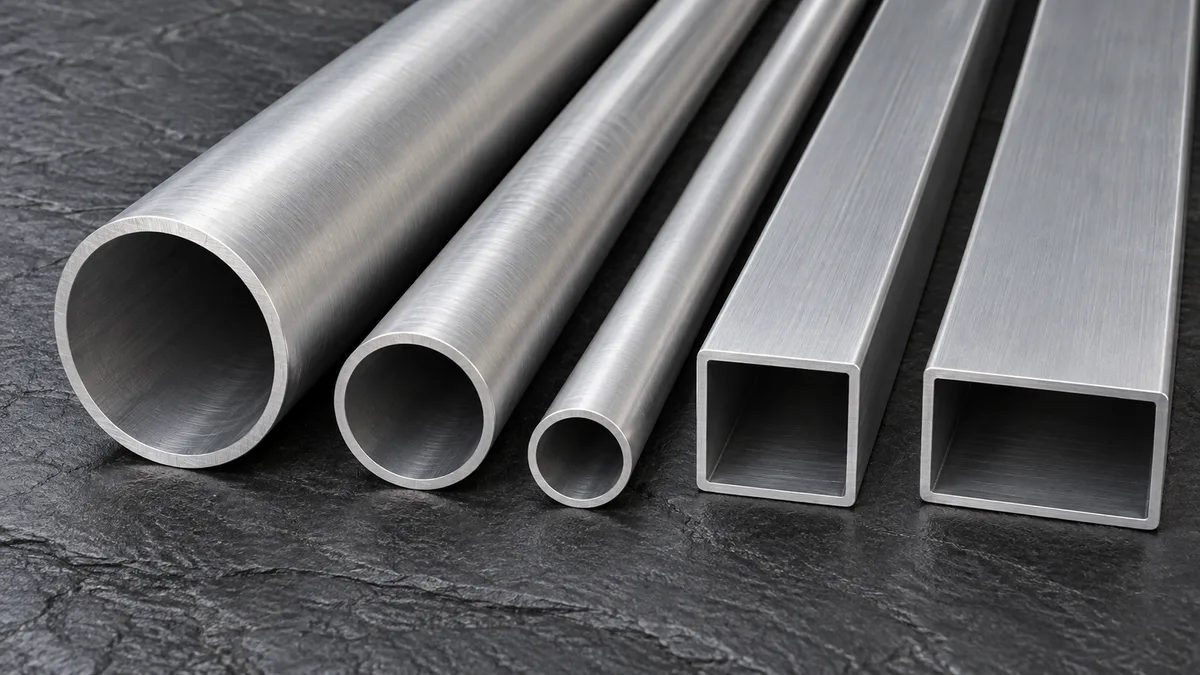
Most aluminium tube is produced on horizontal extrusion presses, which limits seamless round tube to a few hundred millimetres in diameter. Above that size, tube has traditionally been made by rolling plate and welding a seam, by forging and boring, or by ring rolling. Extra-large seamless tube fills the gap: a single hollow, with no weld, in diameters that once required fabricated pipe.
"Seamless" matters because a weld is a metallurgical discontinuity. In heat-treatable alloys such as 6061, 2024 and 7075, the heat-affected zone of a weld loses a large part of its strength, and in high-strength 2xxx and 7xxx alloys arc welding is generally not practical at all. A seamless tube keeps uniform properties around its circumference, which simplifies design for pressure, fatigue and bending, and avoids weld inspection and qualification.
Porthole (bridge-die) extrusions are sometimes sold as "tube", but they contain longitudinal seam welds formed inside the die. For pressure service, many codes and buyers specify seamless tube made from a hollow billet or by piercing, and standards such as ASTM B241 and EN 755-7 are written specifically for seamless product.
The industrial route for the largest sizes is vertical hot extrusion on hydraulic presses rated at several hundred meganewtons. The sequence below is typical; individual mills differ in detail.
Because tooling for each diameter is expensive, mills keep a library of die and mandrel sizes and produce the nearest standard outside and inside diameters, then machine to the customer's final dimensions. Asking for a size close to an existing tool set usually shortens the route and lowers cost; a supplier can tell you which nominal sizes are available.
| Route | Typical size range | Strengths | Limitations |
|---|---|---|---|
| Vertical extrusion (seamless) | About 200 – 1,320 mm OD, walls about 18 – 220 mm | No weld; uniform properties; suits 2xxx and 7xxx; long lengths | Limited to available tool sizes; machining allowance needed |
| Horizontal extrusion (seamless or porthole) | Up to a few hundred mm OD | Lower cost, wide size choice | Diameter limited by press; porthole tube has seam welds |
| Rolled and welded plate pipe | Very large diameters, thinner walls | Economical for low-pressure ducting and piping | Longitudinal or spiral weld; weld strength governs design |
| Ring rolling / forging and boring | Short lengths, very heavy walls | Excellent properties in thick sections | Length usually limited; heavy machining waste |
| Solid billet or bar, gun-drilled or bored | Smaller diameters, short lengths | Simple | Wasteful and slow for large bores |
For low-pressure pipelines in the 500 – 1,000 mm range, longitudinally or spirally welded 5xxx and 6xxx pipe is often the economical answer; see our guides to 500 – 1,000 mm large diameter pipe and spiral welded aluminium pipe. Choose seamless extruded tube when the alloy cannot be welded, when cyclic or pressure loads make a weld undesirable, or when the tube will be machined into a structural part.
Almost any extrudable wrought alloy can be made in large seamless sizes, but most enquiries fall into four families. Values are typical room-temperature properties from published Aluminum Association and ASM data for standard sections; thick walls generally give lower minimums, so design to the certified values for your wall thickness.
| Alloy and temper | Typical tensile strength | Typical yield strength | Character | Typical uses |
|---|---|---|---|---|
| 6061-T6 | 310 MPa | 276 MPa | Weldable, corrosion resistant, good machinability | Pressure vessels, industrial pipelines, machine structures, masts |
| 6082-T6 | About 310 – 340 MPa | About 260 – 300 MPa | European structural equivalent of 6061 | Offshore and structural frames, cranes |
| 5083-O / H112 | 290 MPa (O) | 145 MPa (O) | Non-heat-treatable, excellent in seawater, cryogenic toughness | Marine and offshore piping, LNG and cryogenic service |
| 2024-T3 / T351x | 470 – 485 MPa | 325 – 345 MPa | High strength and fatigue resistance, poor corrosion resistance unprotected | Aerospace structures, drill pipe, high-load tubes |
| 7075-T6 / T651x | 572 MPa | 503 MPa | Very high strength; not weldable by arc | Aerospace and defence parts, high-strength cylinders |
| 7055, 7034 (spray formed) | Above 7075 in suitable tempers | — | Ultra-high strength aerospace alloys | Aerospace and defence structures; properties per certificate |
| Al-Li alloys: 2195, 2050, 1420 | Per specification | — | Lower density, higher stiffness | Launch vehicle and aircraft structures |
Values for 7055, 7034 and aluminium-lithium alloys depend strongly on temper and section size and are given on the mill certificate rather than quoted here.
As a quick rule: 6061 or 6082 for general engineering and pressure work, 5083 for seawater and cryogenics, 2024 where fatigue resistance at high stress matters, and 7075 or newer 7xxx alloys where maximum strength justifies the cost and the loss of weldability. More detail is on our 6061 tube, 7075 tube and 5083 pipe pages.
Not every diameter is available in every wall; the achievable combination depends on tooling and alloy. Send your finished dimensions and we will confirm the nearest production size and machining allowance.
Weight per metre of a round tube is π × (OD − t) × t × density, with dimensions in millimetres and density in g/cm³, divided by 1,000 to give kg/m. The table uses 2.70 g/cm³ (6061, 6082, 6063). Multiply by 1.03 for 2024 (2.78 g/cm³), by 1.04 for 7075 (2.81 g/cm³) and by 0.98 for 5083 (2.66 g/cm³).
| Outside diameter (mm) | Wall (mm) | Weight (kg/m) | Weight of 6 m length (kg) |
|---|---|---|---|
| 210 | 20 | 32 | 193 |
| 310 | 30 | 71 | 428 |
| 410 | 32 | 103 | 616 |
| 510 | 45 | 177 | 1065 |
| 610 | 55 | 259 | 1554 |
| 710 | 65 | 356 | 2134 |
| 810 | 85 | 523 | 3136 |
| 910 | 80 | 563 | 3379 |
| 1010 | 100 | 772 | 4631 |
| 1110 | 110 | 933 | 5598 |
| 1210 | 120 | 1109 | 6657 |
| 1320 | 140 | 1401 | 8408 |
| Standard | Scope | Typical use |
|---|---|---|
| ASTM B241/B241M (ASME SB-241) | Aluminium and aluminium-alloy seamless pipe and seamless extruded tube | Pressure piping, vessels, general engineering |
| ASTM B221 | Extruded bars, rods, wire, profiles and tubes | Structural tube where seamless is specified on the order |
| ASTM B345 | Seamless pipe and extruded tube for gas and oil transmission and distribution piping | Pipelines and process piping |
| EN 755-2 / EN 755-7 | Mechanical properties of extruded products / tolerances for seamless tubes | European projects |
| SAE AMS specifications (e.g. AMS-QQ-A-200 series) | Aerospace extruded products by alloy and temper | Aerospace and defence |
| ISO 15546 | Aluminium alloy drill pipe for the petroleum and natural gas industries | Drill pipe applications |
| ASME B31.3 | Process piping design code, which lists permitted aluminium materials | Process plant design |
Many large tubes are made to a customer drawing that references one of these standards for chemistry and properties but sets its own tolerances on finished machined dimensions. State clearly which governs: the product standard or the drawing.
As-extruded large tube follows the tolerance tables of the product standard, which are relatively wide at these sizes. Where tighter control is needed, the outside is turned and the bore is bored to the drawing. Typical capabilities after machining include concentricity within about 0.5 mm, straightness of the order of 1 mm per metre and surface roughness of Ra 12.5 µm or better; confirm the figures that apply to your size before ordering.
Immersion or contact UT to detect internal discontinuities; aerospace orders typically reference AMS-STD-2154 class levels.
Surface and near-surface defect detection and conductivity checks, which also confirm temper on heat-treated tubes.
OD, ID, wall at several points around the circumference, ovality, straightness and length.
Tensile tests taken from the tube end in the direction the standard requires, plus hardness surveys.
Grain size, recrystallised layer depth and absence of coarse grain bands, important for fatigue-critical parts.
EN 10204 3.1 mill certificate with heat number, chemistry and test results; third-party inspection on request.
Large seamless tubes are often only the starting stock. Common downstream operations are:
Large aluminium tubes are often specified as replacements for steel pipe or forgings. The density is about one third of steel, but so is the elastic modulus (about 69 – 72 GPa against 200 GPa), and that changes how the part should be designed.
Wall thickness for internal pressure is set by the design code, starting from the hoop-stress relation P = 2 S t / D, where S is the code allowable stress for the alloy, temper and temperature. Use the welded allowable stress for any part of the line that will be welded, even if the tube itself is seamless.
With a lower modulus, an aluminium tube deflects about three times as much as a steel tube of the same size. Large diameter-to-wall ratios also raise the risk of local buckling in compression and bending, so check both strength and stability.
Aluminium expands about twice as much as steel (roughly 23 µm/m·°C). Long runs need expansion loops or joints, and mixed aluminium-steel assemblies need allowance for differential movement.
Heat-treated alloys lose strength with long exposure above about 100 – 150 °C. In contrast, 5083 and 6061 keep or improve their toughness at cryogenic temperatures, which is why they are used for liquefied gas service.
Isolate aluminium from steel, stainless and copper alloys in wet or marine service with insulating gaskets, sleeves and washers, or coat the more noble metal.
Very heavy walls cool more slowly during quenching, so minimum properties in 6xxx, 2xxx and 7xxx alloys can fall with increasing thickness. Agree test locations and acceptance values before production.
| Sector | Typical parts | Common alloys |
|---|---|---|
| Aerospace and space | Launch vehicle structural rings and interstages, test fixtures, large hydraulic and structural cylinders | 2024, 7075, 7055, 2195, 2219 |
| Defence | Launcher tubes, mast and radar supports, vehicle structures | 6061, 7075, 2024, 5083 |
| Shipbuilding and offshore | Masts, davit posts, frames, seawater and ventilation piping, walkway structures | 5083, 5086, 6061, 6082 |
| Oil and gas | Drill pipe, risers and process piping where weight matters | 2024-type and 7xxx alloys, 6061, 5083 |
| Energy and power | Wind and tidal equipment structures, rigid bus conductors, cryogenic lines | 6061, 6082, 6101, 5083 |
| Industrial machinery | Rolls, cylinders, vacuum chambers, large bearing housings | 6061, 7075 |
A typical example: a heavy-wall 6061-T6 tube is bored and turned into a vacuum chamber body, replacing a welded plate shell and removing the leak paths and distortion that welding would introduce. Another: a 7075 tube, machined to a stepped profile, replaces a forged ring and boring operation for a high-strength structural cylinder.
Metline supplies large seamless tube with mill test certificates to EN 10204 3.1 and can arrange cutting, machining and third-party inspection. Because each order is matched to available production tooling, we confirm sizes and route at the quotation stage.
Vertical extrusion presses in the industry produce seamless tubes up to about 1,320 mm outside diameter, with walls up to roughly 220 mm and lengths up to about 12 m. Availability of a given diameter and wall depends on existing tooling.
Seamless tube is extruded from a hollow or pierced billet over a mandrel, so it has no internal weld lines. Porthole tube is formed in a bridge die where metal streams re-join, leaving longitudinal seam welds. Pressure and high-integrity applications usually specify seamless.
Not by normal arc welding: 7075 is crack-sensitive and loses much of its strength. 7075 tubes are machined and joined mechanically. For welded large tube, use 6061, 6082 or 5083.
Weight in kg/m = π × (OD − wall) × wall × density ÷ 1,000, with dimensions in mm and density in g/cm³. A 610 × 55 mm tube in 6061 weighs about 259 kg per metre.
They can be supplied as extruded or with the outside turned and bore machined to drawing. Machining removes the extrusion surface and improves concentricity, roughness and straightness.
ASTM B241 is the usual standard for seamless pipe and tube in pressure and general service, EN 755 for European projects, and AMS specifications for aerospace. Many orders combine a standard for material properties with a drawing for finished dimensions.
Spray forming deposits atomised molten alloy onto a collector to build a billet with a very fine, uniform grain structure and little segregation. That allows highly alloyed grades such as 7034 and 7055, and some aluminium-lithium alloys, to be extruded into large sections with better toughness and fatigue performance than conventionally cast billets would give.
Yes. Metline ships worldwide on EXW, FOB, CIF or DAP terms, with capped ends, dried bores, wrapped surfaces and timber cradles to protect the tubes in transit.
Send the alloy, finished dimensions, quantity and standard. We will confirm the production size, machining and delivered terms.





