7075-T6
Peak-aged. Normal for sheet up to about 6 mm. Maximum strength.



7075 is the classic high-strength aluminium alloy: in T6 and T651 it reaches about 570 MPa tensile strength, close to many structural steels at one third of the weight. It machines superbly but is not suited to fusion welding, and the over-aged T7351 temper is used where stress-corrosion resistance matters. Metline supplies 7075 sheet and plate in T6, T651 and T7351, certified to ASTM, AMS and EN, worldwide.
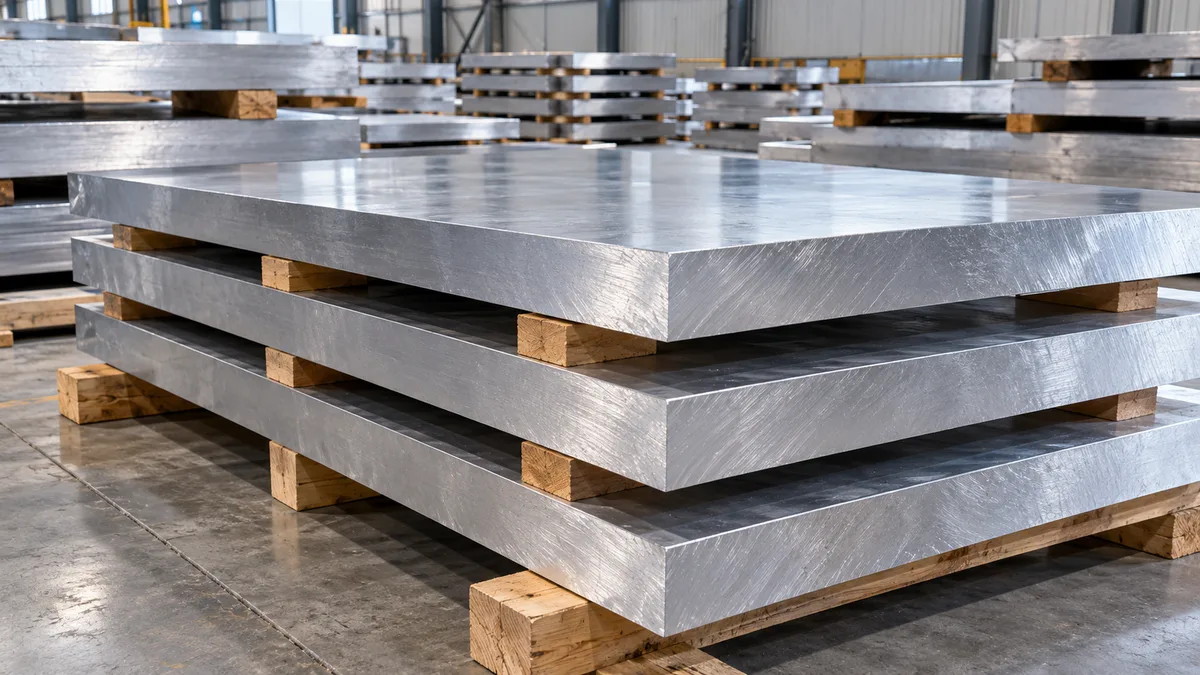
7075 combines about 5.6 % zinc, 2.5 % magnesium and 1.6 % copper, with chromium for grain control. After solution treatment and ageing, fine zinc-magnesium precipitates give it one of the highest strengths of any commercial aluminium alloy.
Introduced in the 1940s for aircraft structure, 7075 is still used for wing and fuselage fittings, but today much of its plate goes into moulds, tooling, jigs, high-performance sports goods and precision machined parts, because it machines cleanly and holds tight tolerances.
Its limits are just as important: it is not weldable by conventional fusion processes, its corrosion resistance is lower than 5xxx and 6xxx alloys, and peak-aged T6 can be sensitive to stress corrosion in the short-transverse direction. The T73 family of tempers addresses that last point at the cost of about 10 – 15 % strength.
| Element | Minimum | Maximum |
|---|---|---|
| Zinc (Zn) | 5.1 | 6.1 |
| Magnesium (Mg) | 2.1 | 2.9 |
| Copper (Cu) | 1.2 | 2.0 |
| Chromium (Cr) | 0.18 | 0.28 |
| Silicon (Si) | — | 0.40 |
| Iron (Fe) | — | 0.50 |
| Manganese (Mn) | — | 0.30 |
| Titanium (Ti) | — | 0.20 |
| Others, each / total | — | 0.05 / 0.15 |
| Aluminium (Al) | Remainder |
Typical values for comparison. Specified minimums in ASTM B209, AMS 4045 and AMS 4078 fall with thickness and differ by test direction; design to those values.
| Temper | Tensile strength | Yield strength (0.2 %) | Elongation | Hardness |
|---|---|---|---|---|
| O | 228 MPa | 103 MPa | about 17 % | 60 HB |
| T6 / T651 | 572 MPa | 503 MPa | about 11 % | 150 HB |
| T73 / T7351 | 505 MPa | 435 MPa | about 13 % | about 135 HB |
Peak-aged. Normal for sheet up to about 6 mm. Maximum strength.
Peak-aged and stretched to relieve stress. Standard for plate that will be machined: moulds, tooling, fittings.
Stretched and over-aged. About 12 % lower strength than T651 but far better resistance to stress corrosion cracking; specified for aerospace fittings under sustained load.
Annealed for forming; heat-treat to T6 afterwards.
| System | Designation | Standard |
|---|---|---|
| ASTM | 7075 | ASTM B209 (sheet and plate) |
| SAE AMS | 7075-T6 / T651 | AMS 4045; AMS-QQ-A-250/12 |
| SAE AMS | 7075-T7351 | AMS 4078 |
| UNS | A97075 | — |
| European (EN) | EN AW-7075 / AlZn5.5MgCu | EN 485, EN 573-3 |
| German Werkstoff | 3.4365 | — |
| Japan (JIS) | A7075P | JIS H4000 |
| China (GB) | 7075 | GB/T 3880 |
| Thickness (mm) | kg per m² | 1250 × 2500 mm (kg) | 1500 × 3000 mm (kg) |
|---|---|---|---|
| 1 | 2.81 | 8.8 | 12.6 |
| 2 | 5.62 | 17.6 | 25.3 |
| 3 | 8.43 | 26.3 | 37.9 |
| 4 | 11.24 | 35.1 | 50.6 |
| 5 | 14.05 | 43.9 | 63.2 |
| 6 | 16.86 | 52.7 | 75.9 |
| 8 | 22.48 | 70.2 | 101.2 |
| 10 | 28.10 | 87.8 | 126.5 |
| 12 | 33.72 | 105.4 | 151.7 |
| 16 | 44.96 | 140.5 | 202.3 |
| 20 | 56.20 | 175.6 | 252.9 |
| 25 | 70.25 | 219.5 | 316.1 |
| 30 | 84.30 | 263.4 | 379.3 |
| 40 | 112.40 | 351.2 | 505.8 |
| 50 | 140.50 | 439.1 | 632.2 |
| 60 | 168.60 | 526.9 | 758.7 |
| 80 | 224.80 | 702.5 | 1011.6 |
| 100 | 281.00 | 878.1 | 1264.5 |
Excellent: short chips, fine finish and tight tolerances. T651 stays flat when heavily machined.
Not recommended for fusion welding: welds crack and lose strength. Join by fastening, adhesive bonding or friction-stir welding.
Fair. Protect with anodising, chromate-free conversion coatings or paint; use T7351 where stress corrosion is a risk.
Hard and protective anodising both work well; colour is slightly darker than 6061.
| Property | 6061-T651 | 2024-T351 | 7075-T651 |
|---|---|---|---|
| Typical tensile strength | 310 MPa | 470 MPa | 572 MPa |
| Typical yield strength | 276 MPa | 325 MPa | 503 MPa |
| Fatigue performance | Good | Very good | Good |
| Weldability | Good | Poor | Poor |
| Corrosion resistance | Good | Poor | Fair |
More detail: 6061 vs 7075 and 2024 vs 7075.
Same strength; T651 plate is stretched after quenching to relieve stress, so it stays flat when machined.
When the part carries sustained tensile load in a corrosive environment, especially across the short-transverse direction. T7351 resists stress corrosion cracking far better than T651.
Not reliably by MIG or TIG; welds crack and lose strength. Use mechanical fastening or friction-stir welding.
7075-T6 has a typical tensile strength of about 572 MPa, comparable with many structural steels, at about one third of the density.
2.81 kg per m² per millimetre. A 1250 × 2500 × 20 mm plate weighs about 176 kg.
Send the temper, thickness, size, quantity and specification. We will confirm availability, certification and a delivered price.





