3003 core
Economical commercial-grade core for architectural, transport and industrial panels where moderate strength is enough.



A carbon fibre honeycomb panel is a sandwich of two thin carbon fibre laminate skins bonded to a lightweight honeycomb core, most often 5052 or 3003 aluminium honeycomb or aramid paper honeycomb. The core spaces the skins apart, so the panel is many times stiffer than a solid carbon sheet of the same weight. This guide explains how to choose the core and skins, avoid galvanic corrosion between carbon and aluminium, and specify and test the panel; Metline supplies aluminium honeycomb core and aluminium sheet to panel builders worldwide.
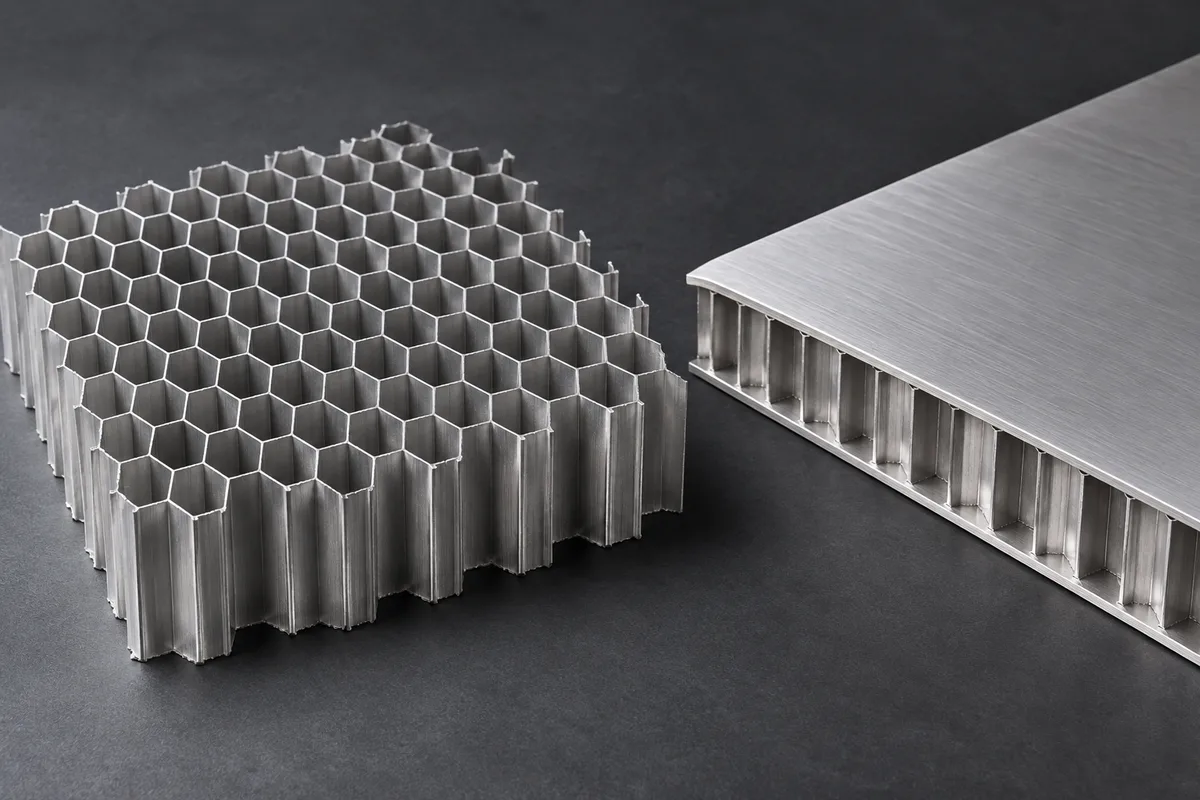
A sandwich panel behaves like an I-beam spread out into a sheet. The two skins act as the flanges and carry bending loads as tension and compression; the core acts as the web, holding the skins apart and carrying shear between them. Because bending stiffness rises with the square of the distance between the skins, adding a thick, very light core gives a large gain in stiffness for a small gain in weight.
Carbon fibre is an excellent skin material: it is very stiff and strong for its weight and does not corrode. Honeycomb is an excellent core: its hexagonal cells, made from thin foil or resin-impregnated paper, give high compressive and shear strength at densities of only a few tens of kilograms per cubic metre. Together they produce panels used in aircraft floors and interiors, drone frames, racing cars, rail interiors, optical benches, medical tables and premium furniture.
| Construction (same skin material) | Relative stiffness | Relative strength | Relative weight |
|---|---|---|---|
| Solid laminate, thickness t | 1 | 1 | 1 |
| Sandwich, total thickness 2t (core = t) | About 7 | About 3.5 | About 1.03 |
| Sandwich, total thickness 4t (core = 3t) | About 37 | About 9 | About 1.06 |
Classic illustrative ratios for honeycomb sandwich construction, assuming the skins are split in half and separated by a light core. Real gains depend on skin thickness, core density and the load case.
Skins are usually made from pre-impregnated (prepreg) carbon fabric or unidirectional tape, cured in a press or autoclave, or from dry fabric infused with epoxy. The fibre grade, weave and number of plies set the strength, stiffness and appearance.
| Parameter | Common options | Notes |
|---|---|---|
| Fibre grade | T300 (standard modulus), T700 (higher strength) | Both about 230 GPa fibre modulus; T700 has higher tensile strength |
| Tow size and fabric | 3K plain or 2×2 twill weave; 12K and UD for structural skins | 3K twill is the familiar cosmetic carbon look |
| Ply thickness | About 0.2 – 0.25 mm per 3K fabric ply (cured) | Two to four plies per skin are typical for general panels |
| Resin | Epoxy (most common); phenolic for fire-rated interiors | Resin choice sets temperature limit and fire behaviour |
| Surface | Gloss, matte, peel-ply textured | Peel-ply surfaces are ready for bonding or painting |
| Lay-up | Balanced and symmetric about the mid-plane | Unbalanced lay-ups warp after cure |
For a quasi-isotropic panel, plies are arranged at 0°, ±45° and 90°. A cosmetic outer ply of 3K twill can be combined with cheaper structural plies underneath.
| Property | Aluminium honeycomb | Aramid (meta-aramid paper) honeycomb |
|---|---|---|
| Alloys / materials | 3003, 5052, 5056 aluminium foil | Meta-aramid paper dipped in phenolic resin |
| Cell size | About 3 – 34 mm (1/8 in to over 1 in) | Typically 1/8 – 3/8 in (3.2 – 9.5 mm) |
| Foil or density | Foil about 0.036 – 0.08 mm; densities roughly 30 – 190 kg/m³ | About 1.8 – 9.0 pcf (29 – 144 kg/m³) |
| Shear and compressive strength at equal density | Higher | Lower |
| Electrical behaviour | Conductive | Insulating, radar-transparent |
| Galvanic risk with carbon skins | Yes: needs isolation | None |
| Formability | Can be formed to gentle curves; flexible cell types available | Readily formed to curves |
| Fire / smoke | Non-combustible core | Good fire, smoke and toxicity performance with phenolic |
| Typical uses | Industrial, rail, marine, tooling, optical tables, floors | Aircraft interiors, radomes, motorsport, UAV |
Economical commercial-grade core for architectural, transport and industrial panels where moderate strength is enough.
The general-purpose aerospace and industrial core: higher strength and better corrosion resistance than 3003.
Highest strength of the three, used where shear and crush loads are high, for example in aircraft floors and structural parts.
See our guides to 5052 honeycomb core and aluminium vs aramid core for property tables by cell size and foil thickness.
Carbon fibre is electrically conductive and sits far towards the noble end of the galvanic series, while aluminium is anodic. If carbon fibres touch an aluminium core in the presence of moisture, the aluminium corrodes preferentially, and the corrosion can spread along the bond line and weaken the panel. This is the single most important design point when combining carbon skins with aluminium honeycomb.
Good adhesive fillets at the cell walls matter more than adhesive quantity. Too little film gives weak bonds; too much adds weight without strength.
| Test | Standard | Purpose |
|---|---|---|
| Flexural (beam) test | ASTM C393 / ASTM D7249 | Panel bending strength and skin stress |
| Flatwise compression | ASTM C365 | Core crush strength |
| Core shear | ASTM C273 | Shear strength and modulus of the core |
| Flatwise tension | ASTM C297 | Skin-to-core bond strength |
| Climbing drum peel | ASTM D1781 | Peel resistance of the skin bond |
| Non-destructive inspection | Tap test, ultrasonic or thermography | Detect disbonds and voids |
| Dimensional | Drawing tolerances | Thickness, flatness, cut-outs and edge condition |
Aluminium honeycomb for aerospace is commonly specified to AMS-C-7438 (formerly MIL-C-7438), which defines alloys, cell sizes, densities and minimum mechanical properties for the core.
Floor panels, interior partitions, fairings, equipment shelves and drone bodies. 5052 and 5056 aluminium or aramid cores, depending on load and fire rules.
Chassis panels, floors, splitters and battery enclosures where stiffness per kilogram is critical.
Lightweight floors, ceilings and partitions that must meet fire, smoke and toxicity requirements.
Robot end-effectors, machine covers, optical breadboards and metrology platforms needing flatness and low weight.
X-ray and CT table tops, where carbon skins with aramid core give low radiation absorption.
Yacht interiors, bulkheads and sports equipment; edge sealing is essential in wet environments.
Metline supplies the aluminium honeycomb core (3003, 5052 and 5056) in blocks, slices and cut sheets, and aluminium sheet for skins, edge closures and inserts. Panel builders and laminators combine these with carbon skins to their own lay-up.
Separating two thin carbon skins with a light honeycomb core multiplies bending stiffness for very little extra weight. A sandwich twice as thick as a solid laminate can be around seven times stiffer at almost the same weight.
Aluminium core gives higher shear and crush strength at a given density and lower cost, and is non-combustible. Aramid core is lighter at low densities, insulating, radar-transparent and has no galvanic issue with carbon skins.
They can if the two are in direct contact and moisture gets in. Prevent it with a glass-fibre isolation ply or carrier-supported adhesive film, a corrosion-treated core and fully sealed edges and cut-outs.
5052 is the general-purpose choice. 5056 is stronger for high-load parts, and 3003 is an economical commercial grade for less demanding panels.
A 3K fabric ply is about 0.2 – 0.25 mm thick when cured, so a skin of two to four plies is roughly 0.4 – 1.0 mm. Structural panels may use more plies or unidirectional layers.
Metline supplies the aluminium honeycomb core and aluminium sheet used in these panels. Panel builders bond the carbon skins to the core to their own design.
Send your core specification and volumes. Metline will reply with matching aluminium honeycomb, treatment options and delivery terms.





