Welding
MIG weld with 5039 or 5183-type fillers as qualified for the programme. The heat-affected zone softens, then partially recovers by natural ageing over several weeks. Keep welds out of the short-transverse direction under tension.



7039 is a heat-treatable aluminium-zinc-magnesium armour alloy, supplied in the T64 temper to MIL-DTL-46063H from 1/2 to 4 in thick. It resists armour-piercing projectiles considerably better than 5083 at similar weight, but is more sensitive to stress corrosion and harder to weld, so it is used where AP protection matters most. Metline supplies 7039 plate to specification, cut to size, worldwide.
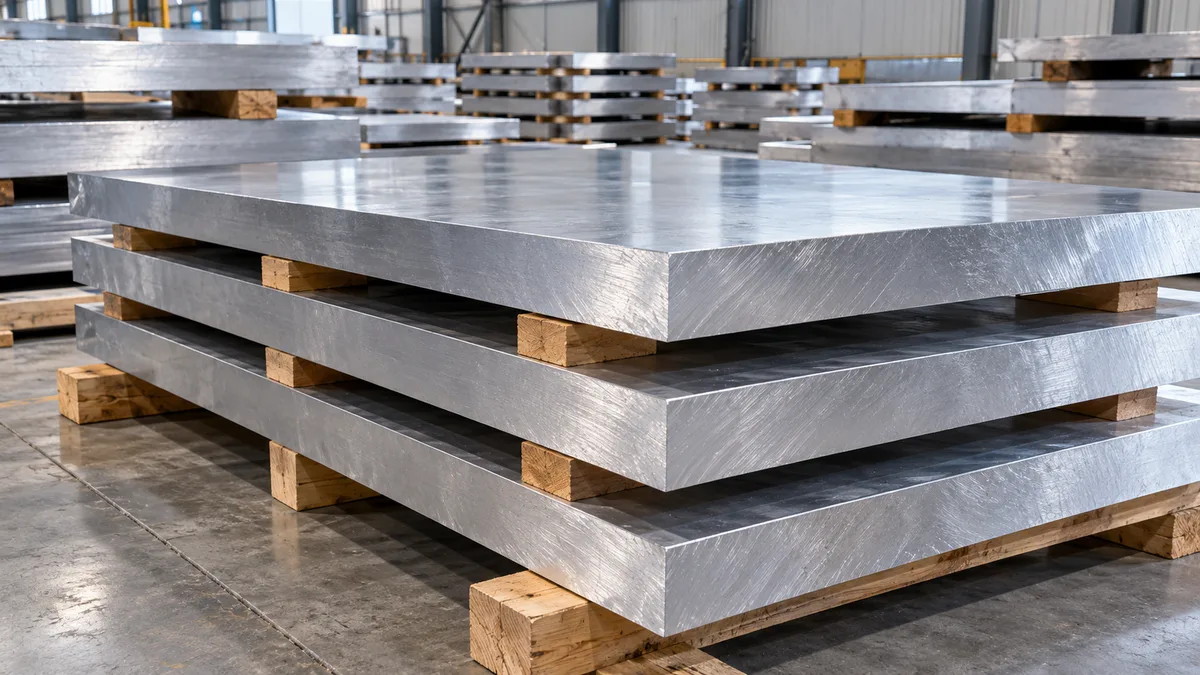
7039 contains about 4 % zinc and 2.8 % magnesium, with chromium and manganese for grain control. After solution treatment and ageing it is roughly 40 – 50 % stronger than 5083-H131, and that strength translates directly into better resistance to armour-piercing bullets.
7039 was introduced as a higher-performance alternative to 5083 for light armoured vehicles and has been used for hulls, turrets and add-on panels. Its Al-Zn-Mg chemistry places it among the "weldable" 7xxx alloys: unlike 7075, it contains almost no copper, so welds do not hot-crack badly and the heat-affected zone partly recovers its strength by natural ageing after welding.
The trade-off is stress-corrosion cracking. Zinc-magnesium precipitates make 7039 susceptible to cracking under sustained tensile stress in moist or salty environments, especially in the short-transverse direction and in the heat-affected zone of welds. Research programmes have looked for replacements such as 7017 and 2139 for exactly this reason. Today 7039 is chosen deliberately: where AP protection per kilogram is the deciding factor and the design keeps residual stresses and exposure under control.
| Element | Limit | Role |
|---|---|---|
| Silicon (Si) | 0.30 max | Impurity |
| Iron (Fe) | 0.40 max | Impurity |
| Copper (Cu) | 0.10 max | Kept low for weldability |
| Manganese (Mn) | 0.10 – 0.40 | Grain control |
| Magnesium (Mg) | 2.3 – 3.3 | Forms MgZn2 strengthening precipitates with zinc |
| Chromium (Cr) | 0.15 – 0.25 | Controls recrystallisation and improves SCC resistance |
| Zinc (Zn) | 3.5 – 4.5 | Main strengthening element |
| Titanium (Ti) | 0.10 max | Grain refiner |
| Others, each / total | 0.05 / 0.15 | |
| Aluminium | Remainder |
Some published tables swap the magnesium and manganese ranges for 7039. The correct registered values are magnesium 2.3 – 3.3 % and manganese 0.10 – 0.40 %.
Values below are typical for 7039-T64 plate and are useful for design comparisons. Acceptance minimums are set by MIL-DTL-46063H for each thickness band and are reported on the mill certificate.
T64 is a specific ageing treatment chosen to balance strength, toughness and stress-corrosion resistance. Peak-aged T6 gives slightly higher strength but worse SCC behaviour, which is why armour plate is supplied in T64 rather than T6.
Armour-piercing (AP) bullets have hard steel or tungsten cores that are resisted mainly by plate hardness and strength. Fragments and fragment-simulating projectiles (FSP) are blunter and are resisted more by toughness and ductility. 7039 is strong, so it excels against AP threats; its fragment performance is less impressive.
| Property | 7039-T64 | 5083-H131 |
|---|---|---|
| Specification | MIL-DTL-46063H | MIL-DTL-46027 |
| Density | 2.74 g/cm³ | 2.66 g/cm³ |
| Typical yield strength | About 380 MPa | About 255 – 290 MPa |
| AP ballistic resistance | Considerably better | Lower |
| Fragment (FSP) resistance | Below 5083 in thinner plate (under about 1.235 in) | Better in thinner plate |
| Weldability | Weldable with care; HAZ recovers partly by natural ageing | Readily weldable |
| Stress-corrosion resistance | Susceptible, especially when welded | Good |
| Typical choice | High-mobility vehicles where AP protection per kg matters | Welded hulls, marine service, general armour |
Published comparisons at about 1.28 in thickness give 7039-T64 a .50 calibre AP V50 of roughly 1,910 ft/s against about 1,780 ft/s for 5083-H131, illustrating the AP advantage. Acceptance testing under MIL-DTL-46063H uses projectiles such as .30 calibre AP and 20 mm FSP, with minimum V50 values tabulated by thickness.
Armour specifications limit the minus thickness tolerance more tightly than commercial plate, because a plate that is too thin may fail ballistic acceptance. The standard ANSI H35.2 tolerance band is kept, but part of the minus allowance is moved to the plus side. For example, if the standard tolerance is ±0.060 in and the armour specification permits only a small minus deviation, the remaining band is added on the plus side. Ask for the tolerance table that applies to your thickness when ordering.
MIG weld with 5039 or 5183-type fillers as qualified for the programme. The heat-affected zone softens, then partially recovers by natural ageing over several weeks. Keep welds out of the short-transverse direction under tension.
Design joints to minimise sustained tensile stress. Shot peening of weld toes and careful sequencing help reduce SCC risk.
Use conversion coating, primer and military paint, and seal edges. Avoid long exposure to wet, salty conditions without protection.
Machines well in T64. Waterjet or saw cutting avoids heat damage at edges; plasma-cut edges should be dressed back.
MIL-DTL-46063H, Armor Plate, Aluminum Alloy, 7039, which covers wrought plate from 1/2 to 4 in nominal thickness, normally in the T64 temper.
Against armour-piercing threats, yes, by a clear margin at similar weight. Against fragments in thinner plate, 5083 does as well or better, and 5083 is easier to weld and far more resistant to stress corrosion.
Yes, with qualified procedures. It is one of the weldable Al-Zn-Mg alloys, and the heat-affected zone partly recovers by natural ageing. Welded 7039 is more prone to stress-corrosion cracking, so joint design and stress control are important.
T64 is an ageing treatment that gives up a little peak strength in return for better toughness and stress-corrosion resistance, which suits armour service.
About 2.74 g/cm³ (0.099 lb/in³), slightly higher than 5083 at 2.66 g/cm³.
Send thickness, size, quantity and test requirements. We will reply with availability, certification and a delivered price.





