Viscous friction
Sound waves push air back and forth through narrow pores and cracks. Friction against the cell walls turns acoustic energy into heat. This is the main mechanism in open-cell foam.



Aluminium foam panels absorb sound through the friction and resonance of air moving in their pores, while remaining non-combustible, moisture-proof and washable, which fibrous absorbers are not. Open-cell foam or treated closed-cell foam, mounted over an air gap or built into a perforated sandwich panel, can reach high absorption across speech frequencies. This guide explains how the panels work, which build to choose and how to read acoustic test data.
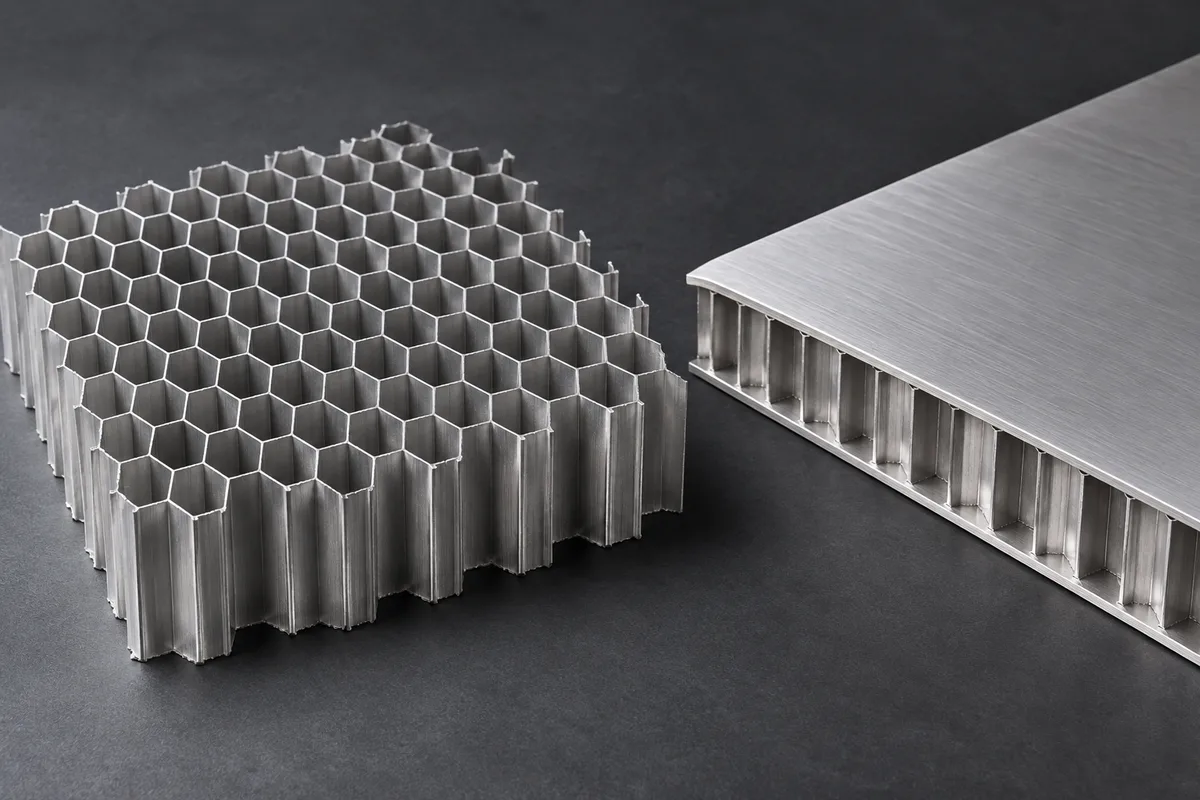
Most sound absorbers are mineral wool, glass wool, polyester fibre or polymer foam behind a perforated or fabric face. They work well, but they can shed fibres, absorb moisture, harbour dirt and, in the case of polymers, burn. Aluminium foam offers a porous absorber that is metallic throughout: it can be washed, used outdoors and in swimming pools, and installed where non-combustible materials are mandatory.
The trade-off is cost and the need for correct design. A closed-cell foam slab used as cast reflects most sound, because air cannot enter the cells. Its absorption is unlocked by opening the cells (by rolling, drilling or slicing) and by mounting it with an air cavity behind. Open-cell foam absorbs without treatment but is more fragile and usually protected by a perforated face.
Metline supplies aluminium foam panels and foam-core composite panels, together with aluminium sheet and profiles for facings, edge trims and suspension systems, to acoustic contractors and panel fabricators worldwide.
Sound waves push air back and forth through narrow pores and cracks. Friction against the cell walls turns acoustic energy into heat. This is the main mechanism in open-cell foam.
Opened cells behind small apertures act as tiny resonators. Combined with an air gap they produce strong absorption peaks, which designers tune to the target frequency.
A thin foam plate over an air cavity behaves as a membrane absorber at lower frequencies. Increasing the cavity depth moves absorption down the frequency scale.
Blocking sound between rooms (insulation) depends mainly on mass and decoupling, not porosity. Foam composites therefore combine an absorptive core with dense facings.
Absorption and insulation are different properties. Absorption, reported as the sound absorption coefficient α (0 to 1) or as NRC or αw, controls echo and reverberation inside a room. Insulation, reported as the weighted sound reduction index Rw in decibels, controls how much sound passes through a wall. An acoustic brief should state which one is needed.
| Foam type | How it is made | Typical density | Cell structure | Best suited to |
|---|---|---|---|---|
| Closed-cell, melt route | Molten aluminium thickened with calcium or ceramic particles and foamed with a gas-releasing agent or injected gas, then cast into blocks and sliced | about 0.2 – 0.7 g/cm³ | Closed cells, roughly 2 – 10 mm | Panels, cores, energy absorbers, noise barriers |
| Closed-cell, powder route | Aluminium alloy powder mixed with a blowing agent, compacted to a precursor and foamed inside a mould or between face sheets | about 0.3 – 0.8 g/cm³ | Closed cells with a dense outer skin | Shaped parts, crash-box fillers, foam sandwich panels |
| Open-cell (reticulated or infiltrated) | Metal cast around a removable pattern or salt space-holder, which is then leached out | about 0.2 – 0.5 g/cm³ | Interconnected pores, fine to coarse | Sound absorption, heat exchange, filtration |
| Panel build | Structure | Main acoustic role | Typical uses |
|---|---|---|---|
| Single foam plate | Sliced foam, 6 – 50 mm, often over an air gap | Absorption; decorative metal texture | Feature walls, ceilings, tunnels |
| Perforated sandwich | Micro-perforated aluminium face + foam core + solid back | Absorption with a smooth, robust face | Wall linings, ceilings in public buildings |
| Solid-faced sandwich | Aluminium or steel faces + foam core | Insulation and damping; light partition panels | Partitions, door panels, modular rooms |
| Multi-layer composite | Perforated face + foam + damping layer + dense back | Absorption and insulation together | Studios, plant rooms, hotel partitions |
Composite panels are commonly 9 – 18 mm thick; single foam plates are sliced from blocks in a wider range of thicknesses. Panel size, perforation pattern and core thickness are agreed to drawings.
| Metric | Test standard | What it tells you | Indicative range for foam panels |
|---|---|---|---|
| Sound absorption coefficient α by frequency | ISO 354 (reverberation room), ISO 10534-2 (impedance tube) | Absorption at each octave or third-octave band | Strongly dependent on build and air gap |
| NRC | ASTM C423 | Average α at 250, 500, 1000 and 2000 Hz | Around 0.6 – 0.9 for well-designed perforated or open-cell builds |
| αw and absorption class | ISO 11654 | Single-number rating and class A – E | Class B – C typical; class A possible with deep cavities |
| Rw (sound reduction) | ISO 10140-2, rated per ISO 717-1 | Airborne insulation of a panel or wall | Depends mainly on mass; light composites around 25 – 35 dB |
Always ask for the mounting condition with any absorption figure. ISO 354 tests use defined mountings such as type A (directly on a hard surface) or type E with a stated cavity depth (for example E-200 for a 200 mm suspended ceiling). The same panel can show very different values depending on mounting, so compare like with like.
| Criterion | Aluminium foam panel | Mineral / glass wool + perforated face | Wood-wool or timber slat panels | Polymer acoustic foam |
|---|---|---|---|---|
| Absorption | Good to very good when designed | Very good | Good | Good at mid-high frequencies |
| Fire | Non-combustible core | Non-combustible wool; facing varies | Combustible unless treated | Combustible |
| Moisture and washing | Unaffected; washable | Degrades when wet | Can swell or stain | Absorbs water |
| Fibre release | None | Possible if face is damaged | Minimal | None |
| Impact resistance | Good | Depends on face | Good | Poor |
| Cost | Higher | Low to medium | Medium | Low |
In ordinary dry offices, mineral wool systems usually remain the economical choice. Aluminium foam earns its premium where moisture, hygiene, fire rules, outdoor exposure or a durable exposed-metal look are part of the brief.
The aluminium foam core is metallic and non-combustible and releases no smoke on its own. A composite panel, however, includes adhesives, films or veneers, so its reaction-to-fire class is determined for the complete panel, for example under EN 13501-1 in Europe or ASTM E84 in North America. Ask for the test report of the exact build you intend to use.
Aluminium foam does not absorb water into the metal, and well-made panels show negligible moisture uptake, which keeps dimensions and acoustic performance stable in humid spaces. Outdoors, the foam forms a natural oxide layer; coastal or polluted sites may call for a coated or anodised face. Panels are fully recyclable as aluminium at the end of their life.
Only weakly as cast, because air cannot enter sealed cells. Rolling, drilling or slicing to open the cells and mounting the panel over an air gap raises absorption substantially.
Well-designed perforated or open-cell builds typically reach around 0.6 – 0.9. The figure depends heavily on thickness, perforation and mounting, so check test data for the exact build.
The foam core is non-combustible. The fire class of a composite panel depends on its adhesives and facings and must be confirmed by test for that build.
Yes. They do not absorb water or rot, which makes them suitable for pools, tunnels, stations and outdoor barriers where fibrous absorbers fail.
Absorption reduces echo inside a room and is rated by α or NRC. Insulation stops sound passing through a wall and is rated by Rw in dB; it depends mostly on mass and decoupling.
Composite panels are commonly 9 – 18 mm thick; single foam plates are sliced to the thickness the acoustic design needs.
Share the acoustic target, panel sizes and mounting. We will propose a build and supply the panels and aluminium components.





