


Large Diameter Aluminium Bar and Billet
Large diameter aluminium bar is round stock above roughly 300 mm in diameter, supplied as forged bar, homogenised cast billet or heavy extruded rod for machining big shafts, discs, rollers, flanges, mould bases and aerospace fittings. Sizes of 600 – 700 mm are common in heavy machining, and larger diameters are possible as forged or cast stock. This guide explains production routes, alloys, weights and how to specify the right bar.
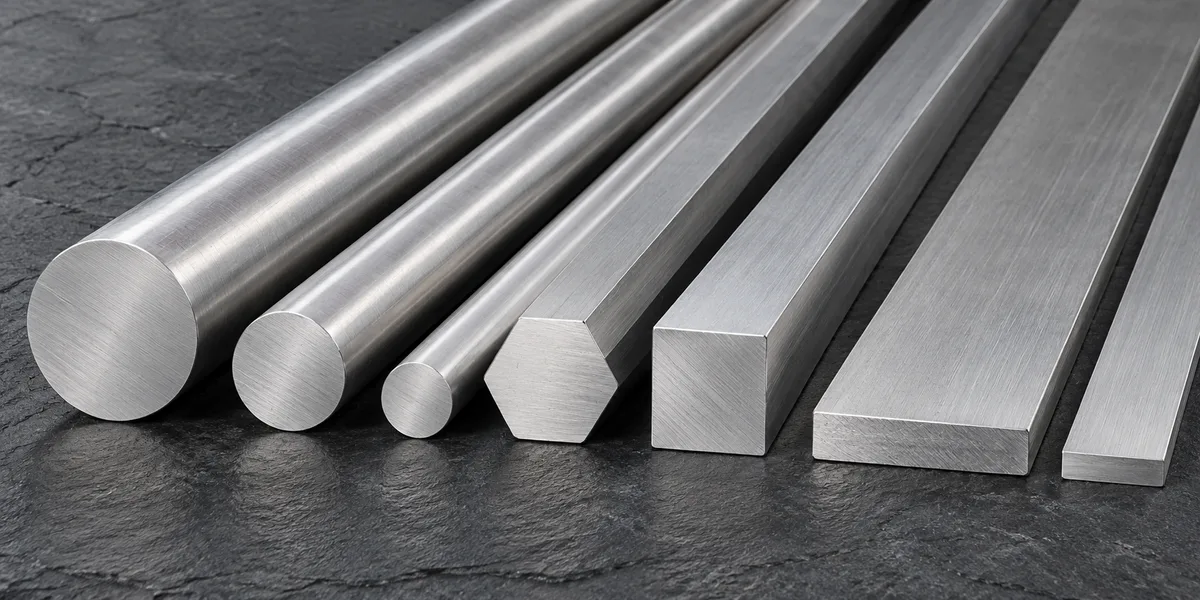
- Diameter range
- About Ø300 – 1,000 mm+
- Common sizes
- Ø600 – 700 mm
- Routes
- Forged · cast billet · extruded
- Alloys
- 2xxx · 5xxx · 6061 · 7xxx
What counts as large diameter aluminium bar?
Standard extruded and drawn round bar covers diameters from a few millimetres to about 300 mm. Above that, the product changes: the bar is either extruded on very large presses, forged from a cast ingot, or supplied as a direct-chill cast and homogenised billet.
The route matters because it decides the internal quality and the properties you can rely on. An extruded bar has a worked structure throughout; a forged bar has had its cast structure broken down and porosity closed by heavy deformation; a cast billet keeps a cast structure, homogenised to even out segregation but not worked. All three are machinable, but they are not interchangeable for highly stressed parts.
Buyers usually need large bar for parts that would otherwise be machined from thick plate or forged to shape: big turned rollers and drums, wheel and turbine discs, large flanges and rings, shafts, mould and die bases, vacuum chamber parts, sputtering target backing plates and aerospace fittings.
Forged, extruded or cast billet?
| Route | Typical diameter | Internal quality | Best used for |
|---|---|---|---|
| Extruded bar (heavy press) | Up to about 300 – 500 mm | Worked structure; properties per ASTM B221 / EN 755-2 bands | Shafts, bushings, general machined parts |
| Open-die forged bar | Roughly 200 – 1,000 mm and above | Porosity closed, refined grain, good properties in all directions | Highly stressed parts, aerospace and defence, pressure-retaining parts |
| Homogenised cast billet | Large diameters, common in 600 – 800 mm class | Cast structure, homogenised; lower ductility than wrought | Forging stock, extrusion billet, non-critical machined parts |
| Sawn discs and blanks | Any of the above, cut to thickness | As per parent bar | Rings, wheels, flanges, target backing plates |
For critical parts, ask for forged bar with ultrasonic testing. For moulds, fixtures and lightly loaded parts where cost matters, homogenised cast billet or heavy extruded bar is often sufficient. Our forged aluminium bar and cast forging stock pages describe each in more detail.
Alloys for large diameter bar
The table lists the alloys most often requested in large diameters, with typical properties for the common temper. Large sections usually test lower than thin sections because quenching is slower at the centre, so design to the minimums on the mill certificate.
| Alloy and temper | Typical tensile / yield (MPa) | Characteristics | Typical large-bar uses |
|---|---|---|---|
| 6061-T6 / T651 | 310 / 276 | Good strength, weldable, corrosion resistant, easy to machine | Machine frames, shafts, rollers, mould bases |
| 2024-T351 | 470 / 325 | High strength and fatigue resistance; needs corrosion protection | Aerospace fittings, structural shafts |
| 2014-T6 / T651 | 483 / 414 | High strength, good forgeability | Heavy-duty fittings, wheels, hubs |
| 2219-T851 | 455 / 350 | Weldable high-strength alloy; good at elevated and cryogenic temperatures | Rocket and cryogenic tank rings and fittings |
| 7075-T651 / T7351 | 572 / 503 (T6); 505 / 435 (T73) | Very high strength; T73 tempers trade strength for stress-corrosion resistance | Aerospace parts, high-load tooling, defence |
| 7050-T7451 | About 524 / 469 | Low quench sensitivity, keeps properties in thick sections | Large aerospace forgings and fittings |
| 5083-O / H112 | 290 / 145 (O) | Non-heat-treatable, excellent seawater resistance and weldability | Marine shafts, flanges, cryogenic parts |
| 5052-H32 / H112 | 228 / 193 (H32) | Good corrosion resistance and formability | Marine and general fittings |
Typical values from ASM / Aluminum Association data for standard sections, for comparison only. Minimum properties for large diameters depend on the product standard (for example ASTM B221, ASTM B247 or AMS specifications) and section size.
Two clarifications for buyers comparing offers. 7075 is very strong but not the strongest aluminium alloy; 7068 and some 7xxx aerospace alloys exceed it. And H116 is a temper for marine plate, not bar: 5083 bar is normally supplied in O or H112.
Weight of large diameter aluminium bar
Weight per metre is calculated from the cross-section and a density of 2.70 g/cm³. For 2xxx and 7xxx alloys (2.78 – 2.81 g/cm³), add about 3 – 4 %.
| Diameter (mm) | Diameter (in) | kg per metre | kg per 100 mm disc | lb per foot |
|---|---|---|---|---|
| 300 | 11.8 | 191 | 19 | 128 |
| 350 | 13.8 | 260 | 26 | 175 |
| 400 | 15.7 | 339 | 34 | 228 |
| 450 | 17.7 | 429 | 43 | 289 |
| 500 | 19.7 | 530 | 53 | 356 |
| 600 | 23.6 | 763 | 76 | 513 |
| 650 | 25.6 | 896 | 90 | 602 |
| 700 | 27.6 | 1,039 | 104 | 698 |
| 800 | 31.5 | 1,357 | 136 | 912 |
| 900 | 35.4 | 1,718 | 172 | 1,154 |
| 1000 | 39.4 | 2,121 | 212 | 1,425 |
| 1200 | 47.2 | 3,054 | 305 | 2,052 |
A Ø700 mm bar weighs over a tonne per metre, so sawing, lifting and packing need planning. Use the round bar weight calculator for other sizes.
Inspection, tolerances and certification
Typical specification points
- Diameter tolerance
- Forged and cast bar are supplied oversize with a machining allowance, or rough-turned to an agreed tolerance
- Length tolerance
- Saw-cut lengths typically +5 / 0 mm or as agreed; discs cut to thickness with allowance for facing
- Ultrasonic testing
- ASTM B594 or AMS-STD-2154 class agreed on order for forged bar and critical parts
- Mechanical testing
- Tensile and hardness from test locations defined by the standard; conductivity checks for 7xxx tempers
- Macro-etch and grain
- Macro-etch inspection for forged bar where required
- Certification
- EN 10204 3.1 mill test certificate with heat number traceability
When ordering, state whether properties are required in the longitudinal, transverse or short-transverse direction and at what location in the section. Large forgings and bars show some directionality, and an unspecified test location leads to disputes later.
Machining and handling tips
- Rough machine first, then finish: removing material relieves residual stress; leave stock on critical faces and finish after a rest period or stress-relief ageing.
- Choose stress-relieved tempers: T651, T7351 and T7451 have been stretched or compressed to reduce quench stress, which limits movement during machining.
- Watch the centre: the core of a large bar is where porosity or segregation would sit; specify UT if the bore or centre stays in the finished part.
- Saw with care: large-diameter band saws with coolant prevent heat build-up and smearing; specify flatness if discs will be used without facing.
- Lift safely: use slings or cradles rated for the weight, and avoid point loads that dent the surface of softer alloys.
How to order large diameter bar
- Define the partSend the finished part drawing or the blank diameter and length, alloy, temper and governing standard.
- Choose the routeWe advise forged, extruded or cast billet depending on stress level, inspection needs and budget.
- Agree testingUltrasonic class, test directions, and any third-party inspection.
- ProcessingSaw cutting to length or into discs, rough turning or boring on request.
- Packing and deliveryBars fixed to timber skids with straps or steel bands and blocked against rolling; shipped on EXW, FOB, CIF or DAP terms worldwide.
References and standards
- ASTM B221 – Aluminum and Aluminum-Alloy Extruded Bars, Rods, Wire, Profiles, and Tubes
- ASTM B247 – Aluminum and Aluminum-Alloy Die Forgings, Hand Forgings, and Rolled Ring Forgings
- ASTM B594 – Ultrasonic Inspection of Aluminum-Alloy Wrought Products
- EN 755-2 – Extruded rod/bar, tube and profiles: mechanical properties
- The Aluminum Association – International Alloy Designations and Chemical Composition Limits
Large diameter aluminium (aluminum) bar: FAQ
What is the largest diameter aluminium bar available?
Extruded bar usually stops at about 300 – 500 mm. Forged bar and cast billet are produced in much larger diameters, with 600 – 700 mm common and around 1,000 mm and above possible for some alloys. Send your size and we confirm feasibility.
Is forged bar better than cast billet for machining?
For stressed parts, yes: forging closes porosity and refines the grain, giving higher ductility and fatigue strength. Cast billet is cheaper and acceptable for moulds, fixtures and lightly loaded parts.
How much does a 600 mm aluminium bar weigh?
About 763 kg per metre in 6061 (density 2.70 g/cm³). A 2xxx or 7xxx alloy bar of the same size weighs about 3 – 4 % more.
Can large diameter aluminum bar be cut into discs?
Yes. Bars are saw-cut into discs or blanks to your thickness, with allowance for facing, and can be rough-turned or bored on request.
Which temper should I order for a large machined part?
Choose stress-relieved tempers such as 6061-T651, 7075-T7351 or 7050-T7451 so the part stays stable during heavy machining. 5083 is supplied in O or H112.
Do you test large bar ultrasonically?
Ultrasonic testing to ASTM B594 or AMS-STD-2154 can be specified on the order, with the acceptance class you need, together with the EN 10204 3.1 certificate.
Looking for large diameter aluminium bar?
Tell us the alloy, diameter, length or disc size, quantity and destination. We reply with route options, testing and a delivered price.





