T3
Solution treated, cold worked, naturally aged. Standard for sheet; best fatigue and crack-growth behaviour.



2024-T3 sheet is the classic fuselage-skin material: high strength, excellent fatigue performance and slow crack growth, usually supplied as Alclad for corrosion protection. 2024-T351 plate is machined into frames, spars and fittings. Metline supplies bare and Alclad 2024 sheet and plate, and the close equivalent 2A12, in O, T3, T4, T351, T81 and T851, certified to AMS, ASTM and EN standards, to customers worldwide.
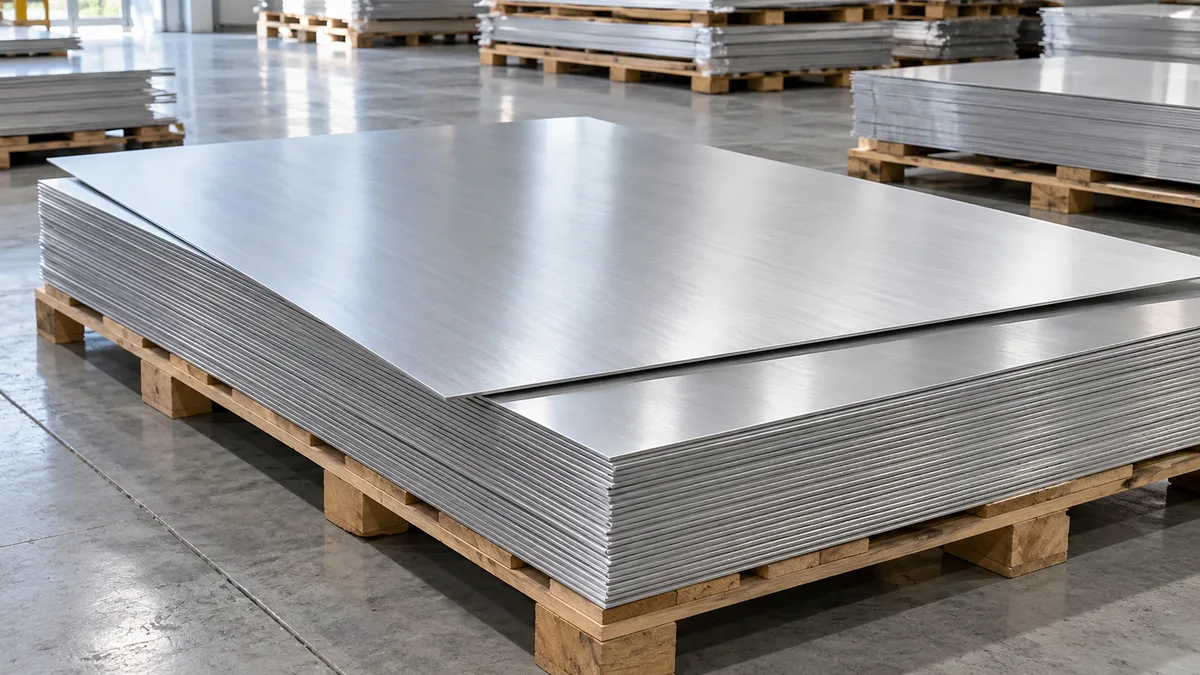
Pressurised fuselages and lower wing skins are loaded in tension and cycled on every flight. The governing properties are fatigue strength, fracture toughness and resistance to fatigue crack growth, and 2024-T3 has been the reference material for those properties since the 1930s.
Sheet (up to about 6 mm) is normally supplied in T3: solution treated, cold worked by flattening and stretching, and naturally aged. Much of it is Alclad 2024, which carries a thin layer of high-purity 1230 aluminium on each face, typically about 5 % of thickness per side for sheet under 1.6 mm and 2.5 % per side for thicker material. The cladding corrodes sacrificially, so scratches and rivet holes do not expose the core to attack.
Plate (over about 6 mm) is supplied in T351, stretched to relieve quench stresses so it stays flat when machined into frames, spars, ribs and bulkheads. Where higher yield strength or better stress-corrosion resistance is needed, T851 plate (artificially aged) is used, and for the most demanding damage-tolerant applications the higher-purity derivatives 2124-T851 and 2524-T3 are specified.
| Element | 2024 (AA / ASTM, EN AW-2024) | 2A12 (GB, close equivalent) | Role |
|---|---|---|---|
| Copper (Cu) | 3.8 – 4.9 | 3.8 – 4.9 | Main strengthening element |
| Magnesium (Mg) | 1.2 – 1.8 | 1.2 – 1.8 | With Cu forms the Al2CuMg (S-phase) precipitates |
| Manganese (Mn) | 0.30 – 0.9 | 0.30 – 0.9 | Grain control, toughness |
| Silicon (Si) | 0.50 max | 0.50 max | Impurity |
| Iron (Fe) | 0.50 max | 0.50 max | Impurity; low Fe improves toughness |
| Chromium (Cr) | 0.10 max | — | Impurity |
| Nickel (Ni) | — | 0.10 max | Impurity |
| Zinc (Zn) | 0.25 max | 0.30 max | Impurity |
| Titanium (Ti) | 0.15 max | 0.15 max | Grain refiner |
| Others, each / total | 0.05 / 0.15 | 0.05 / 0.10 | |
| Aluminium (Al) | Remainder | Remainder | About 90.7 – 94.7 % |
Alclad 2024 has a 2024 core with 1230 cladding (99.30 % Al minimum). The certificate reports core chemistry and, on request, cladding thickness.
Typical values first, then specified minimums from EN 485-2 for bare material. ASTM B209 minimums are very similar (for example 2024-T3 sheet 1.6 – 3.2 mm: 434 MPa tensile, 290 MPa yield). Alclad minimums are a few per cent lower because the soft cladding carries little load.
| Temper | Tensile strength | Yield strength (0.2 %) | Elongation | Brinell hardness | Shear strength |
|---|---|---|---|---|---|
| O | 186 MPa / 27 ksi | 76 MPa / 11 ksi | 20 % | 47 HB | 125 MPa |
| T3 | 483 MPa / 70 ksi | 345 MPa / 50 ksi | 18 % | 120 HB | 283 MPa |
| T4, T351 | 469 MPa / 68 ksi | 324 MPa / 47 ksi | 19 – 20 % | 120 HB | 283 MPa |
| T6 | 476 MPa / 69 ksi | 393 MPa / 57 ksi | 10 % | 125 HB | 283 MPa |
| T81, T851 | 483 MPa / 70 ksi | 448 MPa / 65 ksi | 6 % | 128 HB | 296 MPa |
| EN 485-2 minimums, bare | Thickness (mm) | Tensile Rm (MPa) | Yield Rp0.2 (MPa) | Elongation |
|---|---|---|---|---|
| O | 0.4 – 12.5 | ≤ 220 | ≤ 140 | 12 – 13 % (A50) |
| T3 | 0.4 – 1.5 | 435 | 290 | 12 % (A50) |
| T3 | 1.5 – 6.0 | 435 – 440 | 290 | 14 % (A50) |
| T351 | 6.0 – 12.5 | 440 | 290 | 13 % (A50) |
| T351 | 12.5 – 40 | 430 | 290 | 11 % (A) |
| T351 | 40 – 80 | 420 | 290 | 8 % (A) |
| T351 | 80 – 100 | 400 | 285 | 7 % (A) |
| T351 | 100 – 150 | 360 – 380 | 250 – 270 | 5 % (A) |
| T4 / T42 | 0.4 – 6.0 | 425 | 260 – 275 | 12 – 15 % (A50) |
| T8 / T851 | 0.4 – 12.5 | 460 | 400 | 5 – 6 % (A50) |
| T851 | 12.5 – 40 | 455 | 395 – 400 | 4 % (A) |
Summarised from EN 485-2; check the exact thickness band and the governing specification on the mill certificate.
Solution treated, cold worked, naturally aged. Standard for sheet; best fatigue and crack-growth behaviour.
Solution treated, stretched 1.5 – 3 %, naturally aged. Standard plate temper for machining.
Solution treated and naturally aged without controlled cold work. T42 is the user-heat-treated equivalent, e.g. after forming from O.
T3 sheet or T351 plate artificially aged. Higher yield strength, better stress-corrosion resistance and better elevated-temperature stability; lower toughness.
Annealed for stretch forming, drawing and tight bends before heat treatment.
Higher cold-work variants offered for specific programmes; specify only when the drawing calls for them.
| System | Designation |
|---|---|
| Aluminum Association / UNS | 2024 / A92024 |
| European (EN) | EN AW-2024 / AlCu4Mg1 |
| German Werkstoff / DIN | 3.1355 / AlCuMg2 |
| ISO | AlCu4Mg1 |
| France (old NF) | AU4G1 |
| Japan (JIS) | A2024 |
| China (GB) | 2A12 (close equivalent) |
2024 weighs 2.78 kg per m² for each millimetre of thickness. The plate weight calculator handles any size.
| Thickness (mm) | kg per m² | 1220 × 2440 mm (kg) | 1500 × 3000 mm (kg) |
|---|---|---|---|
| 0.5 | 1.39 | 4.1 | 6.3 |
| 0.8 | 2.22 | 6.6 | 10.0 |
| 1 | 2.78 | 8.3 | 12.5 |
| 1.27 | 3.53 | 10.5 | 15.9 |
| 1.6 | 4.45 | 13.2 | 20.0 |
| 2 | 5.56 | 16.6 | 25.0 |
| 2.5 | 6.95 | 20.7 | 31.3 |
| 3 | 8.34 | 24.8 | 37.5 |
| 4 | 11.12 | 33.1 | 50.0 |
| 5 | 13.90 | 41.4 | 62.5 |
| 6 | 16.68 | 49.7 | 75.1 |
| 10 | 27.80 | 82.8 | 125.1 |
| 12 | 33.36 | 99.3 | 150.1 |
| 20 | 55.60 | 165.5 | 250.2 |
| 25 | 69.50 | 206.9 | 312.8 |
| 40 | 111.20 | 331.0 | 500.4 |
| 50 | 139.00 | 413.8 | 625.5 |
| 80 | 222.40 | 662.0 | 1000.8 |
| 100 | 278.00 | 827.6 | 1251.0 |
Thickness, width, length and flatness tolerances follow ANSI H35.2 for ASTM and AMS orders and EN 485-3/-4 for EN orders. Aerospace plate is commonly ultrasonically inspected to AMS-STD-2154 or ASTM B594, with the class stated on the order.
T3 sheet forms moderately; minimum bend radii are typically about 2.5 – 4 × thickness depending on gauge. Severe forming is done in O or freshly quenched (W) condition.
T351 plate machines well; balance material removal on both faces to keep parts flat.
Riveting and bolting are standard; adhesive bonding is used for panels. 2024 is not fusion-welded in structure.
Use Alclad sheet where possible; anodise or conversion-coat and prime bare parts; seal faying surfaces.
Naturally aged tempers change if held above about 120 °C; T81/T851 are better for warm service.
Protect Alclad surfaces: scratches through the cladding reduce corrosion protection.
| Property | 2024-T3 | 2524-T3 | 7075-T6 | 6061-T6 |
|---|---|---|---|---|
| Typical tensile strength | ~483 MPa | ~460 – 480 MPa | ~572 MPa | ~310 MPa |
| Typical yield strength | ~345 MPa | ~340 MPa | ~503 MPa | ~276 MPa |
| Fatigue crack-growth resistance | Very good | Excellent | Fair | Good |
| Fracture toughness | Good | Very good | Moderate | Good |
| Corrosion (bare) | Low | Low | Low–moderate | Good |
| Typical use | Fuselage skin | Modern fuselage skin | Upper wing, fittings | Secondary structure |
2024-T3 sheet with a thin layer of 1230 high-purity aluminium bonded to each face. The cladding protects the core from corrosion and slightly lowers strength.
T3 applies to sheet that is cold worked by flattening; T351 applies to plate that is stretched to relieve stresses. Strength levels are similar.
2A12 has essentially the same composition and is a close equivalent, but aerospace orders must state the designation and standard the drawing requires.
2024-T3 resists fatigue crack growth and has higher toughness, which matters for pressurised skins loaded in tension. 7075 is stronger but less damage tolerant.
Not by conventional fusion welding for structure; riveting, bolting and bonding are used.
1220 × 2440 mm, 1250 × 2500 mm, 1500 × 3000 mm and 48 × 144 in, with cut-to-size blanks on request.
Send bare or Alclad, temper, size, specification and quantity. We will reply with availability, certification and a delivered price.





