Socket-weld fittings
90° and 45° elbows, equal and reducing tees, crosses, couplings, half couplings and caps, made to ASME B16.11 socket dimensions for small-bore lines.



Forged aluminium pipe and fittings are pressure and structural parts made from forgings rather than from extruded tube: thick-walled hollows, flanges, socket-weld and threaded elbows, tees, couplings and caps. Metline supplies them in 6061, 6082 and 5083, made to the dimensions of ASME B16.11, B16.9 or your drawing, with ASTM B247 or B361 certification, to customers worldwide.
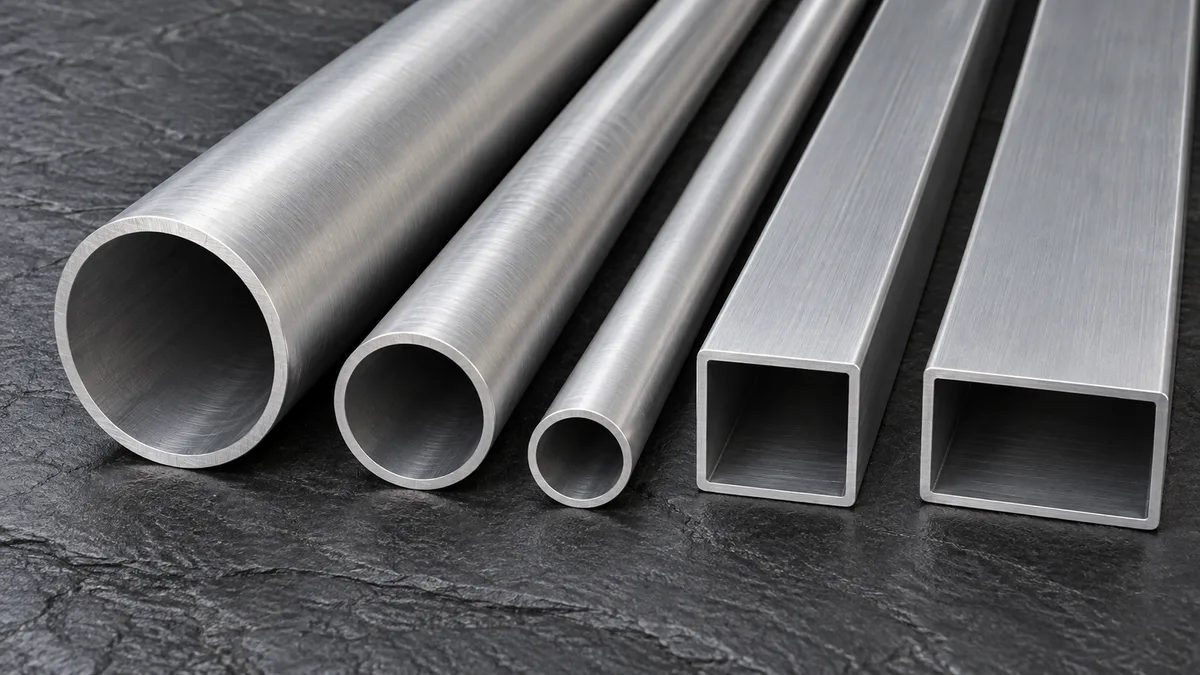
Standard aluminium pipe and tube are extruded or drawn. Forging takes over where extrusion runs out: walls too thick or diameters too large for an extrusion press, short thick hollows that are cheaper to forge and bore than to extrude, and small fittings whose shape (a tee, an elbow with a socket, a boss) is best pressed in a closed die from a solid slug.
Forged fittings are made by pressing a heated slug of bar in a closed die so that the metal flows into the body, branches and bosses of the part. The bore, sockets and threads are then machined. Compared with a fitting machined entirely from bar, a forging uses less metal, its grain follows the branches and its internal soundness is better, which matters for parts that hold pressure.
Forged pipe hollows are made by upsetting and piercing a billet, then drawing it over a mandrel or ring rolling it, or by forging a solid round and deep-hole boring it. They are used for thick-walled pressure shells, hydraulic cylinders, actuator housings and cryogenic vessel nozzles where an extruded tube of the required wall does not exist.
90° and 45° elbows, equal and reducing tees, crosses, couplings, half couplings and caps, made to ASME B16.11 socket dimensions for small-bore lines.
Elbows, tees, couplings, unions, hex bushings, plugs and nipples with NPT (ASME B1.20.1) or BSP (ISO 228 / ISO 7) threads. Use thread sealant suited to aluminium to prevent galling.
Elbows, reducers, tees and stub ends to ASME B16.9 dimensions for larger bores, normally formed from seamless pipe or machined from forgings to ASTM B361.
Weld-neck, slip-on, blind and lap-joint flanges forged in 6061-T6 or 5083, machined to ASME B16.5 or EN 1092 dimensions by agreement.
Weld-on branch bosses and outlets for headers, machined from forgings to drawing.
Manifold blocks, adaptor bodies, swivels and vacuum flanges forged close to shape and finished to drawing.
ASTM B361 is the specification for factory-made wrought aluminium welding fittings. It allows the fitting to be made from forgings, bar, plate or seamless pipe, refers to ASME B16.9 and B16.11 for dimensions, and requires the fitting material to conform to the ordered alloy and temper. For flanges, ASME B31.3 contains an appendix with pressure–temperature ratings for 6061-T6 aluminium pipe flanges; check its current edition for the rating that applies to your design.
| Route | How it is made | Best for |
|---|---|---|
| Pierced and drawn hollow | Billet upset and pierced, then drawn over a mandrel on a press | Thick-walled cylinders of moderate length |
| Ring-rolled hollow | Pierced preform rolled on a radial-axial mill to a short, wide tube | Large diameters with short length (sleeves, shells) |
| Forged and bored | Solid round forged, then trepanned or deep-hole bored | Small bores, long lengths, small quantities |
| Machined from forged bar | Forged bar turned and bored to finish size | Precision tubes, actuator and cylinder bodies |
Forged hollows are normally supplied with machining allowance on the outside and inside diameters and on the ends. Wall uniformity and concentricity are corrected by boring and turning; the achievable finish tolerance depends on length-to-bore ratio. Hollows for hydraulic and pneumatic cylinders are honed or roller-burnished internally after machining.
For standard pipe sizes and lengths, seamless extruded pipe to ASTM B241 (6061, 6063, 5083 and others) is far more economical than a forging and should be the first choice. Choose forged hollows when the wall thickness or diameter is beyond extrusion limits, when the specification calls for a forging, or when the part needs the soundness and grain flow of forged material.
| Alloy / temper | Why it is used | Weldable? | Typical service |
|---|---|---|---|
| 6061-T6 | Good strength, corrosion resistance and machinability; the usual flange and fitting alloy | Yes (ER4043 / ER5356) | Process, vacuum, compressed air, general piping |
| 6082-T6 | European equivalent of 6061, slightly stronger in thick sections | Yes | Structural and process piping in EN projects |
| 5083-O / H112 | Excellent seawater resistance, keeps toughness at cryogenic temperatures, no strength loss from welding in O temper | Yes (ER5183) | LNG and cryogenic lines, marine piping |
| 3003 / 1060 | High corrosion resistance and purity, low strength | Yes | Chemical and food lines at low pressure |
| 7075-T6 / T73 | Very high strength | No (not for fusion welding) | Threaded or bolted hydraulic and aerospace fittings only |
| 2024 / 2014 | High strength, lower corrosion resistance | No | Machined aerospace fittings, protected by anodising |
Use non-weldable 2xxx and 7xxx alloys only for mechanically joined fittings. For any welded pressure system choose 5xxx or 6xxx alloys and the filler wire recommended for that combination.
Aluminium is not suitable for high-temperature steam or hot-oil service: most alloys lose strength rapidly above about 150 °C. Always check chemical compatibility, because aluminium is attacked by strong alkalis, mercury and chloride-rich acids.
| Route | Advantages | Limitations |
|---|---|---|
| Forged fitting | Sound, dense metal with grain following branches; less waste; good for repeat quantities | Needs dies for closed-die shapes; minimum batch makes sense |
| Machined from bar | No tooling; fast for prototypes and small lots | More metal wasted; grain cut at branches |
| Extruded seamless pipe | Lowest cost for standard sizes and long lengths | Limited by press size and wall thickness |
| Fabricated (welded) fitting | Any size possible | Weld seams need inspection; HAZ strength is reduced |
Our article on the difference between pipe and tube explains the sizing conventions; pipe is ordered by nominal size and schedule, tube by outside diameter and wall.
Yes, aluminium fittings can be made to B16.11 dimensions, and ASTM B361 refers to B16.11 and B16.9 for welding fittings. However, the B16.11 class ratings were derived for steel, so the pressure rating of an aluminium fitting must be checked against the aluminium allowable stresses in your piping code.
6061-T6 is the most common: strong, weldable and corrosion resistant. 5083 is preferred for seawater and cryogenic service. 7075 and 2024 are only used for threaded or bolted fittings because they are not suitable for fusion welding.
Forgings are a type of wrought product. "Forged fitting" usually means a closed-die pressing that is then machined, while other wrought fittings are formed from seamless pipe or machined from bar or plate. Forging gives dense metal with grain following the shape.
Use extruded seamless pipe (ASTM B241) for standard sizes. Use a forged hollow when the wall is thicker or the diameter larger than extrusion allows, when the drawing calls for a forging, or for short heavy-wall cylinders.
No. Aluminium alloys lose much of their strength above about 150 °C, so they are unsuitable for steam and hot-oil lines. They are excellent for compressed air, vacuum, inert gases and cryogenic service.
An EN 10204 3.1 certificate with chemistry and mechanical results, dimensional reports and heat-treatment records. NDT reports, hydrostatic test results and 3.2 certification are available on request.
Send the type, size, alloy, design code and quantity. We will propose the manufacturing route and quote a delivered price.





