5005-H34
Strain hardened and stabilised to half-hard. The usual temper for anodised cladding and composite-panel skins: stiff enough to stay flat on large panels, ductile enough for folded returns.



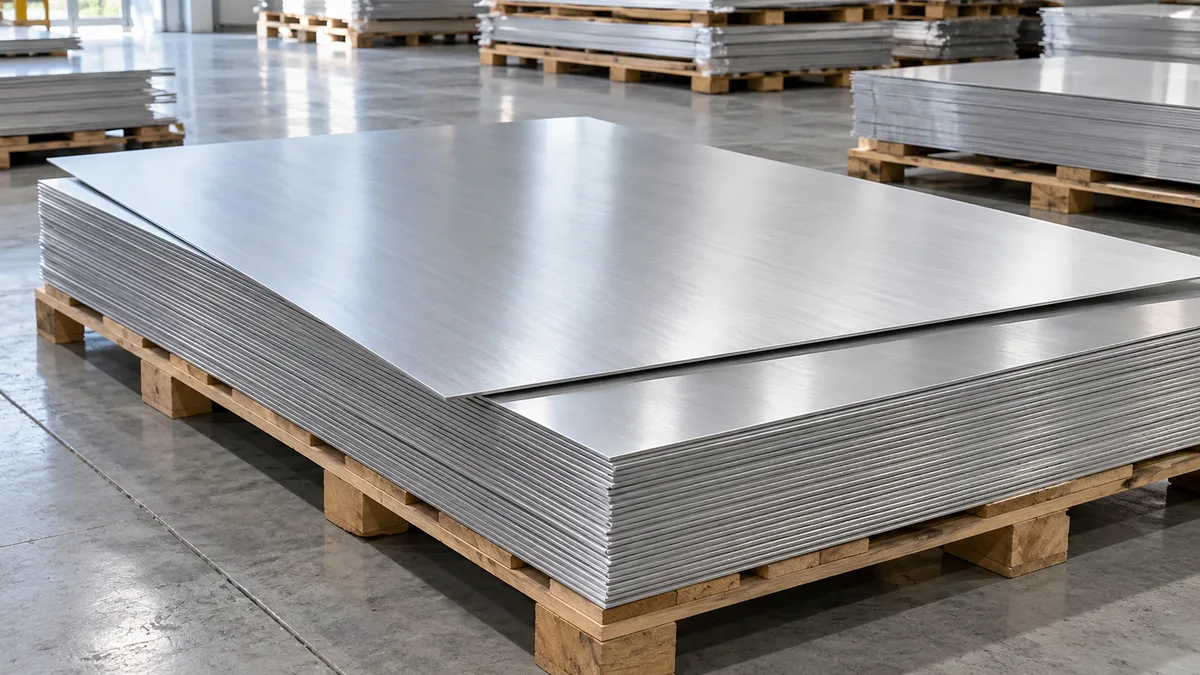
5005 is a low-magnesium aluminium sheet alloy chosen when appearance after anodising matters as much as strength. It gives an even, clear anodic finish that blends with 6063 extrusions, forms easily and resists weathering. Metline supplies 5005 sheet and coil in O, H14, H24, H32 and H34 tempers to ASTM B209 and EN 485, cut to size and shipped worldwide.
5005 is the leanest of the common 5xxx alloys: it contains only about 0.5 – 1.1 % magnesium, roughly a third of the magnesium in 5052. That small addition makes it noticeably stronger than 1100 or 3003 while keeping the clean, bright metal that anodisers prefer.
Because 5005 carries very little iron-bearing or manganese-bearing intermetallic material, its anodic film forms evenly and stays clear. Manganese-rich 3003 tends to give a slightly yellow or cloudy tone after anodising; 5005 does not, which is why architects specify it for cladding panels, soffits, column covers and trims that must match anodised 6063 window and curtain-wall sections on the same elevation.
The alloy cannot be heat-treated. Its strength comes from the magnesium in solid solution and from cold rolling, expressed in the H tempers. In H32 and H34 it bends cleanly, takes roll-forming and folding without cracking, and stays flat on large panels. It also welds well with standard 5xxx filler wire, although welded areas show a colour change after anodising and are usually kept out of sight.
Limits follow the Aluminum Association registration, mirrored by EN 573-3 for EN AW-5005 (AlMg1(B)). For premium architectural work, producers often supply an "anodising quality" (AQ) variant with tighter control of iron and silicon; state this on the order if colour uniformity across many panels is critical.
| Element | Minimum | Maximum | Comment |
|---|---|---|---|
| Silicon (Si) | — | 0.30 | Kept low to avoid grey tones after anodising |
| Iron (Fe) | — | 0.70 | Lower iron improves film clarity |
| Copper (Cu) | — | 0.20 | |
| Manganese (Mn) | — | 0.20 | Low Mn keeps the anodised colour neutral |
| Magnesium (Mg) | 0.50 | 1.10 | Strengthening element |
| Chromium (Cr) | — | 0.10 | |
| Zinc (Zn) | — | 0.25 | |
| Others, each / total | — | 0.05 / 0.15 | |
| Aluminium (Al) | Remainder | About 97 – 99 % |
Typical values come from published handbook data; the specified ranges are what ASTM B209 or EN 485-2 guarantee for sheet and are the values to design to. Ranges narrow slightly with thickness, and the mill certificate shows the actual results for your lot.
| Temper | Typical tensile | Typical yield (0.2 %) | Typical elongation | Specified tensile range (sheet) |
|---|---|---|---|---|
| O (annealed) | 124 MPa | 41 MPa | 25 – 30 % | 105 – 145 MPa |
| H32 | 138 MPa | 117 MPa | 11 % | 115 – 160 MPa (min. yield 85 MPa) |
| H34 | 159 MPa | 138 MPa | 8 % | 140 – 180 MPa (min. yield 105 MPa) |
| H36 | 179 MPa | 165 MPa | 6 % | 160 – 200 MPa |
| H14 / H24 | ≈ 160 MPa | ≈ 130 – 140 MPa | 4 – 8 % | 145 – 185 MPa |
Specified ranges summarised from ASTM B209 and EN 485-2; check the table for your exact thickness band. Typical values are not design allowables.
Strain hardened and stabilised to half-hard. The usual temper for anodised cladding and composite-panel skins: stiff enough to stay flat on large panels, ductile enough for folded returns.
Quarter-hard and stabilised. Easier to fold and roll-form than H34; used for cassette panels with tight returns and for trims.
Half-hard, either cold-rolled direct (H14) or over-rolled and partially annealed (H24). H24 gives better bendability than H14 at similar strength, which helps tight folds.
Fully annealed for deep drawing, spinning and pressings such as lighting reflector housings and cookware lids.
A controlled-chemistry, controlled-surface variant for colour-critical work. Ask for it, and order all panels for one facade from the same production lot.
If you do not want to anodise after fabrication, see our anodised sheet range, where 5005 is a common base metal.
| System | Designation | Sheet / plate standard |
|---|---|---|
| Aluminum Association / ASTM | 5005 | ASTM B209 (ASME SB-209) |
| UNS | A95005 | — |
| European (EN) | EN AW-5005 / EN AW-AlMg1(B) | EN 485-1/-2/-4, EN 573-3 |
| Close European variant | EN AW-5005A / AlMg1(C) | Slightly different limits; check before substituting |
| German Werkstoff | 3.3315 | DIN EN 485 |
| ISO | AlMg1 | ISO 6361 |
| Japan (JIS) | A5005P | JIS H4000 |
| China (GB) | 5005 | GB/T 3880, GB/T 3190 |
An alloy number alone is not a specification. Put the standard, edition, temper and thickness tolerance class on your purchase order, together with any anodising-quality or surface requirement, so the certificate can confirm compliance.
Weight is 2.70 kg per square metre per millimetre of thickness. Use the plate weight calculator for other sizes.
| Thickness (mm) | kg per m² | 1220 × 2440 mm (kg) | 1250 × 2500 mm (kg) | 1500 × 3000 mm (kg) |
|---|---|---|---|---|
| 0.5 | 1.35 | 4.0 | 4.2 | 6.1 |
| 0.7 | 1.89 | 5.6 | 5.9 | 8.5 |
| 0.8 | 2.16 | 6.4 | 6.8 | 9.7 |
| 1 | 2.70 | 8.0 | 8.4 | 12.2 |
| 1.2 | 3.24 | 9.6 | 10.1 | 14.6 |
| 1.5 | 4.05 | 12.1 | 12.7 | 18.2 |
| 2 | 5.40 | 16.1 | 16.9 | 24.3 |
| 2.5 | 6.75 | 20.1 | 21.1 | 30.4 |
| 3 | 8.10 | 24.1 | 25.3 | 36.5 |
| 4 | 10.80 | 32.1 | 33.8 | 48.6 |
| 5 | 13.50 | 40.2 | 42.2 | 60.8 |
| 6 | 16.20 | 48.2 | 50.6 | 72.9 |
Thickness, width, length and flatness follow ASTM B209 (ANSI H35.2) or EN 485-4 for cold-rolled sheet. For facade work the surface matters more than the dimensional class: rolling lines, scratches and handling marks show through an anodic film rather than being hidden by it.
In H32 an inside bend radius of about 0.5 – 1 × thickness is usually achievable for thin sheet; H34 needs slightly more. Bend across the rolling direction where possible.
Anodise after forming. Clear and bronze/black two-step colours are common. Pre-treat consistently: etch time strongly affects the final gloss.
TIG and MIG weld well with ER5356 or ER4043. Welds and heat-affected zones look different after anodising, so plan joints on hidden faces.
Takes PVDF and polyester coil and powder coatings after chromate-free conversion treatment.
Soft and gummy in O temper; harder tempers cut better with sharp, polished tooling and lubricant.
Good resistance in most atmospheres. Isolate from copper and carbon steel and avoid alkaline mortar contact on site.
| Property | 5005-H34 | 3003-H14 | 5052-H32 | 1050-H14 |
|---|---|---|---|---|
| Typical tensile strength | 159 MPa | 150 MPa | 228 MPa | 110 MPa |
| Anodised appearance | Very good, clear | Fair, slightly yellow | Good, slight yellow tint | Very good |
| Formability | Very good | Very good | Good | Excellent |
| Seawater resistance | Good | Good | Very good | Good |
| Typical use | Anodised facades | General sheet, roofing | Marine, tanks | Signs, reflectors |
If you need more strength or will put the panel in direct marine spray, step up to 5052. If appearance is everything and strength is not, 1050 gives an even brighter finish. For painted rather than anodised panels, 3003 or 3105 is often the more economical choice.
3003 contains about 1 – 1.5 % manganese, which forms particles that give the anodic film a cloudy or yellowish tone. 5005 has very little manganese, so its film stays clear and matches anodised 6063 extrusions far more closely.
Both are strain hardened and stabilised. H32 is quarter-hard (about 115 – 160 MPa tensile) and bends more easily; H34 is half-hard (about 140 – 180 MPa) and stays flatter on large panels.
It performs well in coastal atmospheres, especially when anodised. For parts in direct splash or immersion, 5052, 5754 or 5083 offer more strength and better long-term seawater resistance.
No. 5005 is non-heat-treatable; strength is set by cold work. Heating only softens it towards the O temper.
A 1220 × 2440 × 3 mm sheet weighs about 24.1 kg, and a 1250 × 2500 × 2 mm sheet about 16.9 kg, based on 2.70 g/cm³.
EN AW-5005, chemical symbol AlMg1(B), Werkstoff 3.3315. EN AW-5005A is a close variant with slightly different limits.
Tell us the temper, thickness, panel size, quantity and finish. We will confirm availability, certification and a delivered price.





