Cutting and machining
Tubes are saw-cut square, deburred and can be drilled or slotted for fittings and drain holes. Ends can be machined for welded couplers.



Tubular bus pipe is an aluminium tube used as a rigid conductor, mainly for outdoor substation bus, generator connections and high-current indoor runs. A tube puts the metal where AC current actually flows and where bending stiffness is greatest, so it spans further between insulators and runs cooler than a flat bar of the same weight. This guide covers alloy choice, standard sizes, electrical and structural data, fabrication and ordering.
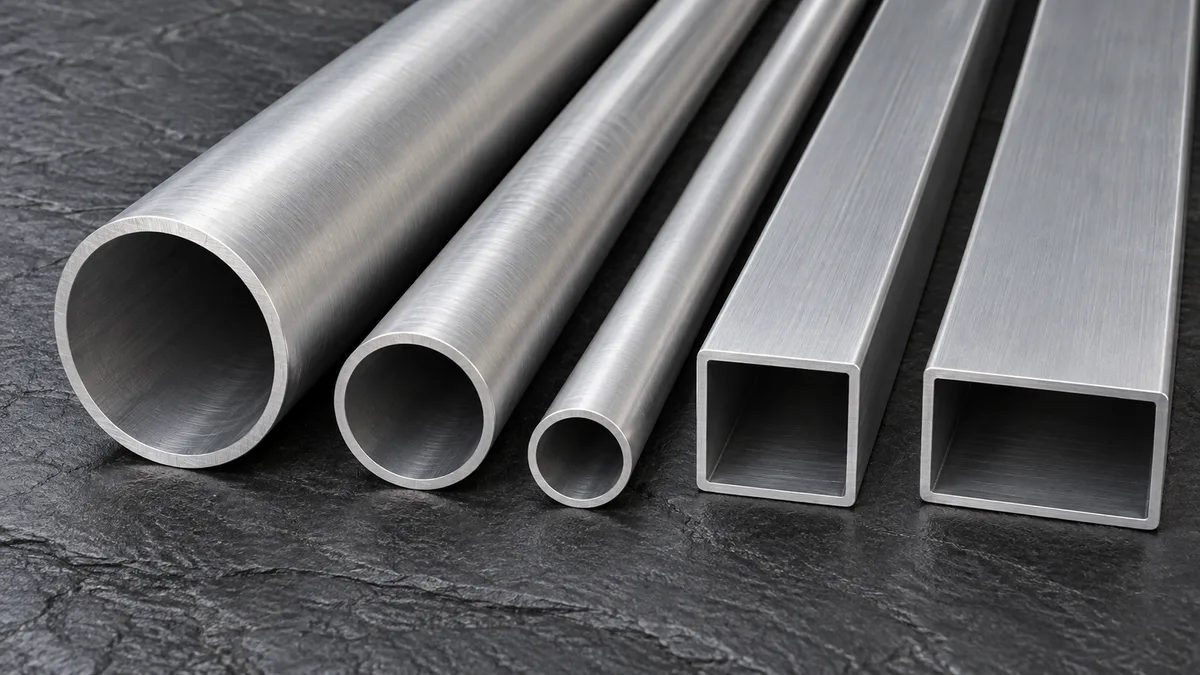
In an alternating-current conductor, current crowds towards the surface (skin effect). In a thick flat bar or solid rod the centre carries little current, so part of the metal is wasted. A tube with a wall of sensible thickness uses nearly all its cross-section, which keeps AC resistance close to DC resistance.
The same geometry is ideal structurally. For a given weight, a round tube has a far higher moment of inertia than a flat bar or solid rod, and it is equally stiff in every direction. That lets substation designers use longer spans between post insulators, reducing the number of supports, foundations and connectors. The round surface has no sharp edges, which lowers the surface electric field and the risk of corona at high voltage, and the large surface area dissipates heat well.
Tubular bus is therefore the standard rigid conductor for air-insulated substations from medium voltage up to extra-high voltage, and is also used for generator and transformer connections, rectifier and furnace bus, and indoor high-current runs in industrial plants.
| Alloy and temper | Conductivity (% IACS) | Strength | Where it fits |
|---|---|---|---|
| 6101-T6 / T61 / T63 | About 55 – 59 (55 min. in T6) | Medium | The standard bus-conductor alloy: good conductivity with enough strength for long spans and short-circuit forces |
| 6063-T6 | About 53 | Medium | Widely used substation bus where structural and electrical demands are balanced; easy to extrude and weld |
| 1350 / 1060 / 1070 | About 61 – 62 | Low | Indoor or well-supported high-current runs where conductivity outweighs stiffness |
| 6061-T6 | About 40 – 43 | High | Structural bus and support members where stiffness and strength matter most |
| 3003 | About 40 – 50 (by temper) | Low – medium | Light-duty conductors and earthing applications needing good corrosion resistance |
Most utility specifications call for 6101-T6 or 6063-T6. 6101 gives roughly 3 – 4 percentage points more conductivity than 6063 for a similar strength level; 6063 is often easier to source in large diameters. 1350 conducts best but is too soft for long outdoor spans and is mainly chosen for indoor bus that is supported at short intervals.
Mechanical minimums for 6101 tubes are set by ASTM B317/B317M; for 6063 and 6061 pipe by ASTM B241/B241M or B429/B429M. The mill certificate states the measured values for the lot.
Bus pipe is usually ordered in American nominal pipe sizes (NPS) with Schedule 40 or Schedule 80 wall thickness to ASME B36.10 dimensions, or in metric outside diameter and wall. The tables convert the standard dimensions to metric and add calculated cross-section, weight, DC resistance in 6101-T6 at its 55 % IACS minimum, and moment of inertia for deflection checks.
| NPS (in) | OD (mm) | Wall (mm) | Area (mm²) | Weight (kg/m) | DC resistance 6101-T6 (µΩ/m) | Moment of inertia (cm⁴) |
|---|---|---|---|---|---|---|
| 1 | 33.4 | 3.38 | 319 | 0.86 | 98.4 | 3.6 |
| 1.25 | 42.2 | 3.56 | 431 | 1.16 | 72.7 | 8.1 |
| 1.5 | 48.3 | 3.68 | 516 | 1.39 | 60.8 | 12.9 |
| 2 | 60.3 | 3.91 | 693 | 1.87 | 45.2 | 27.7 |
| 2.5 | 73.0 | 5.16 | 1099 | 2.97 | 28.5 | 63.7 |
| 3 | 88.9 | 5.49 | 1438 | 3.88 | 21.8 | 125.6 |
| 3.5 | 101.6 | 5.74 | 1729 | 4.67 | 18.1 | 199.3 |
| 4 | 114.3 | 6.02 | 2048 | 5.53 | 15.3 | 301.0 |
| 5 | 141.3 | 6.55 | 2774 | 7.49 | 11.3 | 631.1 |
| 6 | 168.3 | 7.11 | 3601 | 9.72 | 8.7 | 1171.4 |
Schedule 80 walls are thicker, giving more area and stiffness for the same outside diameter, which suits heavier short-circuit duties and longer spans:
| NPS (in) | OD (mm) | Wall (mm) | Area (mm²) | Weight (kg/m) | DC resistance 6101-T6 (µΩ/m) | Moment of inertia (cm⁴) |
|---|---|---|---|---|---|---|
| 1 | 33.4 | 4.55 | 412 | 1.11 | 76.1 | 4.4 |
| 1.25 | 42.2 | 4.85 | 569 | 1.54 | 55.1 | 10.1 |
| 1.5 | 48.3 | 5.08 | 689 | 1.86 | 45.5 | 16.3 |
| 2 | 60.3 | 5.54 | 953 | 2.57 | 32.9 | 36.1 |
| 2.5 | 73.0 | 7.01 | 1454 | 3.93 | 21.6 | 80.1 |
| 3 | 88.9 | 7.62 | 1946 | 5.25 | 16.1 | 162.1 |
| 3.5 | 101.6 | 8.08 | 2373 | 6.41 | 13.2 | 261.4 |
| 4 | 114.3 | 8.56 | 2844 | 7.68 | 11.0 | 400.0 |
| 5 | 141.3 | 9.52 | 3943 | 10.65 | 7.9 | 860.4 |
| 6 | 168.3 | 10.97 | 5423 | 14.64 | 5.8 | 1685.3 |
Calculated from nominal dimensions, density 2.70 g/cm³ and resistivity 0.0313 Ω·mm²/m at 20 °C. For 1350 multiply resistance by 0.90; for 6063-T6 by about 1.04. AC resistance is slightly higher.
Tubes are saw-cut square, deburred and can be drilled or slotted for fittings and drain holes. Ends can be machined for welded couplers.
Bending success depends on ductility, the ratio of wall to diameter and the bending method. Seamless tube in a ductile temper bends more reliably than extruded structural pipe with seam welds from a porthole die.
MIG and TIG with argon or argon-helium shielding. 4043 filler is common for 6xxx bus; joints are solvent-cleaned and wire-brushed, and parts may be pre-dried at low temperature to remove moisture. Tack welding controls alignment.
Welding locally reduces the strength of T6 tempers, so couplers or sleeves are often used at joints, and joints are placed away from the point of maximum bending moment.
Clamp and terminal areas are cleaned, brushed and coated with oxide-inhibiting compound; tin or nickel plating of ends gives a stable contact to copper equipment terminals.
Anodising, insulating sleeves or heat-shrink are used where tubes must be touched-safe or protected from aggressive atmospheres.
A tubular bus system needs more than tube. These are the parts buyers usually specify alongside the conductor; Metline supplies the aluminium tube, bar and plate from which they are made and can machine aluminium parts to drawing.
Main and transfer bus, equipment interconnections and jumpers from 11 kV to extra-high voltage.
Generator and transformer connections carrying very high currents at short spans.
Furnace, rectifier and electrolysis bus, plus indoor high-current distribution.
Collector substations for wind and solar farms, where weight and corrosion resistance help on remote sites.
Substation bus feeding traction networks.
Ground conductors and risers where a rigid, corrosion-resistant conductor is required.
6101-T6 is the dedicated bus-conductor alloy, with at least 55 % IACS conductivity and good strength. 6063-T6 is a close alternative with slightly lower conductivity. 1350 conducts best but is too soft for long outdoor spans.
A tube carries AC current evenly, is equally stiff in every direction and has no sharp edges. It spans further between insulators, resists wind and fault forces, and limits corona at high voltage.
NPS 4 Schedule 40 has a 114.3 mm OD and 6.02 mm wall, a cross-section of about 2,050 mm² and a weight of about 5.5 kg per metre (3.7 lb/ft).
Light steady winds can cause aeolian vibration. Designers usually insert a loose length of stranded conductor inside the tube as a damper, or fit purpose-made dampers, following IEEE 605 guidance.
Seamless pipe to ASTM B241 is preferred if tubes will be bent or highly stressed. Extruded structural pipe is acceptable for straight runs where the specification allows it.
Yes. Metline supplies bus pipe cut to length, drilled, bent and with tin- or nickel-plated contact ends on request, with mill test certificates and export packing, worldwide.
Send the alloy, size, schedule, lengths and quantity. We will confirm conductivity, certification and a delivered price.





