2219-O
Fully annealed for forming. Parts are spun, stretched or bent and then heat treated by the user, usually to T62. AMS 4031 covers O sheet and plate.



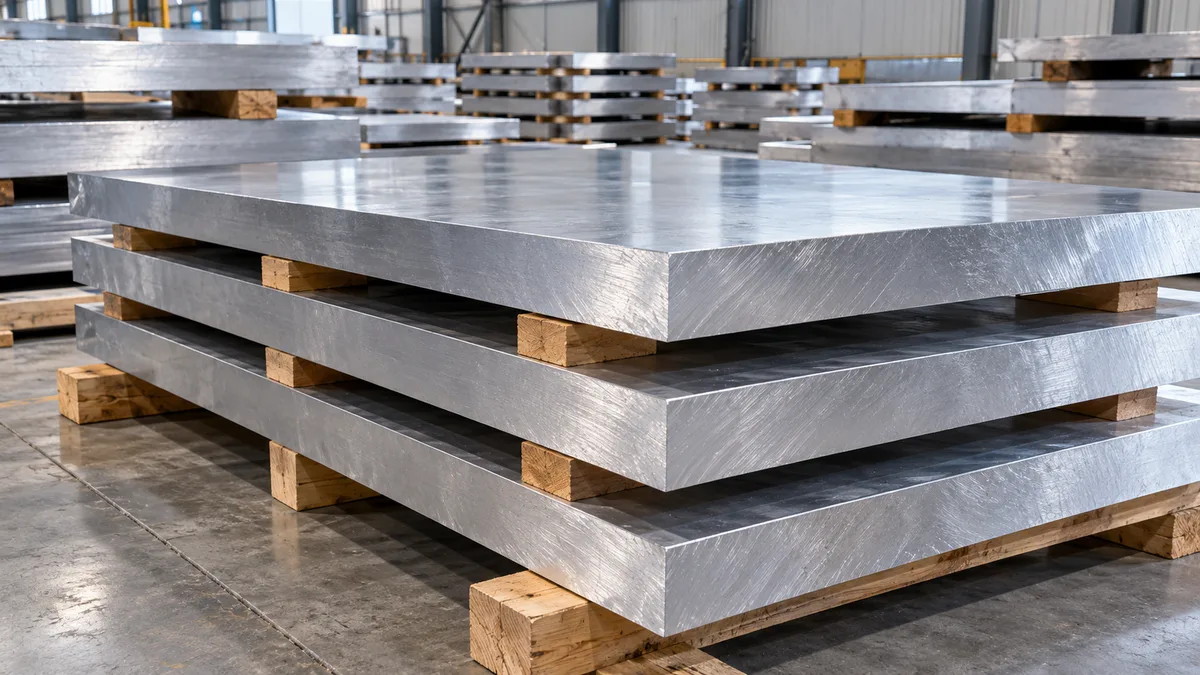
2219 sheet and plate are the established material for welded high-strength aerospace structures, above all cryogenic propellant tanks, because the alloy welds reliably and keeps its strength and toughness from about −253 °C up to roughly 300 °C. It is supplied bare or Alclad in tempers from annealed O to the high-strength T851 and T87. Metline supplies 2219 sheet and plate to AMS 4031, ASTM B209 and customer specifications, cut to size and certified, to aerospace, space and defence buyers worldwide.
Most high-strength aluminium alloys are difficult or impossible to fusion weld. 2219 is the exception among the high-copper alloys: with about 6.3 % copper, almost no magnesium and a zirconium addition, it resists hot cracking and can be welded into large, pressure-tight structures.
The alloy was developed in the 1950s and found its defining use in rocketry. Large launch-vehicle propellant tanks, including those of the Saturn V stages and the original Space Shuttle external tank, were welded from 2219 plate. The same reasoning still applies: 2219 is strong, its toughness rises rather than falls at cryogenic temperatures, it welds with well-understood procedures, and it is available in thick, wide plate for machined and formed tank panels.
At the other end of the temperature range, 2219 resists softening better than 2024 and much better than 7075. Its copper-rich precipitates are stable up to roughly 250 – 315 °C for limited exposures, so the alloy is also chosen for supersonic aircraft skins, engine-area structure and parts that see heat during service or processing.
The price of these advantages is moderate room-temperature strength and limited corrosion resistance. 2219-T87 is weaker than 7075-T6 or 2024-T3 in tension, and like all high-copper alloys it needs anodising, conversion coating or Alclad cladding. Third-generation aluminium-lithium alloys such as 2195 have replaced 2219 in some new tank designs because they save weight, but 2219 remains widely specified for its proven weldability, availability and lower cost.
These are the registered limits for alloy 2219, followed by AMS 4031, ASTM B209 and EN 573-3. Alclad 2219 is clad on both faces with alloy 7072, a zinc-bearing alloy that is anodic to the core and protects it sacrificially.
| Element | Minimum | Maximum | Role |
|---|---|---|---|
| Silicon (Si) | — | 0.20 | Impurity |
| Iron (Fe) | — | 0.30 | Impurity |
| Copper (Cu) | 5.8 | 6.8 | Main strengthening element; also gives strength at temperature |
| Manganese (Mn) | 0.20 | 0.40 | Grain and recrystallisation control |
| Magnesium (Mg) | — | 0.02 | Kept very low, which is key to weldability |
| Zinc (Zn) | — | 0.10 | Impurity |
| Titanium (Ti) | 0.02 | 0.10 | Grain refiner |
| Vanadium (V) | 0.05 | 0.15 | Improves elevated-temperature strength |
| Zirconium (Zr) | 0.10 | 0.25 | Suppresses recrystallisation, refines weld structure |
| Others, each / total | — | 0.05 / 0.15 | |
| Aluminium (Al) | Remainder | About 91.5 – 93.8 % |
Each minor element has a purpose. Manganese and zirconium form fine dispersoids that keep the grain structure unrecrystallised and refine the weld fusion zone. Vanadium and titanium further stabilise the structure at temperature. The tight magnesium limit (0.02 % max.) is critical: even small amounts of magnesium increase hot-cracking sensitivity during welding.
Typical values below apply to bare sheet and plate in the longitudinal direction. Alclad sheet is slightly weaker because the 7072 cladding carries little load. Specified minimums in ASTM B209 and the AMS documents are lower than typical values and decrease in thick plate.
| Temper | Tensile strength (typ.) | Yield strength (typ.) | Elongation (typ.) |
|---|---|---|---|
| O | 172 MPa / 25 ksi | 76 MPa / 11 ksi | 18 % |
| T31 / T351 | 360 MPa / 52 ksi | 250 MPa / 36 ksi | 17 % |
| T37 | 395 MPa / 57 ksi | 315 MPa / 46 ksi | 11 % |
| T62 | 415 MPa / 60 ksi | 290 MPa / 42 ksi | 10 % |
| T81 / T851 / T8511 | 455 MPa / 66 ksi | 350 MPa / 51 ksi | 10 % |
| T87 | 475 MPa / 69 ksi | 395 MPa / 57 ksi | 10 % |
Typical values from Aluminum Association and ASM data. Specified minimums depend on product form, thickness and test direction, and are shown in the governing ASTM or AMS document and on the mill certificate.
The T8 tempers (T81, T851, T87) differ from T6-type tempers in that the material is cold worked, by stretching or rolling, between quenching and ageing. The cold work speeds up and refines precipitation, giving higher yield strength and better resistance to stress corrosion. T87, with about 7 % cold work, is the strongest standard temper; T851 is stretched only 1.5 – 3 % for stress relief and is preferred for plate that will be heavily machined.
2219 is often described as a "wide temperature range" alloy, and the description is accurate. Aluminium alloys with a face-centred cubic structure have no ductile-to-brittle transition, but 2219 goes further: its tensile strength, yield strength and fracture toughness all increase as it is cooled towards liquid-hydrogen temperature (about −253 °C), and its weld joints keep useful toughness too.
| Temperature range | Behaviour of 2219-T8 plate | Design implication |
|---|---|---|
| −253 °C to −196 °C (LH2, LN2) | Strength and toughness higher than at room temperature | Suitable for liquid hydrogen and oxygen tanks and lines |
| −50 °C to 100 °C | Normal room-temperature properties | Standard airframe design data apply |
| 100 °C to 200 °C | Gradual strength reduction; better retention than 2024 and 7075 | Check allowables for time at temperature |
| 200 °C to about 315 °C | Useful strength for limited exposures; over-ageing with long exposure | Engine-area and short-duration heated parts |
For design numbers at temperature, use MMPDS or the producer's data for the exact temper and exposure time; the values depend strongly on how long the part stays hot.
Fully annealed for forming. Parts are spun, stretched or bent and then heat treated by the user, usually to T62. AMS 4031 covers O sheet and plate.
Solution heat-treated, cold worked and naturally aged. Used as the starting temper for parts that will be formed and then artificially aged to T81 or T851.
Solution heat-treated with about 7 % cold work and naturally aged. Precursor to T87.
Solution heat-treated and artificially aged by the user, often after forming or welding. No cold work, so yield strength is lower than T81.
Solution heat-treated, stretched or cold worked, then artificially aged. T851 is stretched for stress relief and is the usual choice for machined plate.
Solution heat-treated, cold worked about 7 % and artificially aged. Highest strength; widely used for welded tank plate.
2219 sheet and plate are ordered against aerospace (AMS), ASTM or European documents. The specification fixes the temper, thickness range, test directions and inspection, so it should be stated on every enquiry.
| Document | Scope |
|---|---|
| SAE AMS 4031 | 2219 sheet and plate, annealed (O) or as-fabricated when specified, about 0.5 – 50.8 mm |
| ASTM B209 / ASME SB-209 | General sheet and plate specification; covers bare and Alclad 2219 in O, T31, T351, T37, T62, T81, T851 and T87 |
| AMS-QQ-A-250/30 | Former federal specification for bare 2219 sheet and plate, still found on many drawings |
| AMS Alclad documents | Separate AMS specifications cover Alclad 2219 sheet in specific tempers; send the number on your drawing |
| UNS | A92219 |
| European | EN AW-2219 (AlCu6Mn) |
| Welding filler | 2319 (AWS ER2319) |
Bare 2219 is the alloy as rolled and heat treated, with no cladding. It is the normal form for plate over a few millimetres, for parts machined on all surfaces, and for welded structures, because cladding would be removed by machining or mixed into the weld.
Bare plate relies on anodising, chemical conversion coating and paint for corrosion protection.
Alclad 2219 has a thin layer of 7072 alloy bonded to each face during rolling. The cladding corrodes preferentially and protects the copper-rich core, even at scratches and cut edges.
It is mainly used for thin sheet skins exposed to the atmosphere. Strength is a little lower than bare sheet, and the cladding must be accounted for in fatigue and weld design.
Wide, thick 2219 plate for tank panels is produced in mill campaigns, so share your size requirements early.
2219 is denser than most aluminium alloys at 2.84 g/cm³, so a plate weighs 2.84 kg per square metre for each millimetre of thickness. The table gives quick reference weights; for other sizes use the plate weight calculator with a density of 2.84.
| Thickness (mm) | kg per m² | 1250 × 2500 mm (kg) | 1500 × 3000 mm (kg) |
|---|---|---|---|
| 1 | 2.8 | 8.9 | 12.8 |
| 2 | 5.7 | 17.8 | 25.6 |
| 3 | 8.5 | 26.6 | 38.3 |
| 5 | 14.2 | 44.4 | 63.9 |
| 6 | 17.0 | 53.2 | 76.7 |
| 8 | 22.7 | 71.0 | 102.2 |
| 10 | 28.4 | 88.8 | 127.8 |
| 12 | 34.1 | 106.5 | 153.4 |
| 16 | 45.4 | 142.0 | 204.5 |
| 20 | 56.8 | 177.5 | 255.6 |
| 25 | 71.0 | 221.9 | 319.5 |
| 30 | 85.2 | 266.2 | 383.4 |
| 40 | 113.6 | 355.0 | 511.2 |
| 50 | 142.0 | 443.8 | 639.0 |
| 60 | 170.4 | 532.5 | 766.8 |
| 80 | 227.2 | 710.0 | 1022.4 |
| 100 | 284.0 | 887.5 | 1278.0 |
| 150 | 426.0 | 1331.2 | 1917.0 |
For welded tank plate, many programmes add their own requirements: weld qualification coupons from the same lot, cleanliness and surface condition limits, and restrictions on surface defects that could open up during forming. List these flow-down clauses on the enquiry so they are included in the quotation.
Gas tungsten arc, gas metal arc, variable-polarity plasma arc and electron beam welding are all used. Filler alloy 2319 (2219 chemistry with added titanium and vanadium for weld grain refinement) is standard.
Solid-state friction stir welding avoids melting, porosity and hot cracking, and gives higher joint strength than fusion welding. It is now common on large tank barrels and domes.
Remove oxide and contamination immediately before welding: degrease, then mechanically or chemically clean. Hydrogen from moisture and hydrocarbons is the main cause of porosity.
The weld and heat-affected zone are weaker than T87 parent plate. Designs either accept as-welded allowables or heat treat the welded assembly to T62.
Form tank gores and panels in O or T31/T37, then age. Brake forming of T8 tempers requires generous bend radii.
Machines cleanly with carbide tools; T851 plate keeps flat when large pockets are milled.
A typical example is a cryogenic tank barrel: 2219-T87 plate is machined into thin isogrid-stiffened panels, formed to the barrel radius, and joined by friction stir or plasma arc welding with 2319 filler.
| Property | 2219-T87 | 2195-T8 (Al-Li) | 2024-T351 | 7075-T651 | 5083-H321 |
|---|---|---|---|---|---|
| Typical yield strength | about 395 MPa | about 500 MPa or more | about 325 MPa | about 505 MPa | about 230 MPa |
| Density | 2.84 g/cm³ | about 2.71 g/cm³ | 2.78 g/cm³ | 2.81 g/cm³ | 2.66 g/cm³ |
| Fusion weldability | Good | Fair (FSW preferred) | Poor | Poor | Excellent |
| Cryogenic toughness | Excellent | Very good | Good | Fair | Excellent |
| Strength at 200 °C | Good | Fair | Fair | Poor | Low |
| Relative cost | Medium | High | Medium | Medium | Low |
Choose 2219 when weldability and a wide temperature range matter together. 2195 saves weight in tanks at higher material cost; 5083 is cheaper and very weldable but much weaker; 2024 and 7075 are stronger at room temperature but are not used for fusion-welded structure.
It combines moderate-to-high strength with reliable weldability and strength and toughness that increase at liquid-hydrogen and liquid-oxygen temperatures.
2319 filler (AWS ER2319) is standard. It matches the parent chemistry and adds titanium and vanadium to refine the weld structure. Friction stir welding needs no filler.
Both are cold worked before artificial ageing. T851 is stretched 1.5 – 3 % for stress relief; T87 receives about 7 % cold work and is stronger.
Not on its own. It is a copper-rich alloy that should be anodised, conversion coated and painted, or supplied as Alclad sheet for external skins.
2.84 kg per m² per millimetre of thickness. A 1250 × 2500 × 10 mm plate weighs about 88.8 kg.
Yes. Welded assemblies can be solution treated and aged to T62 to recover strength, but the process causes distortion that must be planned for.
Yes, to AMS-STD-2154 or ASTM B594 at the class on your order, with the inspection report included.
Send temper, thickness, size, quantity and specification. Our team will confirm availability, inspection and a delivered price.





