5083-H112
As-extruded, with no deliberate cold work or anneal beyond what the process gives. The most economical bar temper and the usual choice for large diameters that will be machined.



5083 aluminium round bar is the strongest of the common non-heat-treatable marine alloys, made for parts that sit in seawater, get welded, or both. Metline supplies extruded and drawn 5083 rod in O, H111 and H112 tempers, certified to ASTM B221 or EN 755-2 and cut to length, to shipyards, fabricators and machine shops worldwide.
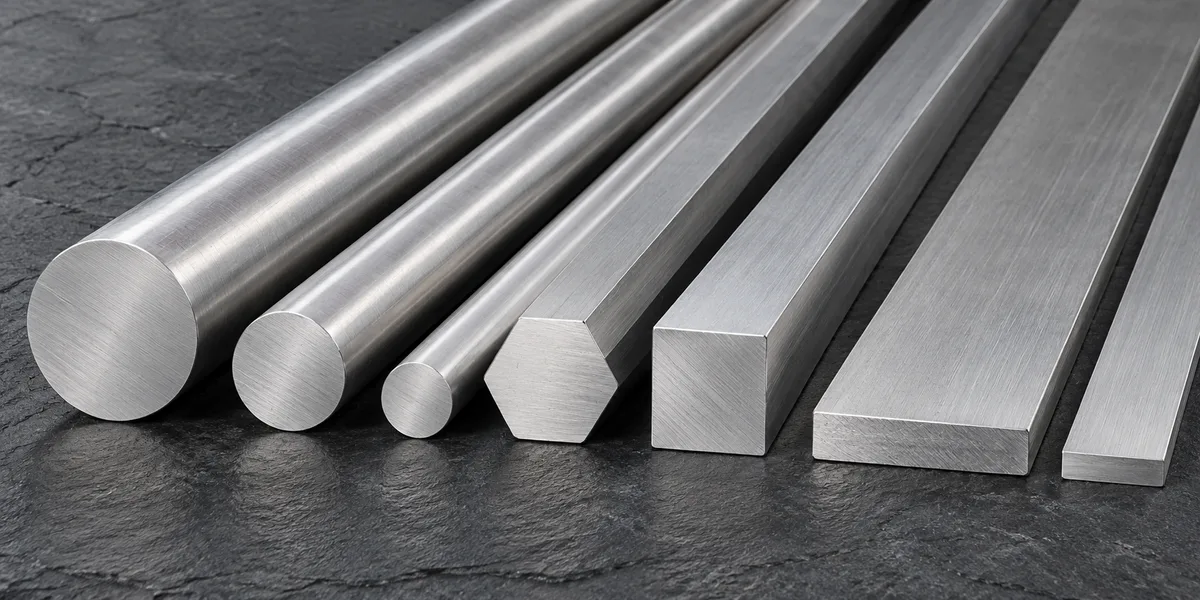
5083 is an aluminium-magnesium-manganese alloy with about 4.5 % magnesium. It cannot be hardened by heat treatment; its strength comes from magnesium in solid solution and, in some tempers, from cold work. That has one big practical consequence: welding does not destroy its strength the way it does with 6061 or 6082.
In round bar form, 5083 is usually extruded and supplied in the O, H111 or H112 temper. Annealed (O and H111) bar has a minimum tensile strength of around 270 – 275 MPa, which is higher than any other common 5xxx bar except 5456, and it keeps good elongation, so it machines into fittings and welds into frames without cracking.
Buyers choose 5083 rod for components that live in or near seawater: shafts and pins for deck machinery, bollard and cleat bodies, stanchions, flange blanks, pump parts, mooring hardware and welded brackets that tie into a 5083 hull. It is also used in cryogenic plant, because like other Al-Mg alloys it gets slightly stronger and stays tough at very low temperatures.
Limits are the Aluminum Association registration, which ASTM B221 and EN 573-3 (EN AW-5083, AlMg4.5Mn0.7) both follow. The mill certificate reports the actual cast analysis for each lot.
| Element | Minimum | Maximum | Effect |
|---|---|---|---|
| Magnesium (Mg) | 4.0 | 4.9 | Main strengthening element; drives corrosion resistance and strength |
| Manganese (Mn) | 0.40 | 1.0 | Adds strength and controls grain structure |
| Chromium (Cr) | 0.05 | 0.25 | Improves resistance to stress corrosion |
| Silicon (Si) | — | 0.40 | Impurity |
| Iron (Fe) | — | 0.40 | Impurity |
| Copper (Cu) | — | 0.10 | Kept low to protect seawater resistance |
| Zinc (Zn) | — | 0.25 | Impurity |
| Titanium (Ti) | — | 0.15 | Grain refiner |
| Others, each / total | — | 0.05 / 0.15 | |
| Aluminium (Al) | Remainder | About 92.4 – 95.6 % |
Bar standards set minimum values by diameter band. The ASTM figures below are the B221 minimums for extruded rod and bar up to the usual size limit; EN 755-2 values are close but expressed in round metric numbers. Typical values are what a lot usually achieves and are given for comparison only.
| Temper and basis | Tensile strength | Yield strength (0.2 %) | Elongation |
|---|---|---|---|
| O, ASTM B221 minimum | 270 MPa / 39 ksi (max. 350 MPa) | 110 MPa / 16 ksi | 14 % |
| H111, ASTM B221 minimum | 276 MPa / 40 ksi | 165 MPa / 24 ksi | 12 % |
| H112, ASTM B221 minimum | 269 MPa / 39 ksi | 110 MPa / 16 ksi | 12 % |
| O / H111, EN 755-2 minimum | 270 MPa (max. 350 MPa) | 110 MPa | 12 % (A) |
| O, typical | 290 MPa / 42 ksi | 145 MPa / 21 ksi | 22 % |
EN and ASTM limits vary with diameter band; the values that apply to your size are printed on the mill certificate. H111 carries a slightly higher yield because of the light straightening strain after annealing.
As-extruded, with no deliberate cold work or anneal beyond what the process gives. The most economical bar temper and the usual choice for large diameters that will be machined.
Annealed, then lightly strain-hardened by straightening. Gives the highest guaranteed yield of the standard bar tempers and is common in marine specifications.
Fully annealed for maximum ductility. Choose it for rod that will be cold headed, bent, swaged or spun.
Cold-drawn rod in harder tempers can be produced for small diameters where extra strength is needed; it is a special order and the properties must be agreed in advance.
5083 is non-heat-treatable, so there is no T6 temper. If a drawing calls for "5083-T6", it is an error; check whether the designer meant 6082-T6 or 5083-H111.
| System | Designation | Bar and rod standard |
|---|---|---|
| Aluminum Association / ASTM | 5083 | ASTM B221 (extruded), ASME SB-221 |
| UNS | A95083 | — |
| European (EN) | EN AW-5083 / EN AW-AlMg4.5Mn0.7 | EN 755-2 (extruded), EN 754-2 (drawn), EN 573-3 |
| German Werkstoff | 3.3547 | DIN EN 755 |
| ISO | AlMg4.5Mn0.7 | ISO 6362 |
| Japan (JIS) | A5083 | JIS H4040 |
| China (GB) | 5083 | GB/T 3191 |
| India (IS) | 54300 | IS 733 |
For ship and offshore work, classification societies (DNV, ABS, Lloyd's Register, BV and others) publish their own rules for aluminium alloys, and many projects require bar from a works approved by the society named on the drawing. State the class society and survey requirement in your enquiry so we can confirm whether class-certified material can be supplied for that order.
Very large diameters are sometimes supplied as forged or cast-and-machined rounds; properties for those routes differ and must be agreed.
5083 has a density of 2.66 g/cm³, so a round bar weighs 0.002089 × d² kg per metre (d in mm). Figures below are theoretical; use the bar weight calculator for other sizes.
| Diameter (mm) | Approx. inch | kg per metre | kg per 3 m bar | lb per foot |
|---|---|---|---|---|
| 10 | 0.39 | 0.209 | 0.63 | 0.140 |
| 12 | 0.47 | 0.301 | 0.90 | 0.202 |
| 16 | 0.63 | 0.535 | 1.60 | 0.359 |
| 20 | 0.79 | 0.836 | 2.51 | 0.562 |
| 25 | 0.98 | 1.31 | 3.92 | 0.877 |
| 30 | 1.18 | 1.88 | 5.64 | 1.263 |
| 40 | 1.57 | 3.34 | 10.03 | 2.246 |
| 50 | 1.97 | 5.22 | 15.67 | 3.510 |
| 60 | 2.36 | 7.52 | 22.56 | 5.054 |
| 80 | 3.15 | 13.37 | 40.11 | 8.985 |
| 100 | 3.94 | 20.89 | 62.67 | 14.039 |
| 120 | 4.72 | 30.08 | 90.25 | 20.215 |
| 150 | 5.91 | 47.01 | 141.0 | 31.587 |
| 200 | 7.87 | 83.57 | 250.7 | 56.154 |
| 250 | 9.84 | 130.57 | 391.7 | 87.741 |
| 300 | 11.81 | 188.02 | 564.1 | 126.347 |
Sensitisation is the quality issue that matters most for 5083. If the alloy spends long periods between roughly 65 °C and 200 °C, magnesium-rich particles form along grain boundaries and the metal can become prone to intergranular corrosion and stress-corrosion cracking. Plate standards for marine use (ASTM B928) include tests for this; for bar, keep the service temperature below 65 °C and avoid long hot holds during fabrication.
Softer tempers are gummy and tend to form long, stringy chips. Use sharp, polished carbide or HSS tools with high positive rake, high speeds and plenty of coolant; chip breakers help on lathes. H111 and H112 cut more cleanly than O.
MIG and TIG weld very well. ER5183 filler matches the strength of the parent metal and is the normal choice; ER5356 is acceptable for lower-strength joints. Never use 4xxx (Al-Si) fillers on high-magnesium alloys.
O temper bends and heads well. Allow generous radii in H111 and H112 and avoid hot forming in the sensitising range.
Excellent in seawater and marine atmosphere, uncoated. Isolate from copper, brass and stainless steel fasteners in wet service to prevent galvanic attack.
Takes a protective anodic film, but the high magnesium gives a slightly duller, greyer finish than 6xxx alloys.
Strength and toughness rise at cryogenic temperatures, which is why 5083 is used in LNG and liquid-gas equipment.
| Property | 5083-H111 | 5086-H111 | 6061-T6 | 6082-T6 |
|---|---|---|---|---|
| Min. tensile (bar) | 276 MPa | 248 MPa | 260 MPa | 295 – 310 MPa |
| Min. yield (bar) | 165 MPa | 145 MPa | 240 MPa | 250 – 260 MPa |
| Strength after welding | Close to parent (O temper) | Close to parent | Falls sharply in HAZ | Falls sharply in HAZ |
| Seawater resistance | Excellent | Excellent | Good | Good |
| Machinability | Fair | Fair | Very good | Very good |
| Max. sustained service temp. | 65 °C | 65 °C (more tolerant) | about 150 °C | about 150 °C |
Pick 5083 when the part is welded and wet. Pick 6061 or 6082 when the bar will be heavily machined, needs a higher yield strength and will not be welded, or will be anodised for appearance. 5086 is a slightly lower-strength alternative that is less sensitive to sensitisation and easier to extrude.
No. 5083 is a non-heat-treatable alloy. It is strengthened by magnesium in solid solution and by cold work, and is supplied as O, H111 or H112 bar. If you need T6-type strength in a machined part, look at 6082-T6 or 6061-T6.
Yes. It is one of the most seawater-resistant aluminium alloys and is used uncoated for marine fittings. Keep the service temperature below about 65 °C and isolate it from stainless steel or copper alloys to avoid galvanic corrosion.
ER5183 is the standard choice and gives joint strength close to annealed 5083. ER5356 can be used where design stresses are lower. Avoid Al-Si fillers such as ER4043 on 5083.
About 5.22 kg per metre, so a 3 m bar weighs roughly 15.7 kg. The weight per metre is 0.002089 × d² kg with d in millimetres.
H111 is annealed and then slightly strain-hardened by straightening, which gives a guaranteed yield of about 165 MPa under ASTM B221. H112 is as-extruded with a lower guaranteed yield of about 110 MPa, though actual values are often higher.
Tell us which society (DNV, ABS, LR, BV or another) and survey level your project requires. We will confirm whether class-certified bar can be supplied for that size and quantity before you order.
Send diameter, temper, length, quantity and any class-society requirement. We will reply with availability, certification and a delivered price.





