6063-T5
Cooled from the press and artificially aged. The most common architectural temper: adequate strength with the best surface and lowest cost.



6063 aluminium tube is the go-to round tube for railings, furniture, curtain rails, irrigation, telescopic poles and decorative work: it bends well, finishes beautifully and costs less than 6061. Metline supplies 6063 round tube and pipe (6063 aluminum tubing) extruded or cold-drawn, in T5, T6 and drawn tempers, cut to length and finished to order, to customers worldwide.
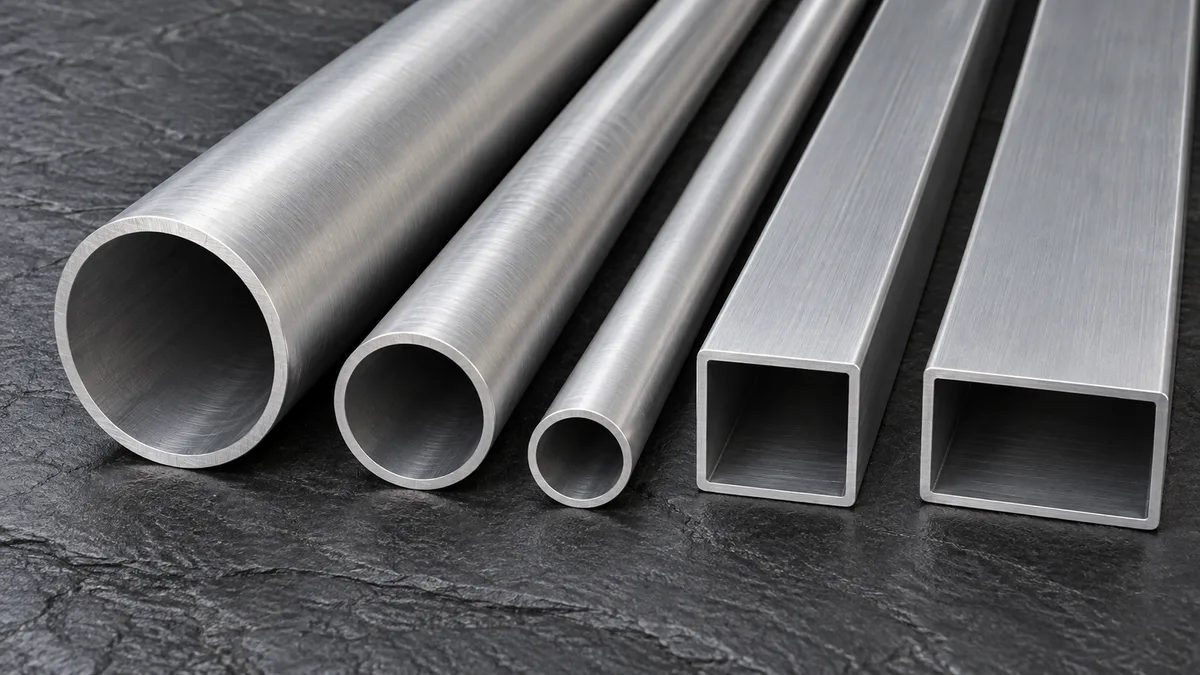
6063 tube is round hollow stock in the "architectural" 6xxx alloy. It is the easiest of the heat-treatable alloys to extrude and draw, giving thin, smooth, bright tube at low cost, with enough strength in T5 or T6 for moderate loads.
Round 6063 tube is made two ways. Extruded tube comes straight from the press, usually press-quenched and aged to T5 or T6, and covers most diameters from about 10 mm upward. Drawn tube is cold-drawn from an extruded hollow, which tightens tolerances, polishes the surface and, in the T832 temper, raises strength close to 6061-T6. Drawn 6063 is common in small diameters for telescopic tubes, antenna sections, instrument tubing and furniture.
Compared with 6061, 6063 has less magnesium and silicon and almost no copper, so its peak strength is lower, but it bends more easily, polishes and anodises more evenly and resists corrosion slightly better. For pipe that must match standard fittings, 6063 is available in nominal pipe sizes to ASTM B241 and B429, and 6063-T6 pipe is widely used for railings and light structural piping.
| Element | Min | Max | Effect |
|---|---|---|---|
| Silicon (Si) | 0.20 | 0.60 | Combines with Mg to form Mg2Si |
| Iron (Fe) | — | 0.35 | Kept low for a bright, even anodised finish |
| Copper (Cu) | — | 0.10 | Kept low for corrosion resistance |
| Manganese (Mn) | — | 0.10 | |
| Magnesium (Mg) | 0.45 | 0.90 | Strengthening element with Si |
| Chromium (Cr) | — | 0.10 | |
| Zinc (Zn) | — | 0.10 | |
| Titanium (Ti) | — | 0.10 | Grain refiner |
| Others each / total | — | 0.05 / 0.15 | |
| Aluminium | Remainder |
Drawn tube in T832 is roughly as strong as 6061-T6 in tension (typical tensile about 290 MPa). Extruded tube values are below.
| Temper / basis | Tensile strength | Yield strength (0.2 %) | Elongation | Hardness |
|---|---|---|---|---|
| O, typical | 90 MPa / 13 ksi | 48 MPa / 7 ksi | 25 % | 25 HB |
| T4, typical | 172 MPa / 25 ksi | 90 MPa / 13 ksi | 22 % | 46 HB |
| T5, typical | 186 MPa / 27 ksi | 145 MPa / 21 ksi | 12 % | 60 HB |
| T6, typical | 241 MPa / 35 ksi | 214 MPa / 31 ksi | 12 % | 73 HB |
| T5, ASTM B221 minimum (≤ 12.5 mm) | 150 MPa / 22 ksi | 110 MPa / 16 ksi | 8 % | — |
| T6, ASTM B221 minimum | 205 MPa / 30 ksi | 170 MPa / 25 ksi | 8 % | — |
| T6, EN 755-2 minimum (wall ≤ 10 mm) | 215 MPa | 170 MPa | 8 % | — |
| T66, EN 755-2 minimum (wall ≤ 10 mm) | 245 MPa | 200 MPa | 8 % | — |
Cooled from the press and artificially aged. The most common architectural temper: adequate strength with the best surface and lowest cost.
Fully solution treated and aged, about 30 % stronger than T5. Chosen when the section carries load, such as handrails or wide-span mullions.
Aged to a slightly lower strength than T5 for better bendability and stability; often used for thermal-break and bent sections.
A European higher-strength variant of T6 obtained by tighter process control, listed in EN 755-2.
Naturally aged; easier to bend and stretch-form, then age to T5 or T6.
Annealed for maximum formability before final shaping.
T832 is a drawn-tube temper: solution heat-treated, cold-worked by a controlled amount and artificially aged. It is listed in ASTM B210 and B483 for drawn 6063 tube.
| System | Designation | Typical tube standard |
|---|---|---|
| ASTM / Aluminum Association | 6063 | ASTM B221 (extruded), B210 (drawn seamless), B241 (seamless pipe), B429 (structural) |
| UNS | A96063 | — |
| Europe | EN AW-6063 (AlMg0.7Si) | EN 755-2 properties; EN 755-8 / EN 755-9 tolerances; EN 12020 precision profiles |
| Germany | 3.3206 | DIN EN 755 |
| Old British | HE9 | BS 1474 (superseded by EN 755) |
| Japan | A6063 | JIS H4100 (shapes), JIS H4080 (tubes) |
| India | 63400 | IS 733 / IS 1285 |
Weight in kg/m = π × (OD − wall) × wall × 2.70 / 1000 (6063 is marginally lighter at 2.69 g/cm³).
| OD × wall (mm) | kg/m | I (cm⁴) | Z (cm³) |
|---|---|---|---|
| 8 × 1 | 0.059 | 0.014 | 0.034 |
| 12.7 × 1.2 | 0.117 | 0.072 | 0.114 |
| 16 × 1 | 0.127 | 0.133 | 0.166 |
| 19.05 × 1.2 | 0.182 | 0.269 | 0.283 |
| 22 × 1.5 | 0.261 | 0.510 | 0.464 |
| 25 × 1.5 | 0.299 | 0.768 | 0.614 |
| 25.4 × 1.6 | 0.323 | 0.851 | 0.670 |
| 32 × 2 | 0.509 | 2.130 | 1.331 |
| 38.1 × 1.6 | 0.495 | 3.061 | 1.607 |
| 42.4 × 2 | 0.685 | 5.192 | 2.449 |
| 50 × 2 | 0.814 | 8.701 | 3.480 |
| 50.8 × 3.2 | 1.292 | 13.614 | 5.360 |
| 63.5 × 3 | 1.540 | 26.153 | 8.237 |
| 76.2 × 3 | 1.863 | 46.285 | 12.148 |
| 101.6 × 3 | 2.509 | 113.035 | 22.251 |
Extruded tube follows ANSI H35.2 or EN 755-7 / 755-8; drawn tube follows ASTM B210 or EN 754-7 and is held to tighter diameter, wall and ovality limits. For telescopic tubes the fit between sizes is critical: specify OD and ID tolerances together, not just OD and wall.
6063 is the reference alloy for decorative anodising: low iron and copper give a clear, uniform film in natural, bronze, black and champagne colours.
Accepts polyester and PVDF coatings to Qualicoat or AAMA 2603/2604/2605 specifications after chromate or chrome-free pre-treatment.
TIG and MIG with ER4043 or ER5356. Strength near the weld falls towards O-temper values, so weld at low-stress points.
Bends more readily than 6061. T5 or T52 tube suits stretch bending and roll bending for curved façades and furniture.
Softer than 6061 and can be gummy in T5; sharp, polished tools and lubricant give the best finish.
Very good resistance in urban and rural atmospheres, and good in coastal locations when anodised or coated.
For handrails, mandrel bending of 6063-T5 or T52 tube to a centreline radius of about 2 – 3 × OD is common; T6 needs larger radii. Polishing before anodising gives the bright "chrome-like" finish used on shower rails and furniture.
| 6063-T5 | 6063-T6 | 6061-T6 | 3003-H14 | |
|---|---|---|---|---|
| Typical yield | 145 MPa | 214 MPa | 276 MPa | 145 MPa |
| Heat-treatable | Yes | Yes | Yes | No |
| Finish / anodising | Excellent | Excellent | Good | Good |
| Bending | Very good | Good | Fair in T6 | Excellent |
| Typical use | Railings, furniture | Light structures | Structural | Heat exchangers, bends |
Yes. 6063-T6 pipe and tube are widely used for handrails and guard rails; the post spacing and wall thickness are set by the governing building code load. For heavy-duty industrial rails, 6061-T6 gives extra margin.
A drawn-tube temper that is solution treated, cold-drawn by a controlled amount and aged. It reaches a typical tensile strength around 290 MPa, close to 6061-T6, while keeping the good finish of 6063.
About 0.30 kg per metre (π × 23.5 × 1.5 × 2.70 / 1000).
Yes. 6063 bends more easily than 6061; T5 or T52 tube suits mandrel bending to about 2 – 3 × OD centreline radius.
Seamless 6063 pipe to ASTM B241 is used for low and moderate pressure duty. For higher pressures, 6061-T6 seamless pipe has higher allowable stresses.
Send OD, wall, temper, finish, length and destination, and we will reply with availability and a delivered price.





