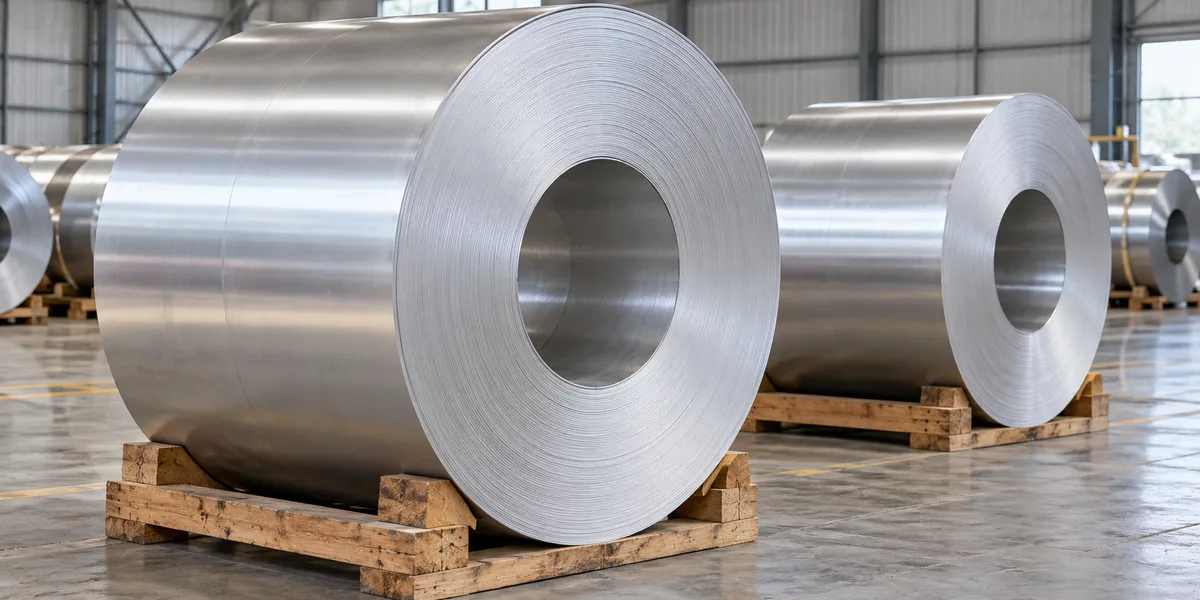
Ultra-wide aluminium means flat-rolled plate, sheet or coil wider than the common 1000 – 1500 mm, typically from 1500 mm up to about 2600 mm for coil and 3000 mm or more for plate. Wider material reduces the number of joints in vehicle skins, tank shells, ship decks, roofs and facades, which saves welding, sealing and weight and improves appearance. This guide covers widths, alloys, coated options and how to buy.
Most service centres stock aluminium sheet in 1000, 1220, 1250 and 1500 mm widths. Anything wider than about 1500 mm is generally called wide or extra-wide, and widths above about 2000 mm are rolled only on wide hot and cold mills. Plate wider than the hot mill's normal output can be produced by cross-rolling, where the slab is turned 90° and rolled across its original width.
The main reason to buy wide material is to eliminate joints. A trailer side wall, a tank shell or a roof panel made from one 2400 mm sheet instead of two 1250 mm sheets has no longitudinal weld or rivet line. That saves fabrication time, removes a potential leak or corrosion path, avoids weld distortion and gives a cleaner surface for painting or graphics.
Wide products come with trade-offs. Fewer mills can roll them, so lead times are longer and minimum lot sizes larger; flatness tolerances are wider for the same thickness; and handling, packing and transport need more care because sheets and coils are heavier and harder to support evenly.
Widths available for a given combination depend strongly on alloy, temper and thickness. Heat-treated plate in T651 is limited by the width of the stretcher used for stress relief, while very thin wide sheet is limited by flatness control. Always confirm the exact width, thickness and temper together before finalising a design around a single sheet.
Production
How ultra-wide plate and coil are produced
Width is decided at the very start of the route. A wide product needs a wide direct-chill cast slab, and that slab must be rolled on a hot mill whose work rolls are long enough to take it. On a reversing hot mill the slab is reduced in several passes, then either finished as plate or passed through a tandem finishing mill and coiled as hot-rolled re-roll stock. Cold rolling then takes the coil to final gauge, with intermediate and final annealing to set the temper.
Rolling wide material evenly is harder than rolling narrow strip. The rolls bend under load, so the strip tends to be thicker at the centre than at the edges, and uneven reduction across the width shows up as wavy edges or centre buckles. Wide mills control this with roll crown, roll bending and cooling across the barrel, and the finished sheet is often tension-levelled to correct remaining shape errors.
Cross-rolling
To make plate wider than the hot mill would normally deliver, the slab is rolled partly in one direction, turned 90°, and rolled across its width. Properties become more uniform in both directions, which also suits some aerospace and armour uses.
Stretching wide plate
Heat-treated plate in T651 or T7451 must be stretched after quenching. The width and force capacity of the stretcher therefore sets the maximum width of stress-relieved plate.
Coating wide coil
Pre-painted wide coil needs a coating line as wide as the strip. Roller-applied primer and top coats are cured in ovens, and the line's width sets the widest coated coil available.
Typical values from Aluminum Association and ASM data for reference only; specified minimum values depend on thickness and the order standard (ASTM B209, ASTM B928 for marine 5xxx, EN 485-2) and are reported on the mill certificate.
Coated products
Wide colour-coated aluminium coil
Wide pre-painted coil is used to roll-form standing-seam roofs and wall cladding with fewer side laps, and as the skin material for wide composite panels. The coating is applied on a continuous coil-coating line, with a primer and top coat on the face side and a backer on the reverse.
Coating
Typical dry film
Character
Typical use
Polyester (PE)
About 18 – 25 µm
Economical, good flexibility
Interior and moderate exterior use, vehicle panels
High-durability polyester (HDP)
About 20 – 25 µm
Better UV and colour retention than PE
Roofing and cladding in sunny climates
PVDF (fluorocarbon)
About 25 – 35 µm (2 – 3 coats)
Excellent UV, chalk and colour retention
Facades and architectural roofs with long warranties
Epoxy / primer systems
Varies
Adhesion and chemical resistance
Backers, insulated panels, special uses
Typical tests on coated coil include T-bend flexibility and adhesion (ECCA methods), solvent (MEK) resistance to confirm cure, neutral salt spray to ASTM B117 and accelerated UV weathering to ASTM G154. Colours are matched to RAL or customer standards, and a protective peel-off film can be applied for fabrication.
2024, 7075 and 7050 wide plate and sheet for skins and large machined parts.
Insulation and packaging
Wide 1xxx and 8xxx foil for roofing underlays, building insulation facings and laminates.
Quality
Tolerances, flatness and inspection
Width tolerances, flatness and edge camber are specified in ASTM B209 (ANSI H35.2) or EN 485-3 / EN 485-4 by thickness and width band. Wider bands carry wider flatness allowances, which matters for visible panels and automated fabrication. If flatness is critical, specify a tension-levelled or stretcher-levelled product and state the limit.
Dimensional: thickness across the width (crown), width, length, squareness and camber
Flatness: wave and edge buckle, especially on thin wide sheet
Surface: roll marks, scratches and coating defects; coated coil checked for colour (ΔE), gloss and film thickness
Mechanical and chemical: tensile, elongation and chemistry per lot
Ultrasonic testing: for thick aerospace and marine plate where required
Documentation: EN 10204 3.1 certificate; class-society certificate where specified for marine plate
Practical advice
Buying wide aluminium: tips and common mistakes
Confirm the width-thickness-temper combinationA width available in 3 mm 5052-H32 may not be available in 1 mm or in T651; check before freezing the design.
Specify coil detailsInside diameter (commonly 508 or 610 mm), maximum coil weight and outside diameter must suit your decoiler.
Plan handlingWide sheets need spreader beams or vacuum lifters; wide coils need suitable saddles and lifting equipment.
Choose packing for the routeEye-to-sky or eye-to-wall coils on wooden skids, plates in reinforced crates, with moisture protection for sea freight.
Agree terms and documentsEXW, FOB, CIF or DAP terms, mill certificate and any third-party or class inspection.
A common mistake is designing a one-piece panel at the absolute maximum width of a mill. Leave a margin for edge trimming and for the width tolerance, and confirm whether the dimension you need is the trimmed width.
Ultra-wide aluminium (aluminum) plate and coil: frequently asked questions
What width is considered ultra-wide for aluminium sheet?
Generally anything wider than about 1500 mm. Wide coil is commonly available up to about 2600 mm, and plate up to around 3000 mm or more using cross-rolling.
Why buy wider aluminium instead of joining two sheets?
One wide sheet removes a weld or rivet line, saving fabrication time, eliminating a potential leak or corrosion path, reducing distortion and improving appearance.
Is wide colour-coated aluminium coil available in PVDF?
Yes. Wide coil can be supplied with polyester, HDP or PVDF coatings, colour-matched to RAL or customer standards, on one or both sides.
Which alloy is used for wide truck and trailer skins?
5052-H32 and 5754 are common for outer skins because they combine strength, formability and corrosion resistance; 3003 is often used for inner linings.
Are tolerances different for wide plate?
Yes. Flatness and width tolerances in ASTM B209 and EN 485 increase with width, so specify levelled material and flatness limits for visible or precision panels.
Can wide plate be supplied with class certification for shipbuilding?
Marine 5083 and 5086 plate can be supplied certified to the classification society named in your order, together with the EN 10204 3.1 mill certificate.
Need wide aluminium plate or coil?
Send alloy, temper, thickness, width, coating and quantity. Our team will confirm availability and quote delivery anywhere in the world.