


Honeycomb Core for Energy Absorption
Crushed along its cell axis, aluminium honeycomb folds progressively at an almost constant force, turning impact energy into permanent deformation over up to about 70 – 75 % of its thickness. That flat, predictable force plateau is why it is used in crash-test barriers, truck-mounted attenuators, rail crash absorbers, landing systems and battery protection. This guide explains how to size an absorber, which core parameters set the crush strength, and what to specify.
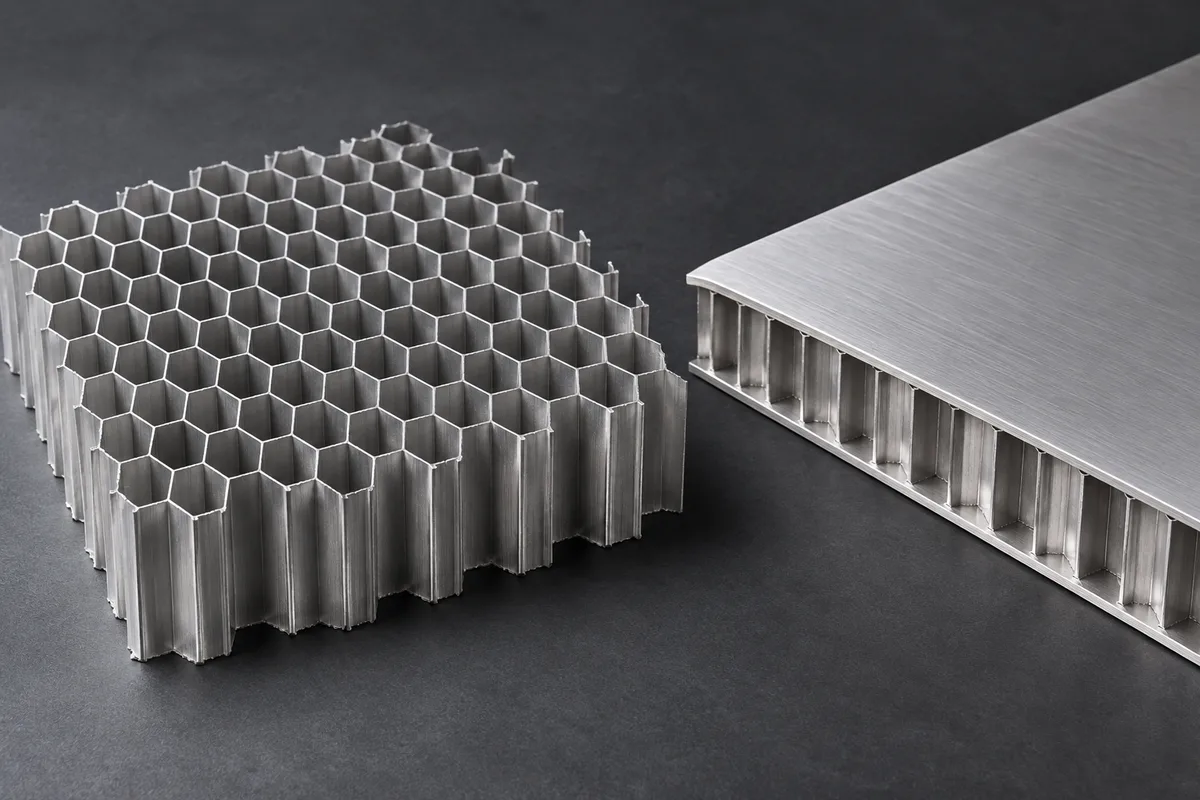
- Core alloys
- 3003, 5052, 5056 aluminium
- Usable stroke
- About 70 – 75 % of thickness
- Force profile
- Near-constant crush plateau
- Key value
- Certified crush strength
How honeycomb absorbs energy
An ideal energy absorber stops a moving mass with the lowest possible peak force, which means applying a constant force over the longest possible distance. Aluminium honeycomb loaded along its cells (the T direction) comes remarkably close to that ideal: after an initial peak, the thin cell walls buckle and fold one layer at a time, and the load stays nearly flat until the folded material starts to stack up.
| Stage | What happens in the core | Force behaviour |
|---|---|---|
| 1. Elastic loading | Cell walls compress elastically | Force rises steeply |
| 2. Initial peak | First row of walls buckles | Peak typically well above the plateau on bare core |
| 3. Progressive crushing | Walls fold in a regular concertina pattern | Near-constant force: the crush strength |
| 4. Densification | Folded layers stack solid at roughly 70 – 75 % stroke | Force rises sharply again |
The energy absorbed is the area under the force–displacement curve, so a flat plateau over a long stroke gives the most energy for the lowest peak deceleration. Because the deformation is plastic, almost none of the energy is returned as rebound, which protects occupants and payloads from a second impulse.
The initial peak in stage 2 is unwanted in most designs. It is removed by pre-crushing: the producer crushes a few millimetres off the block so that the folding pattern is already started. A pre-crushed block begins to crush at the plateau force from the first millimetre, which is why crash-barrier and attenuator specifications normally call for pre-crushed core.
How to size a honeycomb energy absorber
Sizing comes down to three simple equations. Work them through for your case before choosing a core; they tell you the crush strength, area and thickness you need.
Basic sizing relations
- Energy to absorb
- E = ½ m v² (plus m g h for a drop)
- Allowed crush force
- F = m × amax, where amax is the permitted deceleration
- Crush strength needed
- σc = F / A, where A is the loaded core area
- Core thickness needed
- t = E / (σc × A × s), where s is usable stroke ratio, about 0.70 – 0.75
Worked example. A 1,000 kg mass hits at 8 m/s, so E = ½ × 1,000 × 8² = 32,000 J. If the deceleration must stay below 20 g, the force limit is 1,000 × 20 × 9.81 ≈ 196 kN. With a 0.30 m² absorber face, the crush strength needed is 196,000 / 0.30 ≈ 0.65 MPa (about 95 psi). Thickness is then 32,000 / (650,000 × 0.30 × 0.70) ≈ 0.23 m, so a block about 250 mm thick gives a safety margin on stroke.
Real designs add factors for the tolerance on crush strength, the higher crush force at impact speed compared with a slow test, off-axis loading and temperature. Final confirmation always comes from a dynamic test on the real absorber.
| Design variable | If you increase it | Effect |
|---|---|---|
| Crush strength | Higher force, shorter stroke | Higher deceleration on the protected mass |
| Loaded area | Higher force at the same core | Use to reach force targets without changing core grade |
| Core thickness | Longer stroke | More energy at the same force; more packaging space |
| Stacked or graded blocks | Stepped force levels | Soft first stage for small impacts, stiffer stage for severe ones |
What sets the crush strength of aluminium honeycomb
Crush strength is controlled by the same parameters that define any honeycomb: alloy, cell size and foil thickness, which together set density. For the same alloy, crush strength rises faster than density, roughly with density to the power 1.5 – 1.7, so small changes in foil gauge or cell size move the plateau force considerably.
| Parameter | Typical options | Effect on crush behaviour |
|---|---|---|
| Foil alloy | 3003 (economical), 5052 (standard), 5056 (strongest) | Higher-strength foil raises crush strength at the same density |
| Cell size | About 3 mm to 19 mm across flats | Smaller cells give a smoother, more uniform plateau; larger cells for low strengths |
| Foil thickness | About 0.018 – 0.1 mm | Thicker foil raises density and crush strength |
| Density | From under 30 kg/m³ to around 190 kg/m³ in standard ranges | Best single predictor of crush strength |
| Pre-crush | Bare or pre-crushed | Pre-crushing removes the initial peak |
| Load direction | Along cells (T) versus off-axis | Crush strength and stroke fall as load angle grows |
Producers certify energy-absorbing core to a nominal crush strength with a tolerance band, and barrier standards set tight limits. The US offset deformable barrier in 49 CFR Part 587, for example, specifies a main honeycomb block of 3003 aluminium with 0.342 MPa crush strength and a bumper element of 1.711 MPa, and the same two strength levels appear in European barrier specifications. Because lot-to-lot variation is real, ask for crush-strength certification on samples cut from the actual production block.
Where honeycomb energy absorbers are used
| Sector | Typical absorber | What matters most |
|---|---|---|
| Vehicle crash testing | Offset and full-width deformable barriers, mobile deformable barriers | Certified crush strength in narrow tolerance, consistent block to block |
| Roads and highways | Truck-mounted attenuators (TMA) and crash cushions | Repeatable stopping force tested to road-safety protocols such as AASHTO MASH or EN 1317 |
| Rail vehicles | Anti-climbers, primary and secondary crash absorbers in the cab front | Defined force levels per crash scenario, designed to EN 15227 crashworthiness requirements |
| Aerospace and space | Crushable landing-gear cartridges, landing pads, seat and subfloor absorbers | Maximum energy per kilogram, single-use reliability |
| Electric vehicles | Battery underbody guards and side-impact layers | Protection of cells from intrusion with minimum mass and height |
| Industrial and logistics | Machine end stops, airdrop and equipment cushioning pads, elevator buffers | Simple sizing, low cost, easy replacement |
The Apollo lunar module landing gear famously used crushable aluminium honeycomb cartridges in its struts, and the same principle is used today in reusable launch-vehicle and lander concepts. In each case the absorber is a one-shot device: once crushed, the honeycomb is replaced.
Honeycomb compared with other energy absorbers
| Absorber type | Force profile | Energy per kg | Strengths | Limitations |
|---|---|---|---|---|
| Aluminium honeycomb | Flat plateau after pre-crush | Very high | Tunable, certifiable, predictable along one axis | Weak off-axis; single use |
| Aluminium foam | Plateau, more gradual | High | Takes multi-directional loads; fills shapes | Wider property scatter; lower efficiency than honeycomb |
| Thin-walled tubes and crash boxes | Oscillating around a mean force | High | Integral with vehicle structure; carries normal loads | Needs triggers to control folding |
| Polymer foams | Rising, partly elastic | Moderate | Low cost, multi-impact grades exist | Rebound, temperature and ageing sensitivity |
| Hydraulic dampers | Speed-dependent | Low (heavy) | Reusable | Mass, cost, maintenance |
Honeycomb wins where the load direction is known and the highest energy per kilogram matters. Aluminium foam or extruded crash boxes are often combined with it: the crash box carries everyday loads and guides the impact, while a honeycomb insert sets a precise force level. See the aluminium foam panel page for the cellular-metal alternative.
Design and integration tips
- Keep the load axial. Guide the impact so it travels along the cells; off-axis loading lowers crush force and can make the block tip or shear.
- Use pre-crushed core unless you deliberately need the initial peak, for example as a breakaway trigger.
- Allow for rate effects. Dynamic crush force is somewhat higher than static; test at representative impact speed or use the producer's dynamic factor.
- Do not count on the last quarter. Plan usable stroke at about 70 % of thickness; beyond that the core densifies and force rises sharply.
- Back the core properly. Bond or mechanically retain blocks on a stiff aluminium plate so the reaction does not deform the mounting.
- Protect against moisture with coated foil or sealed housings in outdoor attenuators and rail fronts.
- Grade the stack with a softer first block and stiffer second block when the same absorber must handle both minor and severe impacts.
Supply forms, testing and what Metline provides
Metline supplies aluminium honeycomb for energy absorption in 3003, 5052 and 5056 foil, as blocks cut to size, pre-crushed blocks, stacked or graded assemblies, and cores bonded to aluminium plates or sheet. Shapes can be cut to drawing, including tapered and stepped blocks.
- Define the dutyMass, impact speed, deceleration limit, available space and load direction, or simply the target crush strength and block size.
- Select the coreAlloy, cell size and foil chosen to hit the crush strength; we confirm density and available block sizes.
- Agree certificationStatic crush testing of samples from the production block (compression per ASTM C365-type set-up), with dynamic tests where required.
- ProcessCutting, pre-crushing, stacking and bonding to aluminium backing plates as specified.
- Document and shipTest report, material certificates and packing that protects cell edges from accidental crushing.
References and standards
- 49 CFR Part 587 – Deformable Barriers (offset deformable barrier honeycomb specification)
- EN 15227 – Railway applications: crashworthiness requirements for rail vehicles
- AASHTO Manual for Assessing Safety Hardware (MASH)
- ASTM C365 – Flatwise Compressive Properties of Sandwich Cores
- SAE AMS-C-7438 – Core Material, Aluminum, for Sandwich Construction
Energy-absorbing aluminium (aluminum) honeycomb: FAQ
What is honeycomb crush strength?
It is the average stress on the loaded area while the core is crushing steadily along its cells, after the initial peak. It is the value used to size absorbers, and it is certified on samples from the production block.
How much of the thickness can be crushed?
Plan on about 70 – 75 % of the original thickness. After that the folded walls stack up and the force rises steeply.
What does pre-crushed honeycomb mean?
The producer crushes a small depth off the block so the folding pattern is already started. A pre-crushed block crushes at its plateau force from the start, with no initial peak load.
Which aluminium alloy is used for crash barriers?
3003 aluminium honeycomb is specified for the main block and bumper element of standard offset deformable barriers, for example in 49 CFR Part 587. 5052 and 5056 are used where higher strength per unit weight is needed.
Can honeycomb absorbers be reused?
No. Crushing is permanent plastic deformation. The crushed section must be replaced, which is why absorbers are usually designed as replaceable cartridges or blocks.
How do I choose between a higher crush strength and a thicker block?
The deceleration limit sets the maximum force, which with the available area fixes crush strength. Thickness then follows from the energy. If space is short, increase area rather than crush strength, so the force stays within the limit.
Designing a crash or impact absorber?
Send the mass, speed, deceleration limit and space envelope, or your target crush strength. We will propose a core and quote certified blocks.





