7075-T6
Solution treated at about 465 – 480 °C, quenched and aged near 120 °C. Maximum strength; acceptable for thin, simple forgings without sustained short-transverse stress.



7075 aluminium forgings deliver the highest strength of the common forging alloys, with grain flow that follows the part for better fatigue life and toughness than machined plate. They are used for aircraft fittings, landing-gear and wing components, defence hardware and high-performance motorsport parts. Metline supplies 7075 die forgings, hand forgings, rolled rings and discs in T6, T73 and T7352, certified to AMS, ASTM and EN, to customers worldwide.
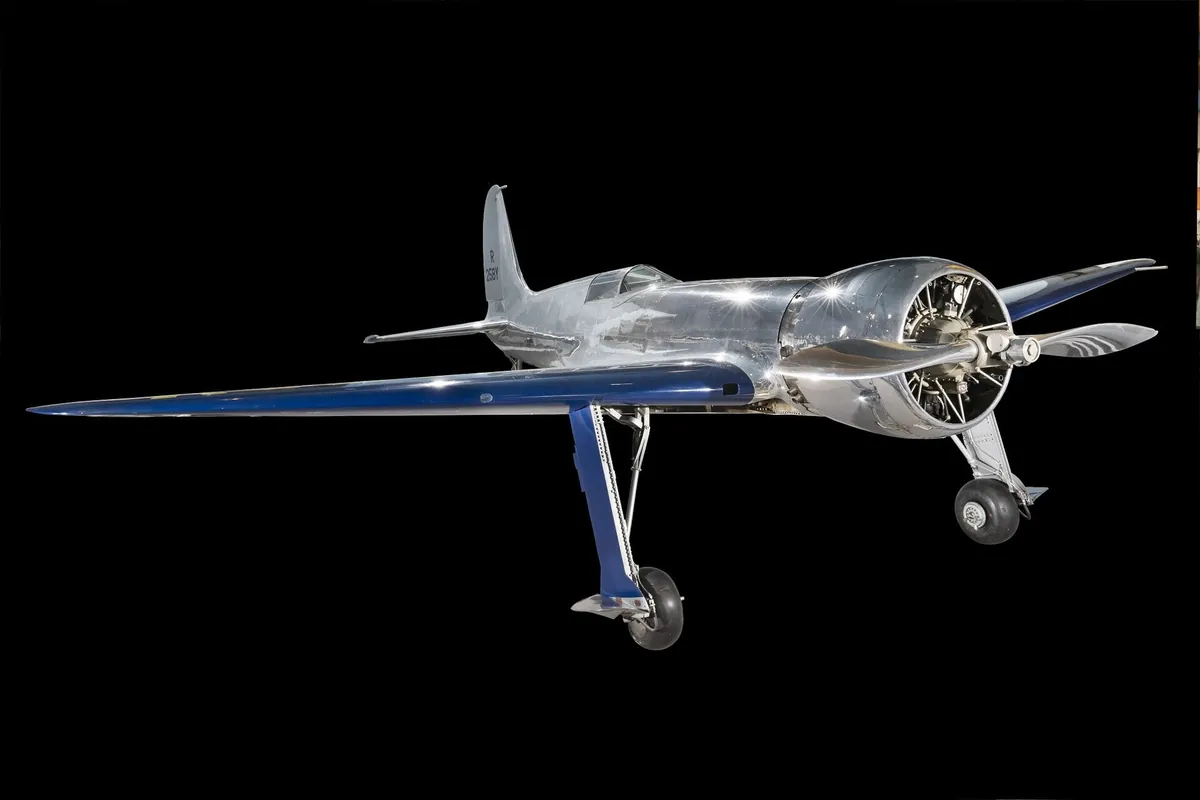
7075 contains about 5.6 % zinc, 2.5 % magnesium and 1.6 % copper. In the peak-aged T6 condition it reaches tensile strengths above 500 MPa, so a 7075 forging can replace a steel part at roughly a third of the weight in many moderately loaded applications.
7075 is harder to forge than 6061 or 2014. Its forging window is narrow (roughly 380 – 440 °C), it needs higher press loads and it is sensitive to cracking if the metal cools on the dies. In exchange, forging gives what 7075 most needs: a refined, unrecrystallised grain structure aligned with the part, which improves fatigue strength and greatly reduces the short-transverse weakness that makes thick 7075 plate vulnerable to stress-corrosion cracking.
The temper decision matters more for 7075 forgings than for almost any other product. T6 gives maximum strength but poor resistance to stress-corrosion cracking (SCC) when residual or assembly stresses act across the grain. That is why most structural aircraft forgings in 7075 are ordered in the over-aged T73 family, and why newer designs often move to 7050 or 7175 in T74. Our job is to make sure the temper on the order matches how the part will actually be loaded and exposed.
Aluminum Association limits, used by AMS, ASTM B247 and EN 573-3 (EN AW-7075). The high-purity variant 7175 has tighter Fe and Si limits for better toughness in forgings.
| Element | Minimum | Maximum | What it does |
|---|---|---|---|
| Zinc (Zn) | 5.1 | 6.1 | Main strengthener with Mg |
| Magnesium (Mg) | 2.1 | 2.9 | Forms MgZn2 precipitates |
| Copper (Cu) | 1.2 | 2.0 | Adds strength and SCC resistance |
| Chromium (Cr) | 0.18 | 0.28 | Restricts recrystallisation during forging and heat treatment |
| Silicon (Si) | — | 0.40 | Impurity |
| Iron (Fe) | — | 0.50 | Impurity |
| Manganese (Mn) | — | 0.30 | |
| Titanium (Ti) | — | 0.20 | Grain refiner |
| Others, each / total | — | 0.05 / 0.15 | |
| Aluminium (Al) | Remainder |
Typical values below are for wrought 7075 in each temper and represent the longitudinal grain-flow direction. Forging specifications set lower guaranteed minimums that depend on section thickness and test direction; the second group of rows shows commonly cited ASTM B247 longitudinal minimums for thinner die forgings.
| Condition | Tensile strength | Yield strength (0.2 %) | Elongation |
|---|---|---|---|
| 7075-T6, typical | 572 MPa / 83 ksi | 503 MPa / 73 ksi | 11 % |
| 7075-T73, typical | 505 MPa / 73 ksi | 435 MPa / 63 ksi | 13 % |
| 7075-T6 die forging, minimum (up to about 25 mm) | 517 MPa / 75 ksi | 441 MPa / 64 ksi | 7 % |
| 7075-T73 die forging, minimum (up to about 75 mm) | 455 MPa / 66 ksi | 386 MPa / 56 ksi | 7 % |
Minimums for hand forgings and rolled rings, for thicker sections and for transverse directions are lower. The applicable values are stated in the order specification and on the certificate.
Solution treated at about 465 – 480 °C, quenched and aged near 120 °C. Maximum strength; acceptable for thin, simple forgings without sustained short-transverse stress.
T6 with 1 – 5 % cold compression before ageing to relieve quench stress; for hand forgings to be heavily machined.
Two-step over-ageing (lower then higher temperature). About 10 – 15 % less strength than T6 but high resistance to SCC and exfoliation. Standard for aircraft die forgings.
T73 with compressive stress relief. The usual temper for 7075 hand forgings and rolled rings that will be machined deeply.
An intermediate over-aged temper with better strength than T73 and good SCC resistance; also used for 7175 and 7050 forgings.
Over-aged tempers are verified by eddy-current conductivity together with hardness, because over-ageing raises conductivity measurably.
| Standard / system | Designation or scope |
|---|---|
| SAE AMS 4126 | 7075-T6 die forgings, hand forgings and rolled rings |
| SAE AMS 4141 | 7075-T73 die forgings |
| AMS-QQ-A-367 / AMS-A-22771 | General aluminium forging requirements and heat treatment of forgings |
| ASTM B247 / B247M | Die forgings, hand forgings and rolled ring forgings for general and aerospace use |
| EN 586-1/-2/-3 | Forgings, EN AW-7075 (AlZn5.5MgCu) |
| UNS / Werkstoff | A97075 / 3.4365 |
| JIS | A7075 forgings to JIS H4140 |
Aircraft forgings are usually bought to the airframer's own material specification, which references these documents. Tell us the full specification and revision; we will confirm compliance before quoting rather than assume equivalence.
Near-net fittings, brackets, links and housings with grain flow following the contour.
Rectangular and stepped blocks in T7352 for machining complex fittings.
Seamless rings for engine mounts, gear blanks and frames.
Upset discs for wheels, flanges and covers.
Large-section bar and stepped shafts beyond the range of extruded bar.
Rough- or finish-machined forgings to drawing, with inspection reports.
Feasible sizes depend on shape, temper and specification. Send a drawing for a forging proposal.
Excellent machinability with sharp carbide tools; stress-relieved T652 and T7352 forgings move least during deep pocketing.
Not fusion weldable. Use fasteners, interference fits or adhesive bonding.
Sulphuric or chromic acid anodising, hard anodising for wear surfaces, conversion coating and primer for aircraft parts.
Commonly applied to fatigue-critical forgings to introduce compressive surface stress.
| Property | 7075-T73 | 7050-T74 | 2014-T6 | 6061-T6 |
|---|---|---|---|---|
| Strength | High | Higher in thick sections | High | Medium |
| Quench sensitivity (thick sections) | High | Low | Moderate | Moderate |
| SCC resistance | Very good | Very good | Low – moderate | Very good |
| Forgeability | Fair | Fair | Good | Excellent |
| Relative cost | High | Very high | Medium | Low |
For forgings thicker than about 75 – 100 mm, 7050 keeps its strength through the section better than 7075 because it is less quench-sensitive. 2014 is a cheaper high-strength option for less critical parts, and 6061 is the right choice when corrosion resistance and weldability matter more than strength. See also the 6061 vs 7075 comparison.
Choose T73 (or T7352 for hand forgings and rings) whenever the part sees sustained tensile stress across the grain or a corrosive environment. T6 gives about 10 – 15 % more strength but is prone to stress-corrosion cracking in thick sections.
Both are over-aged for SCC resistance. T7352 forgings are also cold-compressed after quenching to relieve residual stress, so they stay stable during machining.
Peak strength is similar, but the forging's grain flow follows the part, which improves fatigue life, toughness and short-transverse properties. That often allows a lighter design.
No, not by conventional fusion welding. Design joints for fasteners or bonding.
For thick sections, usually above about 75 – 100 mm, where 7050's lower quench sensitivity gives higher strength and toughness at the centre of the part.
Yes. Ultrasonic inspection to AMS-STD-2154 class AA, A or B can be specified, with reports supplied alongside the mill certificate.
Send the drawing, temper and specification. We will propose a forging route, inspection plan and delivered price.





