Cutting and machining
Large profiles are saw-cut to length and CNC machined for holes, pockets and end preparations. 6061 and 6082 in T6 machine cleanly; 6063 is softer and gummier.



Large aluminium extrusions are profiles whose cross-section is too wide, too heavy or too long for ordinary extrusion presses: interlocking floor planks up to about 750 mm wide, rail car body panels, battery-tray side members, heavy T-slot beams and bridge deck sections. They let designers replace welded or bolted assemblies with one continuous, accurate part. This guide covers what defines a large extrusion, the alloys used, design rules and how to specify one.
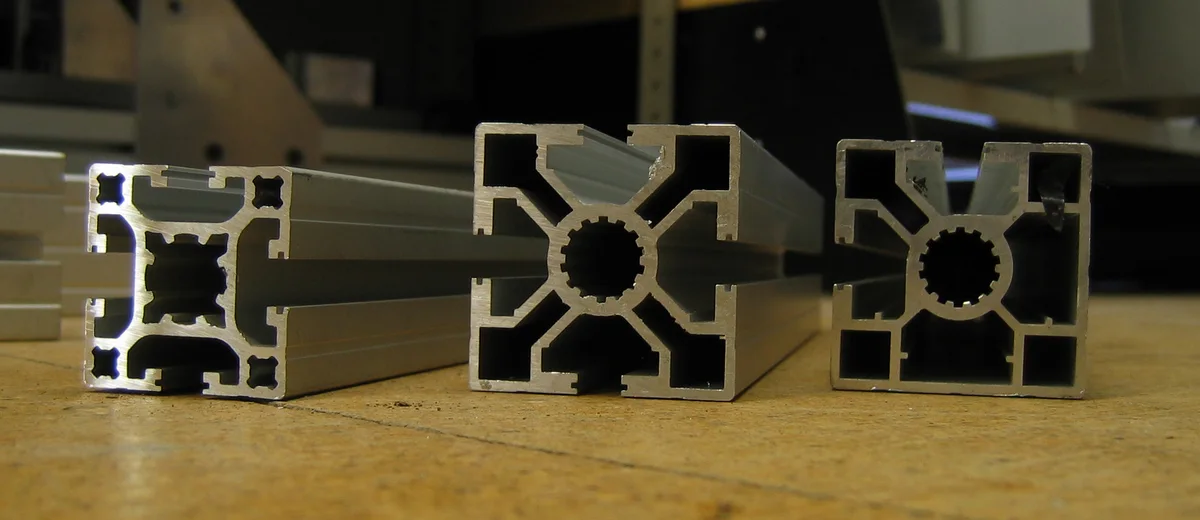
The size of an extrusion is measured by its circumscribing circle diameter (CCD): the smallest circle that fully encloses the cross-section. Most commercial profiles fit inside a circle of about 300 mm, and the majority of extrusion presses are built for that range.
A profile becomes a large extrusion when it exceeds what standard presses can make in one or more of four ways: width (flat panels and floor planks wider than about 300 mm), CCD (hollow sections and heavy beams needing a circle of 400 – 800 mm or more), weight per metre (thick-walled structural sections weighing tens of kilograms per metre) and length (single pieces of 12 – 25 m for rail cars and trailers). The Aluminum Extruders Council notes that a few extruders can produce profiles with a CCD as large as about 800 mm (32 in), compared with the 300 mm (12 in) or less that covers most work.
Large sections need heavy presses with large billet containers, because the press force has to push a big billet through a wide die while keeping metal flow even across the whole section. Wide, thin profiles are the hardest case: the die must feed metal uniformly to the edges, and cooling must be controlled so the panel stays flat and straight.
Almost all large profiles are made from 6xxx alloys, which extrude well, respond to press quenching and weld readily. 7xxx alloys are used where higher strength justifies slower extrusion speeds and more careful processing.
| Alloy and temper | Minimum tensile strength | Minimum yield strength | Where it is used |
|---|---|---|---|
| 6063-T6 (ASTM B221) | 205 MPa / 30 ksi | 170 MPa / 25 ksi | Heat sinks, motor housings, architectural and lightly loaded wide panels |
| 6005A-T6 (EN 755-2, wall ≤ 5 mm) | 270 MPa | 225 MPa | Rail car bodies, trailer floors, bridge decks: thin-walled hollow panels |
| 6061-T6 (ASTM B221) | 260 MPa / 38 ksi | 240 MPa / 35 ksi | Battery trays, heavy T-slot beams, machine frames, container floors |
| 6082-T6 (EN 755-2, wall ≤ 5 mm) | 290 MPa | 250 MPa | Structural beams, trailer chassis members, offshore and crane structures |
| 7005 / 7020 (T6) | Higher than 6xxx | Higher than 6xxx | Welded high-strength structures, rail and defence vehicles |
| 7075, 7050, 2024 | Very high | Very high | Aerospace stringers, spars and beams (AMS specifications) |
Minimums for 6005A and 6082 are for open and hollow profiles up to 5 mm wall to EN 755-2; values change by wall thickness band and are shown on the mill certificate. For 7xxx and 2xxx grades, properties depend on temper and section size; refer to the governing AMS or EN specification.
Large extrusions are usually press-quenched (T5 or T6 after on-line water or air quenching). For thick sections, the quench rate at the centre of the wall is lower, so alloys with good quench sensitivity, such as 6005A and 6063, are preferred for thin-walled wide panels, and 6082 and 6061 for heavier walls where strength matters.
| Profile type | Typical alloys and tempers | Typical size range | Key requirement |
|---|---|---|---|
| Interlocking trailer and truck floor planks | 6061-T6, 6082-T6, 6005A-T6 | Up to about 750 mm wide; full trailer lengths | Wear and impact resistance, flat interlock |
| Container and reefer floor profiles | 6061-T6, 6063-T6, 6082-T6 | Wide T-bar or duct floors | Airflow channels, low-temperature toughness |
| Rail car body panels (side walls, roofs, floors) | 6005A-T6, 6082-T6, 7005 | 100 – 550 mm wide double-skin panels, 12 – 25 m long | Thin walls, flatness, friction stir weldability |
| EV battery tray side and cross members | 6061-T6, 6063-T6, 6082-T6 | Multi-hollow sections | Crash energy absorption, weld seams, coolant channels |
| Heavy T-slot framing beams | 6063-T5/T6, 6061-T6, 6005-T6 | 80 × 160 to 300 × 300 mm | Straightness and slot accuracy for machine bases |
| Water-cooled motor housings | 6063, 6061 | Large hollow sections with cooling channels | Thermal conductivity, leak-tight channels |
| Large heat sinks | 6063-T5/T6, 6061-T6 | Wide bases with tall fins | High fin ratio, flat base |
| Bridge deck and pedestrian bridge profiles | 6005A-T6, 6061-T6, 6082-T6 | Wide hollow deck planks | Fatigue, weldability, low maintenance |
| Aerospace stringers and beams | 7075, 7050, 7475, 2024 | Widths about 100 – 500 mm | Fatigue and fracture toughness, AMS certification |
| Construction formwork panels | 6061-T6, 6082-T6 | Wide ribbed panels | Stiffness, durability over many reuse cycles |
Hollow panels for rail and bridge decks are usually designed as double-skin truss sections: two thin outer skins linked by diagonal webs. The truss makes the panel stiff in bending while keeping walls thin, and adjacent panels are joined by friction stir welding, which avoids the strength loss and distortion of fusion welding in long seams.
Tolerances on extrusions scale with size: the bigger the CCD, the wider the standard band for dimensions, straightness, twist and flatness. Agree any tighter values before tooling is made.
For long profiles, straightness is often the critical tolerance. Ask for straightness per metre and over the total length, and agree how it will be measured (on a flat table, with the profile unrestrained).
Large profiles are saw-cut to length and CNC machined for holes, pockets and end preparations. 6061 and 6082 in T6 machine cleanly; 6063 is softer and gummier.
MIG and TIG with ER4043 or ER5356 filler, or friction stir welding for long panel seams. Design for reduced strength in the heat-affected zone.
6063 and 6060 give the most uniform anodised appearance; 6061 and 6082 anodise well for protective coatings.
Wide panels and frames are often powder coated or painted after pre-treatment, especially in architectural and transport uses.
Large sections can be stretch-bent or roll-bent in T4 and aged afterwards to reach T6 strength.
Long and heavy profiles are bundled with spacers, wrapped and crated or loaded on flat racks for sea freight.
Most presses make profiles that fit within about 300 mm. Large presses produce wide flat panels and floor planks up to about 750 mm, and hollow sections within circumscribing circles of roughly 600 – 800 mm. Feasibility depends on alloy, wall thickness and shape, so send the drawing for review.
6005A for thin-walled wide panels such as rail car bodies and decks, 6082 or 6061 for heavier load-bearing sections, and 6063 for heat sinks and architectural sections. 7xxx alloys are chosen when higher strength is needed.
Standard lengths are typically 6 – 12 m. Large presses with long run-out tables can supply single profiles of up to about 25 m for trailers and rail vehicles; transport and handling also limit length.
Usually yes, unless a matching existing profile is available. Die cost rises with size and complexity but is spread over the production quantity.
EN 755-9 or ANSI H35.2 standard tolerances apply unless the drawing specifies otherwise. Bands widen as the circumscribing circle grows; tighter tolerances can be agreed for critical features.
Yes. Metline supplies large profiles cut to length and, on request, machined, with EN 10204 3.1 certificates and export packing for delivery worldwide.
Share the profile drawing, alloy, length and quantity. We will review feasibility and reply with a quotation.





