6061-O
Fully annealed and as ductile as 6061 gets. Choose O for complex cold heading, tight wire forms and deep upsetting, then solution treat and age the finished parts to T6.



6061 aluminium wire is drawn from the most widely used heat-treatable Al-Mg-Si alloy, giving about twice the strength of 1100 or 3003 wire with good corrosion resistance. It is the standard stock for structural rivets, cold-headed pins and fasteners, and formed or machined small parts. Metline supplies 6061 wire and rod in coils and straight lengths, in soft and heat-treated tempers, certified to ASTM, AMS and EN standards for customers worldwide.
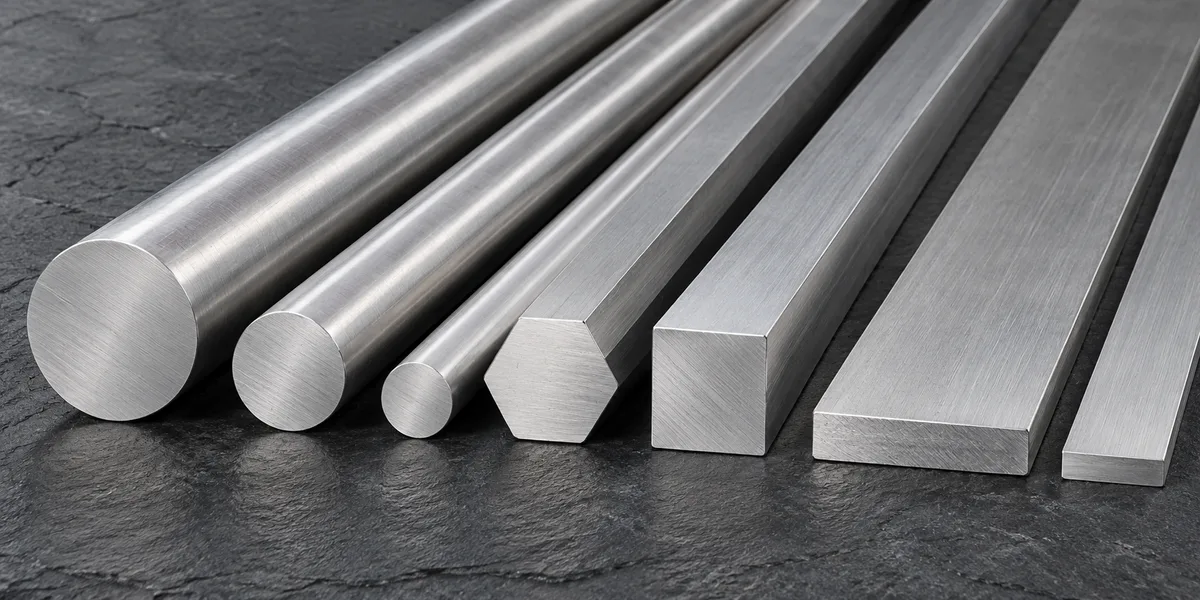
6061 wire is cold-drawn from extruded or rolled redraw rod through a series of dies until it reaches the finished diameter. Because 6061 is heat-treatable, the same wire can be delivered soft for heading and forming, or solution heat-treated and aged to T6 for strength. That flexibility is the main reason it is chosen over the non-heat-treatable 1xxx, 3xxx and 5xxx wire alloys.
The alloy contains roughly 1 % magnesium and 0.6 % silicon, which form magnesium silicide (Mg2Si) during ageing, plus small amounts of copper for strength and chromium for grain control and resistance to stress corrosion. In wire form this gives a typical tensile strength of about 310 MPa in T6, good atmospheric and fresh-water corrosion resistance, and a surface that anodises cleanly.
Most 6061 wire ends up as rivets, pins and cold-headed parts, where it is valued for a predictable shear strength and a forgiving heading response in the softer tempers. Drawn 6061 rod in the upper diameter range is also fed into automatic lathes and screw machines for small turned components, although free-machining grades such as 2011 or 6262 are faster where the part does not need 6061's corrosion resistance.
These are the registered Aluminum Association limits, also used by ASTM B211, ASTM B316 and EN 573-3 (EN AW-6061). The mill test certificate for each lot reports the actual analysis.
| Element | Minimum | Maximum | Effect in wire |
|---|---|---|---|
| Silicon (Si) | 0.40 | 0.80 | Forms Mg2Si with magnesium for age hardening |
| Iron (Fe) | — | 0.70 | Impurity; lower iron improves drawability and heading |
| Copper (Cu) | 0.15 | 0.40 | Raises strength after ageing |
| Manganese (Mn) | — | 0.15 | Minor grain control |
| Magnesium (Mg) | 0.80 | 1.20 | Main strengthening element |
| Chromium (Cr) | 0.04 | 0.35 | Restricts grain growth during solution treatment; aids stress-corrosion resistance |
| Zinc (Zn) | — | 0.25 | Impurity |
| Titanium (Ti) | — | 0.15 | Grain refiner from casting |
| Others, each / total | — | 0.05 / 0.15 | |
| Aluminium (Al) | Remainder | About 95.8 – 98.6 % |
Typical values show what the alloy normally achieves; the specified minimum is what the standard guarantees and what designers should use. Small wire diameters are tested in full section, so results can differ slightly from figures measured on machined bar specimens.
| Temper | Tensile strength | Yield strength (0.2 %) | Shear strength | Typical use |
|---|---|---|---|---|
| O (annealed), typical | 125 MPa / 18 ksi | 55 MPa / 8 ksi | 83 MPa / 12 ksi | Severe forming, heading before heat treatment |
| T4, typical | 240 MPa / 35 ksi | 145 MPa / 21 ksi | 165 MPa / 24 ksi | Rivets driven then naturally or artificially aged |
| T6, typical | 310 MPa / 45 ksi | 276 MPa / 40 ksi | 207 MPa / 30 ksi | Finished pins, rivets, machined parts |
| T6, specified minimum (ASTM B211) | 290 MPa / 42 ksi | 240 MPa / 35 ksi | — | Design basis for rolled or drawn rod and wire |
| T89 / T94 (cold-worked after treatment) | Higher than T6 | Higher than T6 | — | High-strength wire and rivet stock; limits per ASTM B211 |
Typical values from Aluminum Association and ASM data. Specified minimums and elongation requirements vary with diameter; the exact figures for your lot appear on the mill certificate.
Temper choice for wire is mainly a question of when the part is shaped. Heading, bending and coiling are easiest before the final heat treatment; strength comes afterwards.
Fully annealed and as ductile as 6061 gets. Choose O for complex cold heading, tight wire forms and deep upsetting, then solution treat and age the finished parts to T6.
A light draw after annealing, typical of rivet and cold-heading stock under ASTM B316. The slight work hardening gives straighter wire that feeds well through headers while keeping enough ductility to form a head.
Solution heat-treated and naturally aged. Rivets can be driven in T4 and will gain some strength with time; artificial ageing then brings them to T6.
Solution treated and artificially aged for full strength. The normal temper for pins, dowels, shafts, machined parts and rivets that are driven cold in the hardened condition.
Heat treated, then cold drawn (and in T89, aged) to push strength above T6. Used where a small diameter must carry more load, at the cost of lower ductility.
Tell us how the wire will be shaped and what the finished part must carry. We will recommend a temper and confirm which standard it can be certified to.
Wire and small rod are covered by different specifications from plate or extrusions, so quote the standard written for the product you are buying. An alloy number alone does not define tolerances, test methods or temper limits.
| System | Designation | Wire / rod standard |
|---|---|---|
| ASTM (rolled or cold-finished) | 6061 | ASTM B211 / B211M: bar, rod and wire |
| ASTM (rivet and cold heading) | 6061 | ASTM B316 / B316M: rivet and cold-heading wire and rod |
| ASTM (extruded) | 6061 | ASTM B221 for extruded wire and rod |
| Aerospace (SAE) | 6061-O / T4 / T6 | AMS 4115, AMS 4116, AMS 4117 (rolled or cold-finished); AMS-QQ-A-225/8 |
| UNS | A96061 | — |
| European (EN) | EN AW-6061 / EN AW-AlMg1SiCu | EN 1301-1/-2/-3 (drawn wire); EN 754 (cold-drawn rod and bar); EN 573-3 |
| German Werkstoff | 3.3211 | DIN EN 754, DIN EN 1301 |
| ISO | AlMg1SiCu | ISO 209 (composition) |
| Japan (JIS) | A6061W (wire), A6061BD (drawn bar) | JIS H4040 |
| India (IS) | 65032 | IS 733 (wrought bar, rod and sections) |
Coil weight and inner diameter are agreed to suit the customer's header or straightener.
Round 6061 wire weighs 2.12 kg per kilometre for each square millimetre of diameter squared (kg/km = 2.12 × d²). The table gives quick reference figures; the bar and rod weight calculator handles any size.
| Diameter (mm) | Cross-section (mm²) | Weight (kg per 1000 m) | Length per kg (m) |
|---|---|---|---|
| 1 | 0.79 | 2.12 | 471.6 |
| 1.5 | 1.77 | 4.77 | 209.6 |
| 2 | 3.14 | 8.48 | 117.9 |
| 2.5 | 4.91 | 13.25 | 75.5 |
| 3 | 7.07 | 19.09 | 52.4 |
| 3.5 | 9.62 | 25.98 | 38.5 |
| 4 | 12.57 | 33.93 | 29.5 |
| 4.8 | 18.10 | 48.86 | 20.5 |
| 5 | 19.63 | 53.01 | 18.9 |
| 6 | 28.27 | 76.34 | 13.1 |
| 6.35 | 31.67 | 85.51 | 11.7 |
| 8 | 50.27 | 135.72 | 7.4 |
| 9.5 | 70.88 | 191.38 | 5.2 |
| 10 | 78.54 | 212.06 | 4.7 |
| 12 | 113.10 | 305.36 | 3.3 |
Drawn wire is held to much tighter diameter tolerances than extruded rod, which matters for header dies and rivet holes. Unless your order states otherwise, tolerances follow the tables of the governing specification.
Head in O, H13 or freshly quenched (W) condition for the most demanding upsets. T6 wire heads well for simple, shallow heads. Keep header dies polished and use a suitable lubricant to avoid pick-up.
6061 rivets are usually driven cold in T6, or driven in T4 and aged. They suit 6xxx and 5xxx structures because the similar chemistry avoids galvanic problems seen with steel fasteners.
T6 wire bends to about 1.5 – 2 × diameter without cracking; O temper can be bent flat on itself. For springs or tight forms, shape soft and heat-treat after.
Solution treat at about 530 °C, quench rapidly in water, then age at about 160 – 175 °C for 8 – 18 hours to reach T6. Quench delay must be short in fine wire, which cools and loses temperature quickly.
Drawn T6 rod turns cleanly with sharp carbide or high-speed steel tools. Chips are longer than with free-machining grades, so use chip breakers on automatic lathes.
Takes clear and coloured anodic coatings well. When 6061 parts are welded, use ER4043 or ER5356 filler; the heat-affected zone drops to roughly T4 strength unless re-treated.
For overhead power conductors, the electrical grade 6201 is used instead: it offers higher conductivity (about 52.5 % IACS) with similar strength, whereas 6061 is chosen for mechanical duty.
| Property | 6061-T6 | 5056-H32 | 2024-T4 | 3003-H14 |
|---|---|---|---|---|
| Typical tensile strength | 310 MPa | 305 MPa | 470 MPa | 150 MPa |
| Typical yield strength | 276 MPa | 240 MPa | 325 MPa | 145 MPa |
| Heat-treatable | Yes | No | Yes | No |
| Corrosion resistance | Good | Excellent (marine) | Fair (needs protection) | Very good |
| Heading / forming | Good in O, H13, T4 | Good | Must be driven fresh or refrigerated | Excellent |
| Typical use | Structural rivets, pins, forms | Rivets for magnesium, mesh, zippers | Aerospace rivets (DD type) | Low-stress forms, decorative work |
Choose 6061 when you want a heat-treatable wire with balanced strength and corrosion resistance. 5056 is preferred for rivets in magnesium structures and for woven mesh, 2024 when shear strength is the priority and the parts will be protected, and 3003 when formability matters more than strength. See the 2024 wire and 3003 wire pages for details.
No. 6061 weld metal is highly prone to solidification cracking. Weld 6061 parts with ER4043 for crack resistance or ER5356 for higher fillet strength and a better colour match after anodising.
O or H13 for complex or deep heads, followed by heat treatment of the finished parts. Simple rivets can be headed from T4 and aged, or driven cold in T6 where the head shape is shallow.
Typically about 310 MPa tensile, 276 MPa yield and 207 MPa shear. ASTM B211 specifies minimums of 290 MPa tensile and 240 MPa yield for T6 rod and wire.
Weight in kg per 1000 m is about 2.12 × d², with d in millimetres. A 3 mm wire weighs roughly 19.1 kg per kilometre, and a 6 mm wire about 76.3 kg per kilometre.
It conducts about 43 % IACS, so it can carry current in small bonding and grounding parts, but overhead conductors use 1350 or 6201, which offer higher conductivity at a similar or lower cost.
Mainly diameter and production route. Wire is the small-diameter, cold-drawn product supplied in coils; rod is larger and supplied straight. ASTM B211 covers both, with tighter tolerances on drawn sizes.
Yes. Metline supplies customers worldwide from Mumbai, with export packing, mill certificates and shipping by sea or air on EXW, FOB, CIF or DAP terms.
Send the diameter, temper, put-up and quantity. Our team will reply with availability, certification and a delivered price.





