Corner brackets and gussets
Cast or folded brackets with M6 bolts; double up on load-bearing corners.



3030 and 3060 are metric T-slot profiles on a 30 mm module, 30 × 30 mm and 30 × 60 mm, usually with an 8 mm slot for M6 fasteners. They sit between light 20 mm and heavy 40/45 mm systems, and suit workbenches, machine guards, small machine frames and enclosures. Metline supplies 3030, 3045 and 3060 profiles in 6063 alloy, cut, tapped and anodised, with fittings, worldwide.
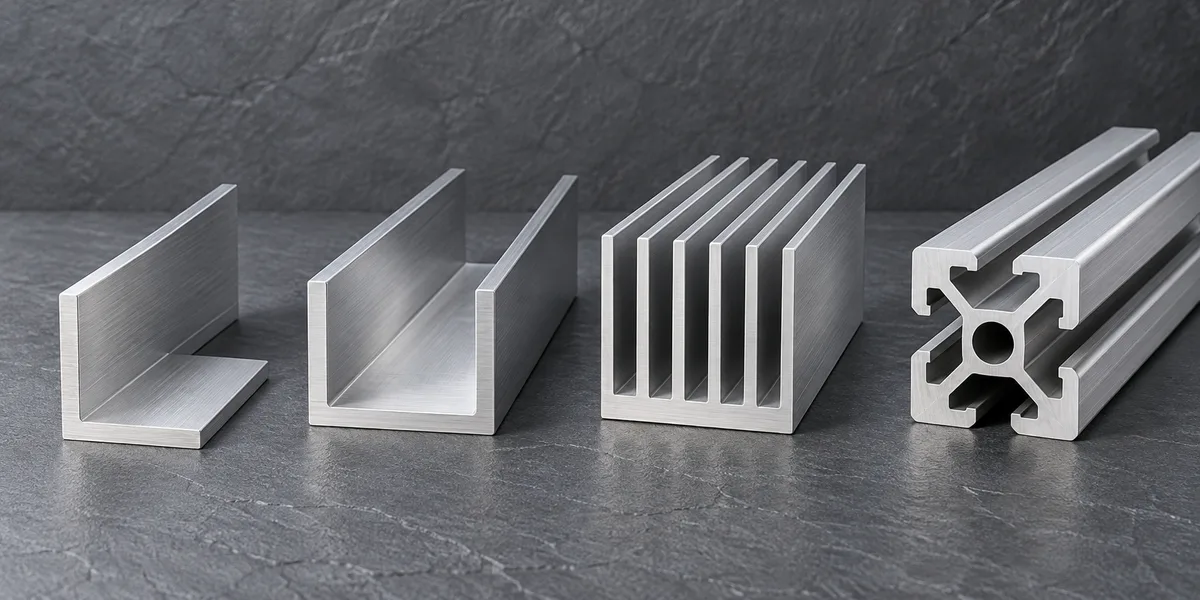
A 3030 is a 30 mm square T-slot profile with a slot on each face; a 3060 is a 30 × 60 mm profile with two slots on each long face. 3045 profiles, 30 × 45 mm, fill the gap between them. All share a 30 mm grid, so fittings and hole patterns repeat across the range.
The 30 mm system is a practical middle size. Compared with 2020, a 3030 is roughly three to four times stiffer and takes M6 bolts, so joints clamp harder and resist loosening. Compared with 4040, it is lighter and cheaper while still strong enough for most benches, guards and medium frames.
Slot geometry varies between systems. The most common 30 mm profiles have an 8 mm slot opening, but some catalogue systems use a 6 mm slot on a 30 mm profile. T-nuts and brackets made for one may not seat properly in the other, so confirm the slot width and profile drawing before ordering mixed parts.
| Profile | Section | Typical use |
|---|---|---|
| 3030 | 30 × 30 mm | Posts, frames, guard uprights, bench legs |
| 3045 | 30 × 45 mm | Beams where 3060 is more than needed; panel holders |
| 3060 | 30 × 60 mm | Beams, cross members, bench tops and longer spans |
| 6060 | 60 × 60 mm | Heavy posts within the 30 mm system |
| 3030 variants | 30 × 30 mm | Closed-face, 1 – 3 slot, quarter-round, 45° and 90° corner profiles |
Fixed-groove and panel-holder profiles in the 30 mm system clamp sheet panels without separate retainers, which speeds up guard building.
Wall thickness and slot form vary between profile designs, so the figures below are ranges for common 8 mm slot profiles. Request the data sheet of the specific profile for design calculations.
| Property | 3030 (8 mm slot) | 3060 (8 mm slot) |
|---|---|---|
| Weight | About 0.8 – 1.1 kg/m | About 1.5 – 2.0 kg/m |
| Moment of inertia (base axis) | About 2.5 – 3.5 cm⁴ | Similar to 3030 when laid flat |
| Moment of inertia (strong axis) | Same as above | Roughly five to seven times the 3030 value on edge |
| Centre bore | Typically tappable to M8 | Two bores |
For a simply supported 1 m beam carrying 200 N at mid-span, a 3030 with I ≈ 2.8 cm⁴ deflects about 2 mm (δ = PL³ / 48EI, E = 69 GPa). A 3060 standing on edge reduces that to well under half a millimetre. Where a bench top or shelf must stay flat, use 3060 on edge for the long members and 3030 for posts.
30 mm profiles are commonly extruded in 6063-T5 or T6 for clean surfaces and good anodising. 6105-T5 or 6061-T6 can be quoted for more highly stressed frames.
| Alloy and temper | Min. tensile strength | Min. yield strength | Character |
|---|---|---|---|
| 6105-T5 | 262 MPa / 38 ksi | 241 MPa / 35 ksi | Usual North American T-slot alloy: strong, extrudes well, good anodising |
| 6063-T5 | 152 MPa / 22 ksi | 110 MPa / 16 ksi | Lowest cost, best surface; adequate for light frames |
| 6063-T6 | 207 MPa / 30 ksi | 172 MPa / 25 ksi | Common for metric profiles; the 25 ksi yield figure often quoted in catalogues |
| 6061-T6 | 262 MPa / 38 ksi | 241 MPa / 35 ksi | Highest strength of the group; harder to extrude in thin, complex sections |
Minimum values from ASTM B221 for sections up to about 12.7 mm wall; EN 755-2 gives similar figures for EN AW-6063 and EN AW-6005A. Stiffness (E ≈ 69 GPa) is the same for all four alloys, so alloy choice changes strength but not deflection.
Cast or folded brackets with M6 bolts; double up on load-bearing corners.
Flat plates for flush joints and splices along long members.
Internal connectors and end-bolt joints for a clean appearance.
Slide-in, drop-in and spring-ball nuts for M6 (and M5 or M4 where needed).
Levelling feet, castors and floor plates for benches and carts.
Hinges, handles, latches and panel retainers for guards and enclosures.
The standard finish: a hard, transparent oxide layer (typically 10 – 15 µm) that resists corrosion and scuffing and keeps a clean satin look.
Black is popular for optical, laser and display equipment because it cuts reflections. Other dyed colours can be quoted for safety or brand colour coding.
A thicker, coloured coating for washdown areas or where a specific RAL colour is required. Slots may need masking so T-nuts still slide freely.
Any cut, drilled or tapped surface made after anodising shows bare aluminium. It is cosmetic only, as aluminium forms its own thin oxide film, but specify machining before finishing if appearance matters.
Matching 3030 and 3060 fittings (brackets, gussets, joining plates and T-nuts) can be supplied in the same finish so the assembled frame looks uniform.
| Feature | 2020 | 3030 | 4040 |
|---|---|---|---|
| Typical slot | 5 – 6 mm | 8 mm | 8 – 10 mm |
| Typical bolt | M4 / M5 | M6 | M8 |
| Approx. weight | 0.4 – 0.57 kg/m | 0.8 – 1.1 kg/m | 1.4 – 1.8 kg/m |
| Approx. I (base profile) | 0.7 – 0.9 cm⁴ | 2.5 – 3.5 cm⁴ | 7 – 10 cm⁴ |
| Best for | Desktop machines | Benches, guards, medium frames | Machine frames, heavier structures |
For heavier machine bases, move to 4040 / 4080 or the 45 series; for compact desktop equipment, 2020 / 2040 is lighter and cheaper.
Most 3030 profiles have an 8 mm slot for M6 hardware; some systems use a 6 mm slot on a 30 mm profile. Check before mixing fittings.
Typically 0.8 – 1.1 kg per metre depending on design; 3060 weighs about 1.5 – 2.0 kg/m.
For beams and long members, especially bench tops and shelves. Standing on edge, 3060 is several times stiffer than 3030.
M6 bolts with matching T-nuts are standard for 8 mm slots.
Yes. Black anodising is available, as are clear anodising and powder coating.
Yes. Profiles can be cut, end-tapped and drilled for connectors, then packed as labelled kits with fittings.
Send your cut list or drawing, slot width, finish and fittings. We will quote the complete package.





