Cutting
Panels cut cleanly with carbide circular saws, CNC routers and waterjet. Support the panel fully to avoid crushing the core near the cut.



An aluminium honeycomb panel is a sandwich of two thin aluminium skins bonded or brazed to a hexagonal aluminium foil core, giving a flat, very stiff plate at a fraction of the weight of solid sheet. This guide explains how to choose the core, skins, bonding method, thickness and finish, and what to put on an enquiry. Metline supplies honeycomb panels, loose core and skin sheet to fabricators and project buyers worldwide.
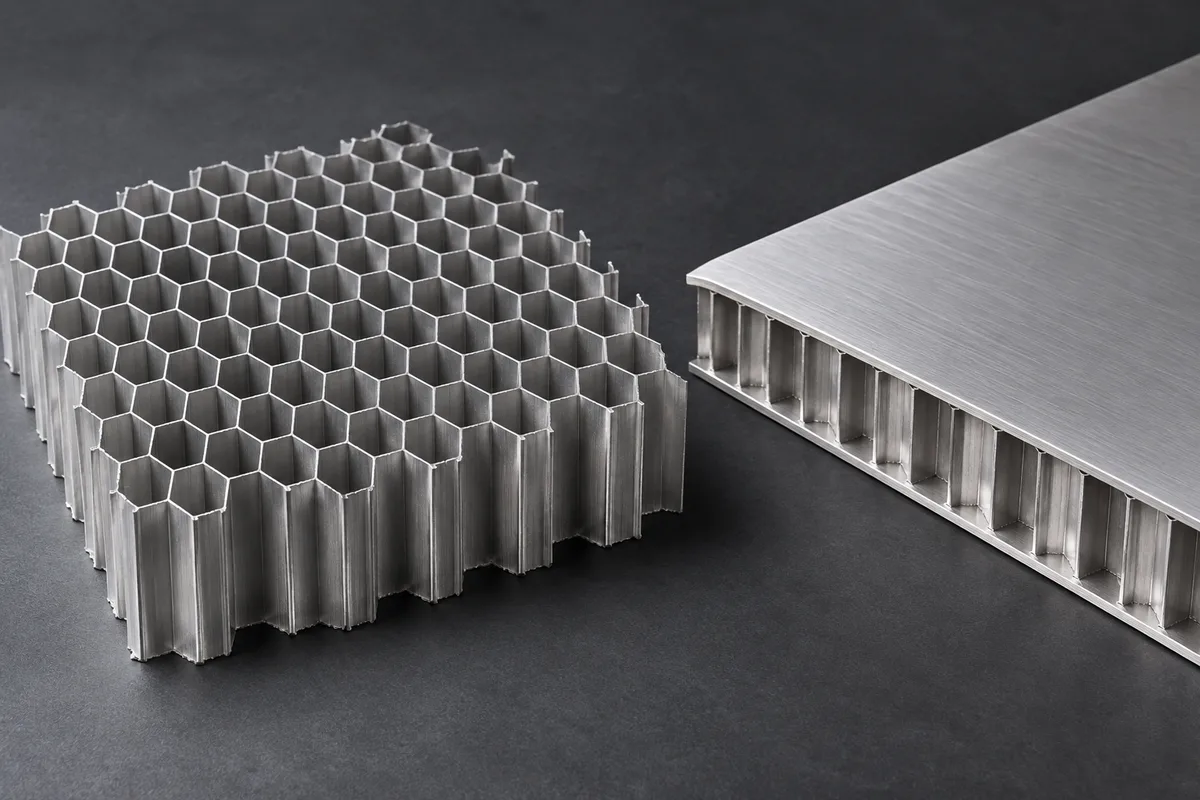
A honeycomb panel works like an I-beam spread out in two directions. The skins carry tension and compression, and the core holds them apart and carries shear. Doubling the core height roughly quadruples the bending stiffness, while adding only a few hundred grams per square metre, so a 20 mm honeycomb panel can be as stiff as solid aluminium plate several times its weight.
The core is made from aluminium foil, typically 0.04 – 0.10 mm thick, printed with adhesive node lines, stacked, cured and then expanded into hexagonal cells. Cell sizes range from about 3 mm to 19 mm across the flats (1/8 in to 3/4 in). Smaller cells and thicker foil raise core density and strength; larger cells and thinner foil save weight. The skins are usually 0.5 – 2 mm aluminium sheet, coil-coated or anodised when the panel is visible.
Because the panel is mostly air, it does not sag, ripple or oil-can the way large sheets of solid aluminium or aluminium composite panel (ACP) can. That is why honeycomb panels are chosen for large flat facade cassettes, raised floors, cleanroom walls, vehicle floors and bulkheads, lift interiors, signage and lightweight machine covers.
The table shows the alloys most often used. Core alloy affects strength and corrosion behaviour; skin alloy affects flatness, finish quality and fabrication. Mill test certificates for the skin coil and the core foil can be supplied with the panel.
| Component | Alloy and temper | Why it is chosen |
|---|---|---|
| Core foil | 3003-H18/H19 | Economical general-purpose core for building, signage, interiors and furniture |
| Core foil | 5052-H38/H39 | Higher strength and better corrosion resistance; the usual core for transport, marine and aerospace-type panels |
| Core foil | 5056-H38/H39 | Highest strength of the common cores, used where crush and shear loads are high |
| Skin sheet | 3003-H24 / H14 | Good formability and flatness; common for coil-coated facade and interior panels |
| Skin sheet | 5005-H14 / H24 | Anodising quality for architectural finishes |
| Skin sheet | 5052-H32 | Stronger, corrosion-resistant skins for vehicle floors and marine interiors |
| Skin sheet | 1100 / 1050 | Soft, highly formable skins for decorative panels |
| Skin sheet | 6061-T6, 2024-T3, 7075-T6 | High-strength skins for machine tables, structural floors and aerospace-type panels |
Mixing alloys between core and skin is normal, but avoid combining aluminium with carbon fibre or stainless skins without isolation, because galvanic corrosion can attack the aluminium core at the bond line. See our guides to 3003 core, 5052 core and 5056 core for core-only data.
Most panels are laminated with a structural adhesive in a heated press or a cold-press line. Brazed panels instead join the core to the skins metallurgically using an aluminium-silicon filler in a vacuum or controlled-atmosphere furnace at around 600 °C. The choice decides temperature limits, strength and price.
| Factor | Adhesive-bonded panel | Brazed panel |
|---|---|---|
| Joint | Epoxy, polyurethane or modified epoxy film or liquid adhesive | Al-Si braze metal; no organic material |
| Service temperature | Limited by the adhesive, typically about 80 – 150 °C | Far higher; limited by softening of the aluminium itself rather than the joint |
| Fire behaviour | Adhesive adds a small combustible load; A2 builds use low-organic adhesives and thin layers | Essentially all-metal, so naturally suited to non-combustible classes |
| Strength | Good for building, interior and most transport uses | Higher flatwise tensile and peel strength |
| Formats | Very large sheets, curved and folded panels | Smaller formats; furnace size limits panel dimensions |
| Relative cost | Lower | Considerably higher |
Published strength values vary widely with core density, adhesive and test method. For design, ask for test results to ASTM C297 (flatwise tension), C365 (flatwise compression), C273 (core shear) and D1781 (climbing drum peel) on the actual build.
For high-temperature service, outgassing-sensitive interiors or panels that must be welded at the edges, read our dedicated page on brazed aluminium honeycomb panels.
Unusual sizes are cut from larger sheets or laminated to order.
Panel weight is the two skins (2.70 kg per m² per mm of aluminium) plus the core. Core density depends on cell size and foil gauge and typically lies between about 30 and 130 kg/m³. The table below is calculated for two common core densities and excludes adhesive, which usually adds a few hundred grams per m².
| Panel thickness | Skins | Core height | Skins only (kg/m²) | Total with 50 kg/m³ core | Total with 80 kg/m³ core |
|---|---|---|---|---|---|
| 10 mm | 0.7 + 0.7 mm | 8.6 mm | 3.78 | 4.2 | 4.5 |
| 15 mm | 1.0 + 1.0 mm | 13.0 mm | 5.40 | 6.1 | 6.4 |
| 20 mm | 1.0 + 1.0 mm | 18.0 mm | 5.40 | 6.3 | 6.8 |
| 25 mm | 1.0 + 1.5 mm | 22.5 mm | 6.75 | 7.9 | 8.6 |
| 30 mm | 1.5 + 1.5 mm | 27.0 mm | 8.10 | 9.5 | 10.3 |
| 50 mm | 2.0 + 2.0 mm | 46.0 mm | 10.80 | 13.1 | 14.5 |
Fire performance depends on the whole build: skin coating, adhesive type and quantity, and edge details. A panel is only as good as its test report, so always ask for the report that covers the exact construction offered.
| Standard | Region / sector | What it means for honeycomb panels |
|---|---|---|
| EN 13501-1 | Europe, many export markets | Reaction-to-fire class; A1 and A2-s1,d0 are the non-combustible and limited-combustibility classes required for many facades |
| ASTM E84 / UL 723 | North America | Surface flame spread and smoke index; Class A is the usual target |
| NFPA 285 | USA, exterior walls | Full-scale wall assembly test that some facade projects require |
| EN 45545-2 | Rail vehicles | Fire safety hazard levels HL1 – HL3 for interior panels |
| IMO FTP Code | Shipbuilding | Non-combustibility and surface flammability for marine interiors, usually with type approval |
| ASTM C297, C365, C273, C393, D1781 | All sectors | Mechanical tests for sandwich panels and cores |
| AMS-C-7438 | Aerospace | Specification for aluminium honeycomb core material |
Unless a project specification says otherwise, honeycomb panels are commonly supplied to commercial tolerances like those below. Facade cassettes and cleanroom walls often need tighter flatness, which should be stated on the order.
| Characteristic | Typical commercial tolerance |
|---|---|
| Length and width, up to 2 m | ± 2 mm |
| Length and width, over 2 m | ± 3 mm |
| Thickness | ± 0.25 mm on the nominal panel thickness |
| Diagonal difference | ≤ 3 mm |
| Edge straightness | ≤ 2 mm per metre |
| Flatness | ≤ 2 mm per metre |
Panels cut cleanly with carbide circular saws, CNC routers and waterjet. Support the panel fully to avoid crushing the core near the cut.
A V-groove routed through the inner skin and core lets the outer skin fold to 90° or other angles, producing cassette trays with a sharp corner.
Single-curved panels are made by pre-rolling skins or by kerfing the core. Tight radii are best ordered pre-formed.
Open edges are closed with extruded aluminium edge profiles, folded skins or potting compound to keep out water and dirt.
Potted inserts, threaded blind inserts, through bolts with spacers and hook-on extrusions spread loads into the core without crushing it.
PVDF and polyester coil coatings, powder coating, anodising, wood or stone-grain film and perforation for acoustic panels.
| Sector | Typical use | Typical build |
|---|---|---|
| Building facades | Large-format cladding cassettes, soffits, column covers | 20 – 25 mm, 3003 or 5005 skins, PVDF coating, A2 build |
| Interiors | Ceilings, partitions, lift cars, kiosks | 10 – 15 mm, 3003 skins, decorative film or powder coat |
| Cleanrooms and labs | Wall and ceiling modules, equipment enclosures | 25 – 50 mm, coated skins, sealed edges |
| Rail and bus | Floors, sidewalls, ceilings, partitions | 5052 skins and core, EN 45545-2 build |
| Marine | Cabin walls, ceilings, furniture, bulkhead linings | 5052 core, IMO-approved build |
| Industry | Vacuum tables, machine covers, optical breadboards | 6061 or 5052 skins, flat-ground or machined |
| Signage and exhibition | Large flat signs and stands | Thin 6 – 10 mm panels with printable skins |
For architectural-only panel designs, see decorative aluminium honeycomb panels; for non-aluminium skins and cores such as stone, fibreglass or aramid, see our honeycomb sandwich panel overview. Metline supplies the panels and materials; facade systems are designed and installed by your project team.
| Property | Aluminium honeycomb panel | Aluminium composite panel (ACP) | Solid aluminium sheet |
|---|---|---|---|
| Typical thickness | 6 – 100 mm | 3 – 6 mm | 2 – 4 mm for cladding |
| Weight for a stiff 1.5 m span | Lowest | Low | Highest |
| Flatness of large panels | Excellent | Good | Fair; may need stiffeners |
| Core material | Aluminium foil honeycomb | Polyethylene or mineral-filled core | None |
| Best fire class achievable | A1 / A2 (all-aluminium build) | A2 with mineral core; PE core is not suitable for high-rise facades | A1 |
| Formability | Folded or curved to order | Easily routed and folded on site | Bent and folded |
| Relative cost per m² | Higher | Lower | Medium |
The most common sheet is 1220 × 2440 mm (4 × 8 ft), followed by 1250 × 2500 mm and 1500 × 3000 mm. Larger formats and cut-to-size panels are produced to project requirements.
With two 1 mm skins and a core of about 50 kg/m³, a 20 mm panel weighs roughly 6.3 kg/m² plus adhesive, compared with 54 kg/m² for 20 mm solid aluminium plate. Heavier cores or thicker skins raise the figure.
The aluminium itself does not burn, and panels with low-organic adhesive and suitable coatings can achieve EN 13501-1 A2-s1,d0 or even A1. The class applies only to the tested build, so ask for the report covering your exact construction.
ACP is a thin panel (usually 4 mm) with a solid plastic or mineral core. A honeycomb panel has a much thicker, mostly hollow aluminium core, so it is lighter for the same stiffness, stays flatter in large sizes and is easier to make non-combustible.
3003 core is economical and fine for building and interior panels. 5052 core is stronger and more corrosion resistant, so it is preferred for vehicles, marine interiors and outdoor panels exposed to salt or humidity.
When the panel must work above the temperature limit of adhesives, must contain no organic material, or needs the highest peel and tensile strength. For facades and interiors, a good adhesive-bonded panel is normally sufficient.
Yes. Metline supplies expanded or unexpanded aluminium honeycomb core and coil-coated or mill-finish skin sheet for customers who laminate their own panels.
Tell us the panel size, thickness, skins, finish, fire class and quantity. We will propose a build and send a delivered price.





