T6
Solution treated (at the press or in a furnace), quenched and artificially aged. The standard structural temper for profiles and tube.



6061 is the structural choice among extrusion alloys: about 25 % stronger than 6063 in the T6 temper, weldable, machinable and corrosion resistant. Metline supplies 6061 extruded profiles, structural shapes, bar and tube in T4, T6 and the stretched T6511 temper, to standard dies or your own drawing, certified to ASTM, AMS and EN and shipped worldwide.
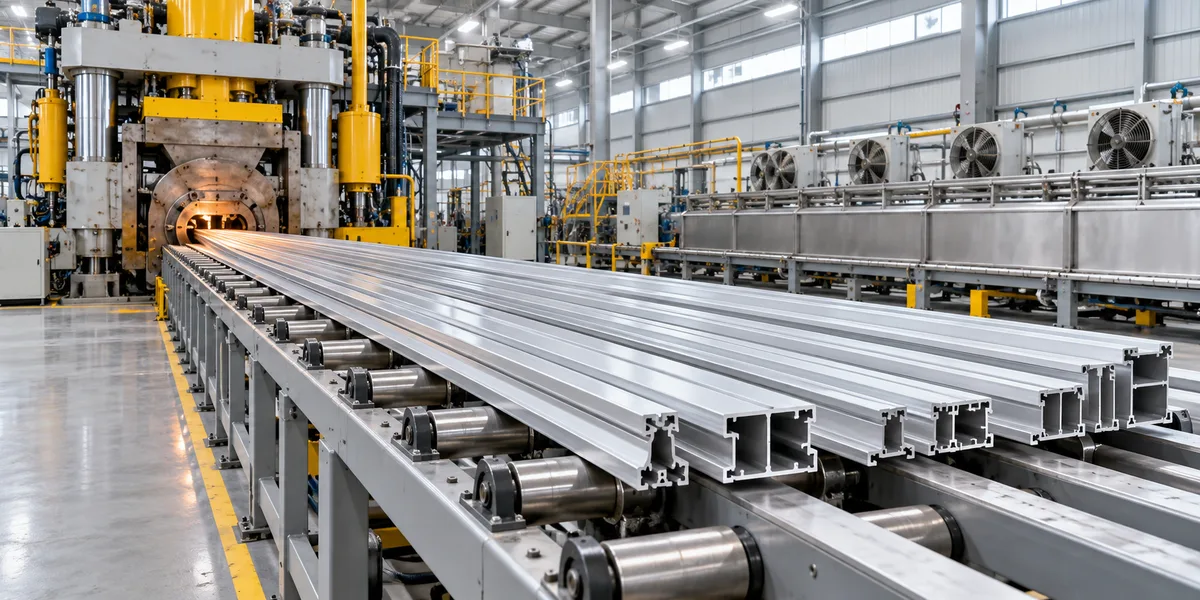
Extrusion forces a heated billet through a steel die to make a long product with a constant cross-section. 6061 is one of the stronger alloys that can still be extruded economically into hollow and complex shapes, which is why it is specified for load-bearing profiles in machinery, transport and structures.
The alloy gets its strength from magnesium silicide precipitates formed during ageing, helped by a small copper addition. Chromium controls grain structure and improves resistance to stress corrosion. In return for this richer chemistry, 6061 extrudes more slowly than 6063, needs a faster quench at the press to reach full T6 strength, and produces a slightly less bright surface. For thin decorative sections 6063 is the better option; for parts that carry load, 6061 is the safer one.
In North America 6061 is the default structural extrusion grade, and the Aluminum Association standard I-beams, channels and angles are usually supplied in 6061-T6. In Europe the role is more often filled by 6082 or 6005A, which give similar strength; Metline supplies all three so a design can follow the standard used in the destination market.
| Element | Min | Max |
|---|---|---|
| Silicon (Si) | 0.40 | 0.80 |
| Iron (Fe) | — | 0.70 |
| Copper (Cu) | 0.15 | 0.40 |
| Manganese (Mn) | — | 0.15 |
| Magnesium (Mg) | 0.80 | 1.20 |
| Chromium (Cr) | 0.04 | 0.35 |
| Zinc (Zn) | — | 0.25 |
| Titanium (Ti) | — | 0.15 |
| Others, each / total | — | 0.05 / 0.15 |
| Aluminium (Al) | Remainder |
Registered Aluminum Association limits, identical to EN 573-3 for EN AW-6061. The actual cast analysis is reported on the mill certificate.
Designers should use specified minimums. Typical values are given for comparison and are what the material usually achieves.
| Temper | Tensile strength | Yield strength (0.2 %) | Elongation | Basis |
|---|---|---|---|---|
| O | ≤ 150 MPa | ≤ 110 MPa | 16 % min | Specified (annealed, maximum values) |
| T4 / T4511 | 180 MPa min | 110 MPa min | 14 – 16 % min | Specified, ASTM B221 / EN 755-2 |
| T6 / T6511 | 260 MPa min (38 ksi) | 240 MPa min (35 ksi) | 8 – 10 % min (by thickness) | Specified, ASTM B221 / EN 755-2 |
| T6, typical | about 310 MPa (45 ksi) | about 275 MPa (40 ksi) | about 12 % | Typical |
| T6 welded (heat-affected zone) | about 165 MPa (24 ksi) | about 105 MPa (15 ksi) | — | Design value, Aluminum Design Manual |
Solution treated (at the press or in a furnace), quenched and artificially aged. The standard structural temper for profiles and tube.
T6 plus a controlled stretch of about 1 – 3 % to relieve quench stress, with minor straightening allowed. Preferred for bar and profiles that will be machined, because parts stay straight.
Stretched like T6511 but with no straightening after stretching. Used where the specification asks for it.
Naturally aged and softer. Bend or form the profile in T4, then age it to T6.
Annealed for maximum ductility, for severe forming or bending, followed by full heat treatment.
Cooled from the press and aged without a separate solution treatment. Lower and less consistent strength than T6; use only where the drawing permits.
| System | Designation | Extrusion standards |
|---|---|---|
| ASTM / Aluminum Association | 6061 | ASTM B221 (profiles, bar, tube), B241 (seamless pipe and tube), B308 (standard structural shapes), B429 (structural pipe and tube) |
| Aerospace and defence | 6061-T6 / T6511 | AMS 4150 and related AMS specifications; AMS-QQ-A-200/8 |
| UNS | A96061 | — |
| European | EN AW-6061 (AlMg1SiCu) | EN 755-1/-2 (properties), EN 755-9 (profile tolerances), EN 12020 (precision profiles) |
| ISO | AlMg1SiCu | ISO 6362 |
| Japan | A6061S (extruded shapes) | JIS H4100 |
| India | 65032 (formerly HE20) | IS 733, IS 1285 |
The Indian grade is a commonly cross-referenced close equivalent rather than an identical chemistry; confirm the governing standard on your drawing.
6061 can be extruded into solid, semi-hollow and hollow shapes, including porthole-die hollows, but it is less forgiving than 6063. Following a few rules keeps die cost down and quality up.
Our team reviews each drawing for extrudability and suggests changes before a die is made. For a step-by-step design guide see extrusion design and production.
Machines well in T6 and T6511 with sharp carbide tools, high speeds and coolant. T6511 keeps long bars straight as material is removed.
MIG or TIG with ER4043 or ER5356 filler. The heat-affected zone drops to near T4 strength, so welded frames are designed to reduced stresses or re-heat-treated.
Limited in T6. For tight bends, bend in T4 or O and then age. Stretch forming and rotary draw bending suit long curved profiles.
Takes clear, coloured and hard anodising, though the finish is slightly less bright than 6063. Specify visible faces on the drawing.
Coats well after chromate-free pretreatment; standard for architectural and outdoor equipment.
Good in atmospheric and fresh-water service. In seawater, anodise or coat, or use 5xxx or 6082 for immersed parts.
| Property | 6063-T6 | 6061-T6 | 6082-T6 | 7075-T6 |
|---|---|---|---|---|
| Min. tensile (thin walls) | 205 – 215 MPa | 260 MPa | 290 – 310 MPa | about 540 MPa |
| Min. yield (thin walls) | 170 MPa | 240 MPa | 250 – 260 MPa | about 480 MPa |
| Extrudability | Excellent | Good | Good | Poor (simple shapes only) |
| Surface finish | Excellent | Good | Good | Fair |
| Weldability | Good | Good | Good | Not recommended |
| Typical use | Architecture, trims, heat sinks | Structural profiles, machined parts | European structural profiles | Aerospace, highly stressed parts |
Read more in 6061 vs 6063 and 6061 vs 6082.
Both have the same minimum strength. T6511 has been stretched after quenching to relieve residual stress and may have minor straightening, so it stays straighter when machined. Order T6511 for bar and profiles that will be machined.
6063 extrudes faster, into thinner walls, with a brighter surface, so it suits architectural and decorative profiles. 6061 is about 25 % stronger and is chosen for load-bearing parts. If the profile carries significant load, use 6061 (or 6082 in Europe).
Yes, with ER4043 or ER5356 filler by MIG or TIG. Expect the heat-affected zone to fall to about 165 MPa tensile, and design welded joints for that reduced strength.
It depends on profile size and shape, but 6061 generally needs thicker walls than 6063, often from about 1.5 – 2 mm for small and medium profiles. Send the drawing and we will confirm what can be extruded reliably.
Yes. Metline supplies 6061 profiles from existing dies or from new dies made to your drawing, with samples for approval before production.
Send the drawing, temper, lengths and quantity. We will reply with die details, certification and a delivered price.





