7075-T6
Peak-aged for maximum strength. Standard for drawn sports and precision tube.



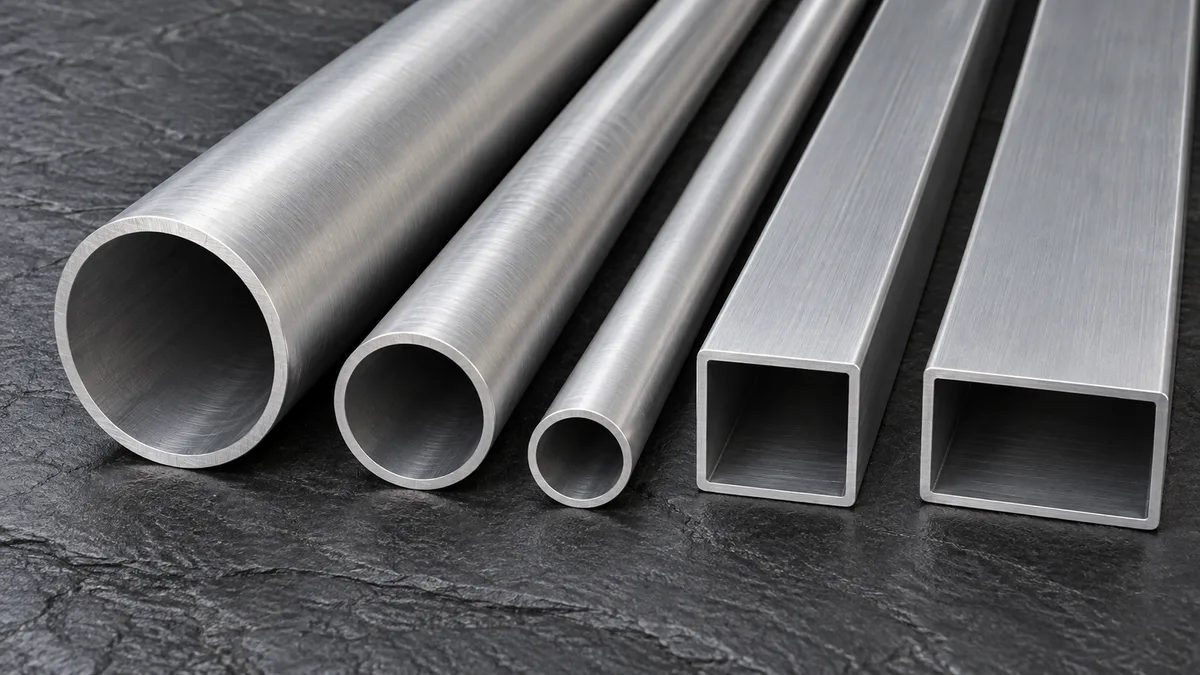
7075 aluminium tube is the strongest common aluminium tube, with a typical yield strength of about 500 MPa in T6, close to many structural steels at a third of the weight. It is used for aircraft parts, high-performance sports equipment, defence hardware and precision machined components that are not welded. Metline supplies 7075 tube (7075 aluminum tubing) drawn seamless and extruded, in T6, T651X and T73 tempers, to customers worldwide.
7075 is a zinc-magnesium-copper alloy developed for aircraft structures. In the T6 temper it is roughly 80 % stronger than 6061-T6, which lets designers use much thinner walls for the same load.
Tube in 7075 is made by extruding a hollow and, for most small and medium sizes, cold-drawing it over a mandrel. Drawn seamless 7075 tube has tight dimensional tolerances and a smooth surface and is the form used for arrow shafts, ski and trekking poles, tent poles, bicycle components, drone arms, instrument tubes and aircraft parts. Larger sizes are supplied as extruded tube or bored from bar.
Strength comes at a price. 7075 is not suitable for fusion welding, its corrosion resistance is lower than 6xxx alloys, and in the peak-aged T6 temper it is sensitive to stress corrosion cracking under sustained tensile stress. For parts exposed to such stresses the over-aged T73 tempers are used, which trade about 10 – 15 % of strength for much better resistance to stress corrosion.
| Element | Min | Max | Role |
|---|---|---|---|
| Silicon (Si) | — | 0.40 | Impurity |
| Iron (Fe) | — | 0.50 | Impurity |
| Copper (Cu) | 1.2 | 2.0 | Raises strength and stress-corrosion resistance; prevents weldability |
| Manganese (Mn) | — | 0.30 | |
| Magnesium (Mg) | 2.1 | 2.9 | Forms MgZn2 with zinc |
| Chromium (Cr) | 0.18 | 0.28 | Grain control, stress-corrosion resistance |
| Zinc (Zn) | 5.1 | 6.1 | Main strengthening element |
| Titanium (Ti) | — | 0.20 | Grain refiner |
| Others each / total | — | 0.05 / 0.15 | |
| Aluminium | Remainder |
| Temper / basis | Tensile strength | Yield strength (0.2 %) | Elongation | Hardness |
|---|---|---|---|---|
| O, typical | 228 MPa / 33 ksi | 103 MPa / 15 ksi | 17 % | 60 HB |
| T6 / T651X, typical | 572 MPa / 83 ksi | 503 MPa / 73 ksi | 11 % | 150 HB |
| T73 / T7351X, typical | 505 MPa / 73 ksi | 435 MPa / 63 ksi | 13 % | 135 HB |
| T6 extruded (thin wall), specified minimum | about 540 MPa / 78 ksi | about 480 MPa / 70 ksi | 7 % | — |
Minimums depend on product route, wall thickness and specification; the mill certificate shows the guaranteed values for your lot.
Peak-aged for maximum strength. Standard for drawn sports and precision tube.
Extruded tube stretched to relieve stress and straightened, for machining stability.
Over-aged for high resistance to stress corrosion and exfoliation; used in aircraft parts under sustained load.
Annealed for forming, swaging or drawing before heat treatment to T6 or T73.
| System | Designation / standard |
|---|---|
| ASTM | B210 (drawn seamless tube), B221 (extruded tube), B241 (seamless extruded tube) |
| Aerospace | AMS-QQ-A-200/11 (extrusions); AMS-WW-T-700/7 (drawn seamless tube, now noncurrent but still cited) |
| UNS | A97075 |
| Europe | EN AW-7075 (AlZn5.5MgCu), EN 755-2 and EN 754-2 |
| Germany | 3.4365 |
| Japan | A7075 (JIS H4080) |
| China | 7075 (GB/T 3191, GB/T 4437) |
Weight in kg/m = π × (OD − wall) × wall × 2.81 / 1000.
| OD × wall (mm) | kg/m | I (cm⁴) | Z (cm³) |
|---|---|---|---|
| 6 × 0.5 | 0.024 | 0.003 | 0.011 |
| 8 × 0.5 | 0.033 | 0.008 | 0.021 |
| 10 × 1 | 0.079 | 0.029 | 0.058 |
| 12 × 1 | 0.097 | 0.053 | 0.088 |
| 16 × 1 | 0.132 | 0.133 | 0.166 |
| 20 × 1.5 | 0.245 | 0.375 | 0.375 |
| 25 × 2 | 0.406 | 0.963 | 0.770 |
| 30 × 2 | 0.494 | 1.733 | 1.155 |
| 40 × 3 | 0.980 | 6.007 | 3.003 |
| 50 × 5 | 1.986 | 18.113 | 7.245 |
| 60 × 5 | 2.428 | 32.938 | 10.979 |
| 80 × 10 | 6.180 | 137.445 | 34.361 |
| 100 × 10 | 7.945 | 289.812 | 57.962 |
| 150 × 20 | 22.952 | 1766.360 | 235.515 |
Drawn tube follows ASTM B210 or EN 754-7 tolerance tables; extruded tube follows ANSI H35.2 or EN 755-7. For sports and telescopic tubes, concentricity and straightness are usually tighter than the standard and should be written on the drawing. Aerospace orders typically add eddy-current or ultrasonic inspection, electrical conductivity checks (to verify temper) and full traceability.
Excellent in T6: short chips, fine finishes and tight tolerances. Use carbide tools and coolant.
Not recommended. Fusion welding causes hot cracking and severe strength loss. Use threaded, swaged, bonded or riveted joints.
Limited in T6. Swage, flare or bend in O or W temper and then age.
Clear and hard anodising are common and improve corrosion and wear resistance; the colour is slightly yellowish.
Lower than 6xxx alloys. Anodise, prime or paint, and avoid contact with carbon fibre or steel without isolation.
Specify T73 for parts under sustained tension in humid or marine service.
| 6061-T6 | 7005-T6 | 2024-T3 | 7075-T6 | |
|---|---|---|---|---|
| Typical yield | 276 MPa | 290 – 345 MPa | 345 MPa | 503 MPa |
| Weldable | Yes | Yes | No | No |
| Corrosion resistance | Good | Moderate | Poor | Moderate–poor |
| Fatigue | Good | Good | Excellent | Good |
| Typical use | General | Welded frames | Aircraft, fatigue-critical | Highest strength |
Typical tensile strength is about 572 MPa and yield about 503 MPa, roughly 80 % higher than 6061-T6.
No, not for structural joints. Fusion welding causes cracking and a large loss of strength. Use mechanical, threaded or bonded joints, or choose 7005 or 7020 for welded designs.
T73 is over-aged. It is about 10 – 15 % weaker than T6 but much more resistant to stress corrosion cracking, so it is specified for parts under sustained load in corrosive environments.
Use π × (OD − wall) × wall × 2.81 / 1000. A 25 × 2 mm tube weighs about 0.41 kg/m.
Yes. Drawn 7075-T6 tube is the standard premium material for poles because it is light, stiff for its weight and resists permanent bending.
Send OD, wall, temper, length, specification and destination, and we will reply with availability, certification and a delivered price.





