Automotive
Radiator and heater headers and tanks, condenser manifolds, evaporator plates, oil cooler plates, charge-air cooler end plates.



Aluminium brazing sheet is a roll-bonded composite: a core alloy such as 3003 or 6951 clad on one or both sides with an aluminium-silicon filler alloy, and often with a zinc-bearing liner for corrosion protection. In the brazing furnace the cladding melts and joins every contact point in the assembly. This guide covers the heavier gauges used for headers, tanks, plates, side supports and battery cold plates: structures, alloys, properties, sizes and how to specify them.
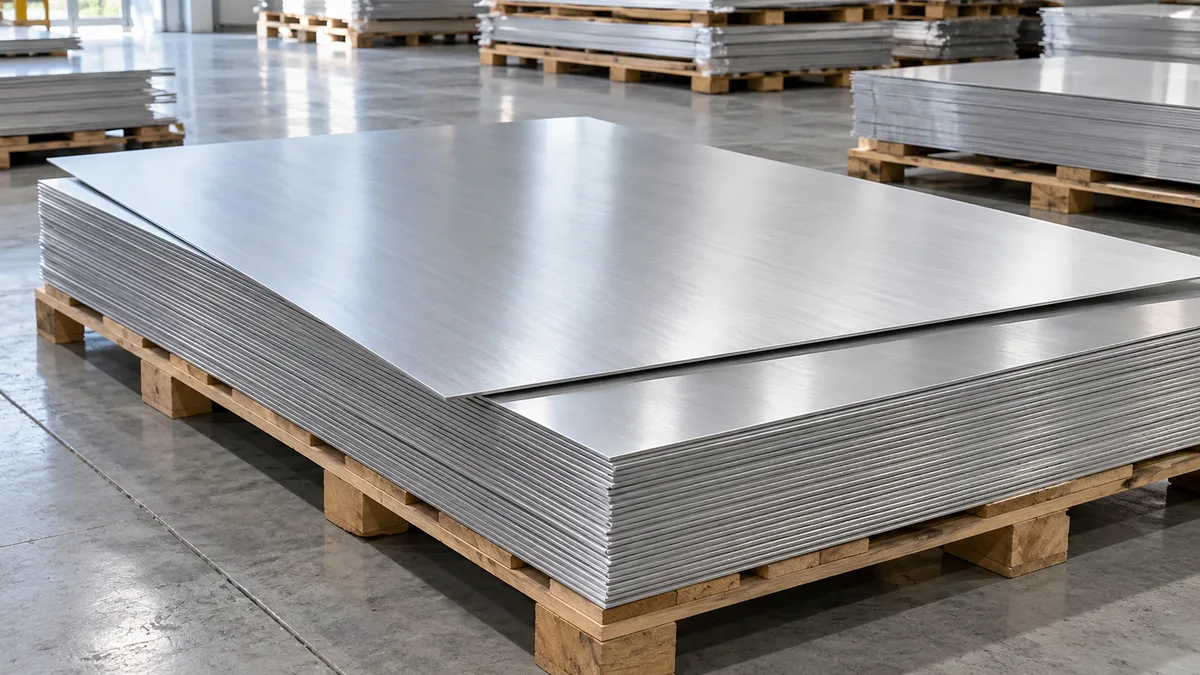
Brazing sheet was developed so that a whole heat exchanger can be joined in one furnace cycle. Instead of adding filler at each joint, the filler is rolled onto the sheet itself. Parts are stamped, formed and assembled, then heated to about 600 °C; the cladding melts, runs into every joint by capillary action, and solidifies into fillets.
The core alloy melts at a higher temperature than the cladding, typically about 615 – 655 °C depending on alloy, so it stays solid and carries the load. The cladding, with 7 – 13 % silicon, begins to melt at 577 °C. That narrow gap between filler melting and core melting is why aluminium brazing needs accurate furnace control.
This page covers the thicker end of the range: sheet and coil from roughly 0.4 mm upwards, used for headers, manifolds, tanks, plates, side supports, flat-tube stock and cold plates. Thin fin foil has its own considerations, covered in our brazing foil guide; narrow slit material is covered under brazing strip.
| Structure | Description | Typical parts |
|---|---|---|
| 4343 / 3003 | Filler on one side | Headers and plates that braze on one face; side supports |
| 4343 / 3003 / 4343 | Filler on both sides | Drawn-cup evaporator plates, separator plates, parts brazing on both faces |
| 4045 / 3003 / 4045 | More fluid filler on both sides | Complex plates and flat-tube stock with long joints |
| 4343 / 3003 / 7072 | Filler outside, zinc liner inside | Radiator and heater tubes and headers where the coolant side needs sacrificial protection |
| 4343 / 3005 / 4343 or 4343 / 3105 | Stronger Al-Mn-Mg core | Plates and tanks that need more strength after brazing |
| 4045 / 6951 / 4045 | Heat-treatable core | Oil coolers and plates that age-harden after brazing; vacuum or Cs-flux CAB |
| 4004 / 3003 / 4004 | Mg-bearing filler for vacuum | Vacuum-brazed oil coolers, aerospace and electronics cold plates |
7072 is a sacrificial liner (Al-1 % Zn), not a filler. Structures are written from one face to the other.
| Alloy | Role | Key composition | Notes |
|---|---|---|---|
| 3003 | Core | Mn 1.0 – 1.5 %, Cu 0.05 – 0.20 % | Standard core; good formability and corrosion resistance |
| 3005 | Core | Mn 1.0 – 1.5 %, Mg 0.20 – 0.6 % | Higher strength than 3003; Mg limits CAB flux tolerance |
| 3105 | Core | Mn 0.30 – 0.8 %, Mg 0.20 – 0.8 % | Moderate strength; less common as a brazing core |
| 6951 | Core | Mg 0.40 – 0.8 %, Si 0.20 – 0.50 %, Cu 0.15 – 0.40 % | Heat-treatable; regains strength after brazing and ageing |
| 4343 | Cladding | Si 6.8 – 8.2 % | Melting range approx. 577 – 613 °C; common CAB filler |
| 4045 | Cladding | Si 9.0 – 11.0 % | Approx. 577 – 591 °C; more fluid |
| 4047 | Cladding | Si 11.0 – 13.0 % | Approx. 577 – 582 °C; near-eutectic, most fluid |
| 4004 / 4104 | Cladding | Si 9.0 – 10.5 %, Mg 1.0 – 2.0 % (4104 also Bi) | Vacuum brazing |
| 7072 | Liner | Zn 0.8 – 1.3 % | Sacrificial anode layer for the coolant side |
Composition values are Aluminum Association limits for the main alloying elements. Many heat exchanger makers use modified, proprietary "long-life" cores with controlled copper, titanium and manganese to resist pitting and silicon penetration; specify the properties you need and the supplier proposes a matching core.
Brazing sheet starts as separate slabs. A thick core ingot is scalped, and thinner liner plates of filler alloy (and of 7072 where needed) are rolled to a precise thickness. The liner plates are laid on the core, strapped or welded at the edges, preheated and hot-rolled. The first passes press the layers together so hard that the oxide films break and the metals bond across the interface, forming a single composite slab.
The composite is then hot-rolled to coil and cold-rolled to final gauge, with intermediate and final anneals to set the temper. Because every layer is reduced in the same proportion, the clad ratio set by the starting plate thickness is carried through to the finished sheet. That is why clad ratio is specified as a percentage rather than as an absolute thickness: a 10 % clad 1.0 mm sheet carries about 0.1 mm of filler per clad face.
Edge trimming removes the zone where the cladding thins at the slab edges, and finished coils are slit or cut to length. Quality checks on the cross-section confirm that the clad layer is continuous and within tolerance across the width.
A brazing cycle at about 600 °C fully anneals non-heat-treatable cores. Whatever temper the sheet arrives in, a 3003 core ends up close to its O-temper properties after brazing, so design strength should be based on post-braze values. Heat-treatable 6951 cores are different: they are solution-treated by the brazing cycle and gain strength by natural or artificial ageing afterwards.
| Material (typical values) | Tensile strength | Yield strength | Thermal conductivity |
|---|---|---|---|
| 3003-O | 110 MPa | 42 MPa | approx. 190 W/m·K |
| 3003-H14 | 150 MPa | 145 MPa | approx. 160 W/m·K |
| 3003 core after brazing | close to 3003-O | close to 3003-O | close to 3003-O |
| 6951 core after brazing and ageing | higher than 3003; see certificate | higher than 3003; see certificate | varies with condition |
Typical values for unclad 3003 from ASM data. Clad composites differ slightly; supplied properties are reported on the mill certificate, and post-braze properties can be tested on request after a simulated brazing cycle.
Common delivery tempers are O (for deep drawing and complex stamping), H24 (partially annealed, a balance of strength and elongation) and H14 (half-hard, for flat parts and better handling). Because brazing anneals the core anyway, choose the temper for how the part is formed, not for final strength.
Weight is calculated with a composite density of 2.73 g/cm³, close for 3xxx cores with Al-Si cladding.
| Thickness (mm) | kg per m² | 1000 × 2000 mm sheet (kg) | 1250 × 2500 mm sheet (kg) |
|---|---|---|---|
| 0.4 | 1.09 | 2.2 | 3.4 |
| 0.5 | 1.36 | 2.7 | 4.3 |
| 0.6 | 1.64 | 3.3 | 5.1 |
| 0.8 | 2.18 | 4.4 | 6.8 |
| 1 | 2.73 | 5.5 | 8.5 |
| 1.2 | 3.28 | 6.6 | 10.2 |
| 1.5 | 4.09 | 8.2 | 12.8 |
| 2 | 5.46 | 10.9 | 17.1 |
| 2.5 | 6.83 | 13.7 | 21.3 |
| 3 | 8.19 | 16.4 | 25.6 |
| 4 | 10.92 | 21.8 | 34.1 |
| 5 | 13.65 | 27.3 | 42.7 |
| 6 | 16.38 | 32.8 | 51.2 |
Radiator and heater headers and tanks, condenser manifolds, evaporator plates, oil cooler plates, charge-air cooler end plates.
Liquid cold plates, battery module cooling plates, inverter and motor cooling jackets.
Microchannel heat exchanger headers, plate heat exchangers and side plates.
Plate-fin heat exchangers for compressors, hydraulics and gas processing.
Vacuum-brazed cold plates for power electronics, radar and data-centre cooling.
Radiators and oil coolers for locomotives, buses, construction and agricultural machines.
A core alloy, usually 3003 or a modified 3xxx alloy (or 6951 for higher strength), roll-bonded with an Al-Si filler such as 4343 or 4045 on one or both faces. Some structures add a 7072 zinc liner for corrosion protection.
Yes. The brazing cycle anneals non-heat-treatable cores, so a 3003-based sheet ends up close to O-temper strength whatever temper it was delivered in. A 6951 core can recover strength by ageing after brazing.
Most brazing sheet has 5 – 15 % cladding per side. The right figure depends on joint size, sheet thickness and how much core erosion can be tolerated.
Single-side clad sheet has filler on one face only. Suppliers mark the clad side; make sure drawings and press tooling keep the braze face where the joints are.
It can be formed and even welded, but the cladding adds cost and offers no benefit unless the part is brazed. For unbrazed parts, plain 3003 or 5xxx sheet is usually the better buy.
Yes, when clad with a magnesium-bearing filler such as 4004 or 4104. Standard 4343 and 4045 clad sheet is designed for flux-based CAB brazing.
Send the clad structure, clad ratio, thickness, size, temper and quantity. We reply with supply options, certification and delivery terms.





