H116
Strain hardened with special process control to pass the ASTM G66 exfoliation and G67 intergranular corrosion tests. Standard for hull, deck and superstructure plating.



5083 is the standard marine aluminium plate: the strongest widely available non-heat-treatable alloy, with excellent seawater resistance and welded joints that keep most of their strength. It is the default material for aluminium hulls, LNG tank structures, pressure vessels and cryogenic equipment. Metline supplies 5083 sheet and plate in O, H111, H112, H116 and H321 to ASTM B928, ASTM B209 and EN 485, cut to size and shipped worldwide.
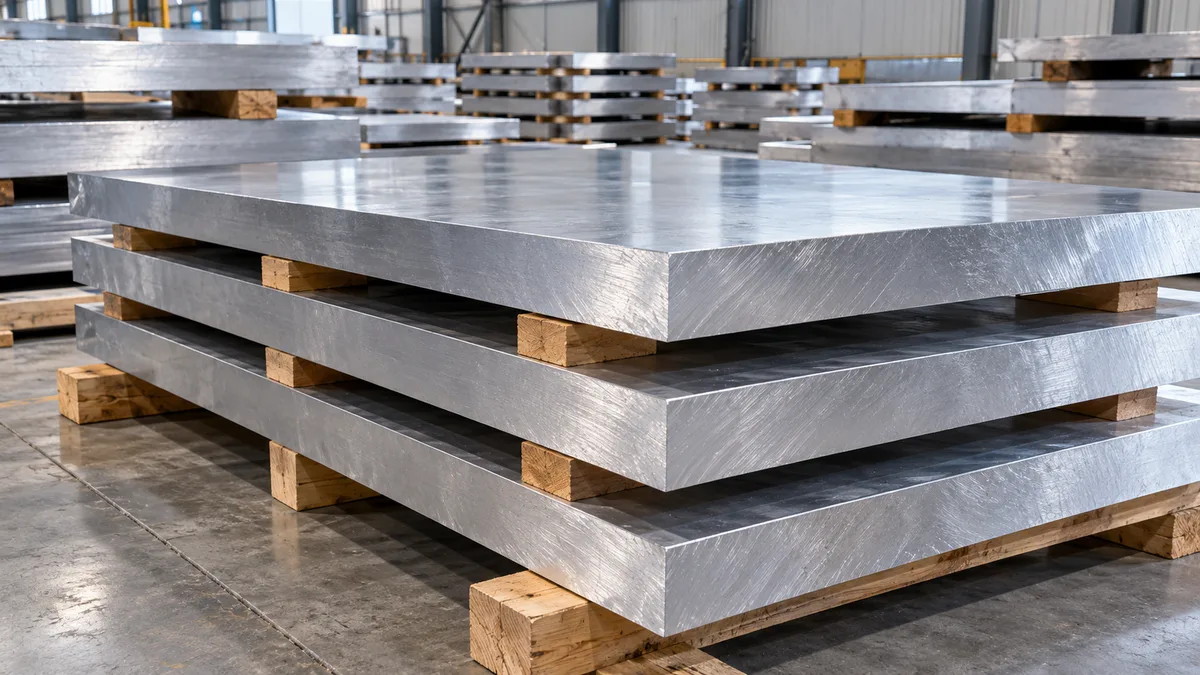
5083 contains about 4.0 – 4.9 % magnesium with 0.4 – 1.0 % manganese and a little chromium. It gains strength from magnesium in solid solution and from strain hardening, not from heat treatment, so welding does not destroy its properties the way it does in 6061 or 7075.
That is the reason 5083 dominates welded marine structures. In the as-welded condition a 5083 joint retains roughly its O-temper strength, which is high for an aluminium alloy, while the parent plate in H116 or H321 offers a minimum yield of 215 MPa. Corrosion resistance in seawater and marine atmospheres is excellent, and the alloy keeps or even improves its strength and toughness at cryogenic temperatures down to −196 °C, which is why it is used in LNG carrier tank structures and liquefied gas equipment.
Two cautions frame its use. First, 5083 should not be used for sustained service above about 65 °C, where magnesium-rich β-phase can form on grain boundaries and make the alloy susceptible to intergranular corrosion and stress corrosion cracking. Second, for plating in seawater you need the corrosion-tested H116 or H321 tempers rather than generic H32 or H34, because only these are verified against exfoliation.
Limits are the Aluminum Association values used by ASTM B209, ASTM B928 and EN 573-3 (EN AW-5083).
| Element | Minimum | Maximum | Role |
|---|---|---|---|
| Silicon (Si) | — | 0.40 | Impurity |
| Iron (Fe) | — | 0.40 | Impurity |
| Copper (Cu) | — | 0.10 | Kept low for corrosion resistance |
| Manganese (Mn) | 0.40 | 1.0 | Strength and grain control |
| Magnesium (Mg) | 4.0 | 4.9 | Main strengthening element |
| Chromium (Cr) | 0.05 | 0.25 | Grain control, stress-corrosion resistance |
| Zinc (Zn) | — | 0.25 | |
| Titanium (Ti) | — | 0.15 | Grain refiner |
| Others, each / total | — | 0.05 / 0.15 | |
| Aluminium (Al) | Remainder | About 92.4 – 95.6 % |
Specified minimums are the values to design with; typical values show what the plate usually achieves. Minimums fall for thick plate (above about 40 mm), so always read the band that matches your thickness.
| Temper | Tensile strength | Yield strength (0.2 %) | Elongation | Basis |
|---|---|---|---|---|
| O / H111 | 275 – 350 MPa | ≥ 125 MPa | ≥ 12 – 16 % | EN 485-2 / ASTM B209, sheet and plate to about 40 mm |
| H116 / H321 | ≥ 305 MPa | ≥ 215 MPa | ≥ 10 – 12 % | ASTM B928 / EN 485-2, about 4 – 40 mm |
| H116 / H321 thick plate | ≥ 285 MPa | ≥ 200 MPa | ≥ 10 % | ASTM B928, above 40 mm to 80 mm |
| H112 plate | ≥ 270 – 275 MPa | ≥ 110 – 125 MPa | ≥ 10 – 12 % | As-rolled plate, varies with thickness |
| O typical | 290 MPa | 145 MPa | 22 % | Typical |
| H116 / H321 typical | 317 MPa | 228 MPa | 16 % | Typical |
Strain hardened with special process control to pass the ASTM G66 exfoliation and G67 intergranular corrosion tests. Standard for hull, deck and superstructure plating.
Strain hardened and thermally stabilised, corrosion-tested in the same way. Equivalent in strength to H116; accepted by class rules interchangeably in most cases.
Annealed then lightly strain hardened (for example by levelling). The usual temper for pressure vessels, tanks and cryogenic equipment where forming and toughness matter.
Fully annealed: maximum ductility for heavy forming and spinning.
As-fabricated thick plate, used for machined parts, flanges and tooling.
Cast and precision-milled 5083 plate is a different product, chosen for flatness and stability in machined fixtures rather than for strength.
| System | Designation | Product standard |
|---|---|---|
| Aluminum Association / ASTM | 5083 | ASTM B928 (marine), ASTM B209 (general), ASME SB-209 (pressure vessels) |
| UNS | A95083 | — |
| European (EN) | EN AW-5083 / AlMg4.5Mn0.7 | EN 485-2, EN 573-3, EN 13195 (marine) |
| German Werkstoff | 3.3547 | DIN EN 485 |
| ISO | AlMg4.5Mn0.7 | ISO 6361 |
| Japan (JIS) | A5083P | JIS H4000 |
| China (GB) | 5083 | GB/T 3880, GB/T 3190 |
| Pressure equipment | 5083-O / H111 | ASME Section VIII via SB-209; EN 12392 for PED |
For classed vessels, the plate must be made and tested under the rules of the relevant society (DNV, ABS, LR, BV, ClassNK, KR, CCS and others) and certified accordingly, often with an EN 10204 3.2 certificate. Name the society and rule edition in your enquiry so we can confirm what certification can be supplied with the order.
5083 weighs 2.66 kg per m² for each millimetre of thickness.
| Thickness (mm) | kg per m² | 1250 × 2500 mm (kg) | 1500 × 3000 mm (kg) | 2000 × 6000 mm (kg) |
|---|---|---|---|---|
| 2 | 5.32 | 16.6 | 23.9 | 63.8 |
| 3 | 7.98 | 24.9 | 35.9 | 95.8 |
| 4 | 10.64 | 33.2 | 47.9 | 127.7 |
| 5 | 13.30 | 41.6 | 59.9 | 159.6 |
| 6 | 15.96 | 49.9 | 71.8 | 191.5 |
| 8 | 21.28 | 66.5 | 95.8 | 255.4 |
| 10 | 26.60 | 83.1 | 119.7 | 319.2 |
| 12 | 31.92 | 99.8 | 143.6 | 383.0 |
| 15 | 39.90 | 124.7 | 179.6 | 478.8 |
| 20 | 53.20 | 166.2 | 239.4 | 638.4 |
| 25 | 66.50 | 207.8 | 299.2 | 798.0 |
| 30 | 79.80 | 249.4 | 359.1 | 957.6 |
| 40 | 106.40 | 332.5 | 478.8 | 1276.8 |
| 50 | 133.00 | 415.6 | 598.5 | 1596.0 |
| 60 | 159.60 | 498.8 | 718.2 | 1915.2 |
| 80 | 212.80 | 665.0 | 957.6 | 2553.6 |
| 100 | 266.00 | 831.2 | 1197.0 | 3192.0 |
MIG and TIG with ER5183 (preferred for strength) or ER5356. The as-welded joint is designed to about O-temper strength: ASTM and class rules give welded minimums near 275 MPa tensile.
O and H111 form well. H116/H321 bend to moderate radii, typically 1.5 – 3 × thickness depending on gauge; do not heat to aid forming.
Fair. The alloy is soft and can be gummy; use sharp carbide tools with high rake and coolant.
Avoid sustained service above 65 °C. At cryogenic temperatures, strength and elongation increase.
Excellent in seawater. Isolate from copper alloys and stainless steel fasteners; avoid copper-based antifouling.
Possible, but the finish is less bright than 5005 or 6063; mainly used for protective rather than decorative purposes.
| Property | 5083-H116 | 5086-H116 | 5059-H116 | 5052-H32 | 6061-T6 |
|---|---|---|---|---|---|
| Min. yield | 215 MPa | 195 MPa | ≈ 270 MPa | 160 MPa | 240 MPa |
| Welded strength | High | Medium–high | Highest | Medium | Low |
| Seawater resistance | Excellent | Excellent | Excellent | Very good | Fair–good |
| Formability | Good | Good–very good | Fair–good | Very good | Limited |
| Above 65 °C | No | No | No | Yes | Yes |
| Availability | Very wide | Wide (Americas) | Limited | Very wide | Very wide |
5086 is a little weaker but easier to form, and is popular in North American boatbuilding. 5059 is the step up when weight saving justifies cost. For hot-service tanks, 5454 replaces 5083.
H111 is annealed and lightly strain hardened, giving high ductility for tanks and pressure vessels. H116 and H321 are stronger (minimum yield 215 MPa against 125 MPa) and are tested for exfoliation and intergranular corrosion, making them the correct choice for hull plating in seawater.
Yes. 5083-O and H111 keep their toughness down to −196 °C and gain strength as temperature falls, which is why they are used in LNG and liquefied gas equipment.
Prolonged heating above about 65 °C can precipitate β-phase (Al3Mg2) on grain boundaries. The material becomes sensitised and can suffer intergranular corrosion or stress corrosion cracking. Use 5454 or 5052 for hot service.
ER5183 is preferred because it matches the strength of the parent metal in the welded condition; ER5356 is also used where slightly lower weld strength is acceptable.
At 2.66 g/cm³, a 1500 × 3000 × 6 mm plate weighs about 71.8 kg and a 2000 × 6000 × 10 mm plate about 319 kg.
Yes, these are the same alloy under different naming systems; Werkstoff number 3.3547 and UNS A95083 also refer to it.
Send the temper, thickness, sizes, quantity, destination and any class requirement. We will confirm supply, certification and a delivered price.





