Flanges
Weld-neck, slip-on, blind and lap-joint flanges machined from forgings or thick plate, commonly 6061-T6 or 5083. See aluminium flanges.



Large diameter aluminium pipe covers round tube from about 300 mm up to more than 1.5 m in diameter, made by seamless extrusion, forging and boring, or by forming and welding plate and strip. The right route depends on diameter, wall thickness, pressure and alloy: seamless for pressure and critical service, spiral- or seam-welded for very large, thin-walled lines. This guide compares the options and explains sizes, standards, fittings and how to order.
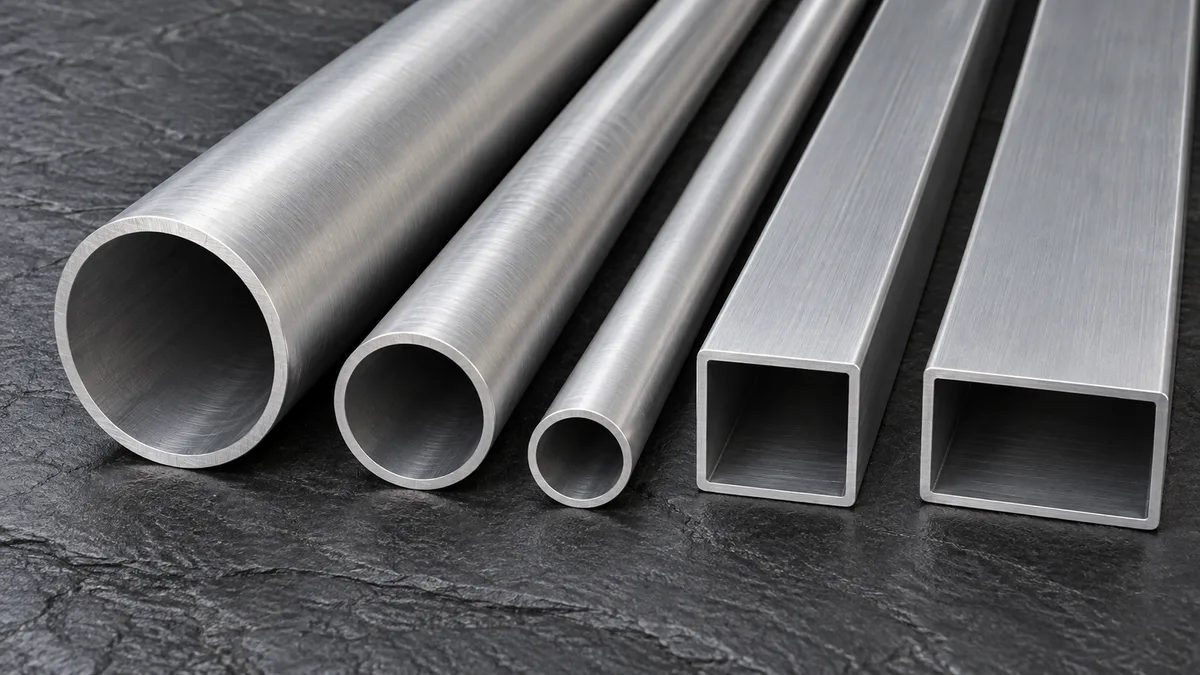
Most extruded aluminium tube and pipe is below about 300 mm (NPS 12) in diameter, the practical limit of ordinary horizontal presses. Larger sizes are made by heavier presses or by entirely different processes, and each process brings its own limits on wall thickness, length, alloy and quality.
Aluminium is chosen for large pipe because it is light (about one third of the weight of steel), does not rust, stays tough at cryogenic temperatures and is non-magnetic and non-sparking. That makes it a standard material for LNG and industrial gas lines, cryogenic transfer, ship and offshore piping, chemical process lines handling media that attack steel, large ducts, fire mains on vessels, and structural uses such as columns, towers and rollers.
In this guide, "pipe" refers to products sized by nominal pipe size (NPS) and schedule, and "tube" to products ordered by outside diameter and wall thickness. In large sizes the two often overlap, and most buyers specify outside diameter and wall directly.
| Route | Typical diameter range | Wall range | Strengths | Typical uses |
|---|---|---|---|---|
| Horizontal seamless extrusion | Up to about 500 mm | Medium to heavy | Seamless, good properties, standard sizes | Process piping, structural tube, cylinders |
| Large-press seamless extrusion (incl. vertical presses) | About 500 – 1,300 mm | Heavy walls, tens of mm up to about 200 mm | Seamless at very large size; long lengths | Pressure vessels, nuclear and petrochemical piping, large cylinders |
| Forged and bored | Up to about 1,000 mm | Heavy | Highest integrity; short lengths | Pressure parts, flanged spools, aerospace rings |
| Spiral (helical) welded | About 300 – 1,500 mm | Thin to medium (from a few mm) | Very large diameters economically, long lengths | Ducts, low-pressure lines, cooling water, structural columns |
| Rolled and longitudinally welded from plate | Almost any large diameter | Medium to heavy | Flexible sizes, short lead to custom diameters | Tanks, shells, large spools |
| Thin-wall extruded or drawn large tube | Up to about 500 mm | About 2 – 10 mm | Light, smooth, good tolerances | Rollers, frames, vacuum and instrument housings |
As a rule, choose seamless pipe when the line carries pressure, cyclic loads or hazardous media, or when a code requires it. Welded pipe is economical for large, thin-walled lines at low pressure, provided the joint efficiency of the weld is taken into account in the design. Forged and bored tube is reserved for short, heavy, critical parts.
| Alloy and temper | Main property | Weldability | Typical large-pipe service |
|---|---|---|---|
| 6061-T6 | Medium-high strength, good corrosion resistance | Good (HAZ softens) | Process piping, structural tube, pressure cylinders |
| 6063-T6 | Moderate strength, smooth finish | Good | Low-pressure lines, architectural columns, bus pipe |
| 6082-T6 | Higher strength than 6061 in heavy walls | Good | Structural and offshore tubulars |
| 5083-O / H112 | Excellent seawater and cryogenic performance, high as-welded strength | Excellent | LNG and cryogenic lines, marine piping, pressure vessels |
| 5086, 5052, 5754 | Good corrosion resistance and formability | Excellent | Marine piping, spiral-welded and seam-welded pipe |
| 3003 | Good formability and corrosion resistance, low strength | Excellent | Ducting, heat exchanger shells, thin-wall welded pipe |
| 7075-T6 / T73 | Very high strength | Not fusion welded | High-load structural tube, defence and aerospace parts |
| 2024, 2219, Al-Li alloys (2195, 2050) | High strength; 2219 and Al-Li for cryogenic aerospace tanks | 2219 and Al-Li weldable by specialised processes | Launch vehicle and aerospace structures |
For cryogenic and marine service, 5083 is usually the first choice because it keeps its strength after welding and has no ductile-to-brittle transition. For general process piping, 6061-T6 gives more strength in the as-supplied condition, but welded joints fall to a lower strength, which codes such as ASME B31.3 account for in allowable stresses.
Large aluminium pipe is often ordered to the dimensional system used for stainless steel pipe (ASME B36.19 schedules 5S and 10S, and ASME B36.10 schedule 40). The table gives calculated weights in aluminium at 2.70 g/cm³. Diameters beyond NPS 24, and non-standard walls, are ordered by outside diameter and wall thickness.
| NPS | OD (mm) | Sch 5S wall (mm) | kg/m | Sch 10S wall (mm) | kg/m | Sch 40 wall (mm) | kg/m |
|---|---|---|---|---|---|---|---|
| 12 | 323.8 | 3.96 | 10.8 | 4.57 | 12.4 | 10.31 | 27.4 |
| 14 | 355.6 | 3.96 | 11.8 | 4.78 | 14.2 | 11.13 | 32.5 |
| 16 | 406.4 | 4.19 | 14.3 | 4.78 | 16.3 | 12.70 | 42.4 |
| 18 | 457.2 | 4.19 | 16.1 | 4.78 | 18.3 | 14.27 | 53.6 |
| 20 | 508.0 | 4.78 | 20.4 | 5.54 | 23.6 | 15.09 | 63.1 |
| 24 | 609.6 | 5.54 | 28.4 | 6.35 | 32.5 | 17.48 | 87.8 |
Walls converted from ASME B36.19 / B36.10 inch values; confirm the edition required by your project specification. Weights exclude coatings and are for plain-end pipe.
For sizes beyond the NPS range, weight per metre is π × (OD − t) × t × 2.70 × 10⁻³ kg (OD and t in mm). A 1,000 mm OD tube with a 50 mm wall weighs about 403 kg/m; a 1,500 mm spiral-welded pipe with a 10 mm wall about 126 kg/m.
| Standard | Scope | Notes |
|---|---|---|
| ASTM B241 / ASME SB-241 | Seamless pipe and seamless extruded tube | Main specification for pressure piping in aluminium |
| ASTM B210 / ASME SB-210 | Drawn seamless tube | Smaller diameters, precision tube |
| ASTM B313 | Round welded tube | Welded from sheet or strip |
| ASTM B547 (withdrawn 2019) | Formed and arc-welded round tube, about 230 – 1,520 mm | Still cited in older project specifications for helically welded pipe |
| EN 755-2, -7, -8 | Properties and tolerances of extruded seamless and porthole tube | European orders |
| ASME B31.3 | Process piping code | Allowable stresses, weld joint factors, testing |
| Classification society rules (LR, DNV, ABS) | Pressure vessel and marine piping materials | Approved materials and survey requirements |
When a line is designed to a pressure code, the pipe grade and temper, weld joint efficiency, corrosion allowance and testing (hydrostatic test, radiography or ultrasonic testing of welds) all come from the code. Specify these on the purchase order so that certification matches the design basis. For pressure vessels approved by Lloyd's Register, see our pressure vessel pipe guide.
For a thin-walled pipe, the hoop stress from internal pressure is approximately p × D / (2 × t), where p is pressure, D the outside diameter and t the wall. Codes such as ASME B31.3 turn this into a required wall thickness using an allowable stress for the alloy and temper, a weld joint quality factor, and allowances for corrosion, threading and manufacturing tolerance.
Three aluminium-specific points change the answer compared with steel. First, allowable stresses are lower, so walls are thicker for the same pressure. Second, for welded construction in heat-treatable alloys such as 6061-T6, codes base allowable stress on the much lower as-welded strength, which often makes 5083 the more efficient choice for welded systems. Third, allowable stresses fall faster with temperature above about 100 – 150 °C, so aluminium piping is generally used from cryogenic temperatures up to moderate service temperatures.
| Design factor | Effect on large aluminium pipe |
|---|---|
| Diameter | Required wall rises in proportion to diameter for the same pressure |
| Alloy and temper | Higher allowable stress (e.g. 6061-T6 seamless) means thinner walls |
| Weld joint factor | Welded pipe needs a thicker wall than seamless unless welds are fully examined |
| Temperature | Allowable stress drops at elevated temperature; cryogenic service is favourable |
| External loads | Large thin-walled pipe may be governed by vacuum, buckling or support spacing rather than pressure |
Weld-neck, slip-on, blind and lap-joint flanges machined from forgings or thick plate, commonly 6061-T6 or 5083. See aluminium flanges.
Long-radius bends formed from pipe, or segmented mitre elbows welded from pipe sections for very large diameters. See aluminium elbows.
Extruded-outlet or fabricated tees for branch connections. See tee fittings.
Concentric and eccentric reducers between diameters. See reducer pipe.
Dished ends and caps for vessels and pipe ends, formed from plate.
Explosion-bonded aluminium-steel transition joints allow aluminium lines to be welded to steel structures without galvanic or welding problems.
Seamless aluminium pipe is produced up to about 1,300 mm OD on the largest presses, and spiral-welded pipe up to about 1,500 mm. Rolled and welded shells can be made larger. Feasibility depends on wall thickness, alloy and length.
Seamless for pressure service, cyclic loading, hazardous media or where the code requires it. Spiral-welded pipe suits large, thin-walled, low-pressure lines such as ducts and cooling water, where it is more economical.
5083 in O or H112 temper is the usual choice: it stays tough at cryogenic temperatures, welds well and keeps good strength in the weld zone. 6061-T6 is also used where higher parent strength is needed.
Weight per metre is π × (OD − wall) × wall × 0.0027 kg with dimensions in mm. For example NPS 24 schedule 10S (610 mm × 6.35 mm) weighs about 32.5 kg/m, and a 1,000 × 50 mm seamless tube about 403 kg/m.
Yes. Flanges, elbows, tees, reducers and caps in matching alloys can be supplied with the pipe, along with cutting, end bevelling and certification.
An EN 10204 3.1 mill test certificate with chemistry and mechanical results; NDT and pressure test reports where specified; 3.2 certification with third-party or class surveyor witness on request.
Send sizes, alloy, standard, quantity and destination. We will recommend the route and quote pipe and fittings delivered.





