5083 and 5456
The original weldable armour grades. Strength comes from magnesium in solution and cold work (H131), so welding does not destroy a heat treatment. Still the default for hulls that must be welded easily and survive salt water.



Aluminium armour has evolved through three generations of monolithic plate (weldable 5xxx, Al-Zn-Mg 7xxx and high-copper 2xxx) and now into roll-bonded laminates that stack hard and ductile 7xxx layers. This page explains how each type works, which alloys and specifications apply, and how armour plate is qualified and accepted, so you can match the material to your threat level and weight budget. Metline supplies armour plate to drawing and specification, with mill certificates, to defence integrators worldwide.
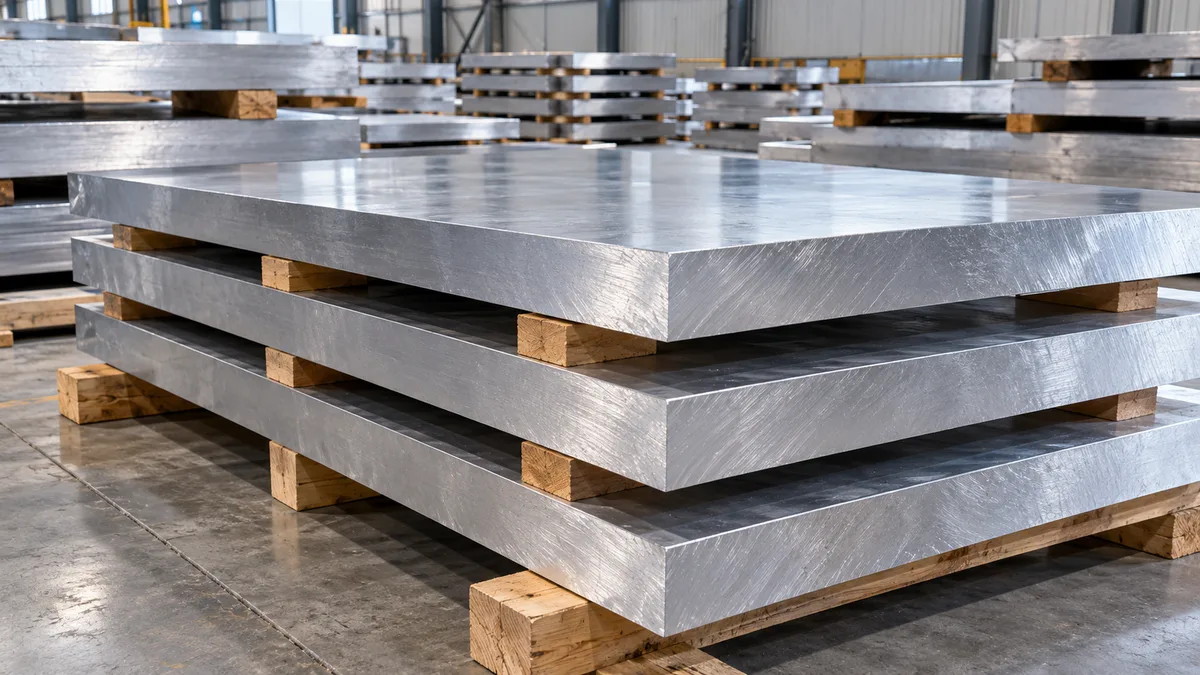
Aluminium armour plate is not chosen because it stops more per millimetre than steel; it does not. It is chosen because, at equal weight, an aluminium plate is roughly three times thicker than rolled homogeneous steel armour, and that extra thickness makes the hull far stiffer, easier to weld into a self-supporting structure, and more effective against fragments and small-arms threats per kilogram.
That logic, first proven on tracked personnel carriers in the 1960s, still drives the use of aluminium in light armoured vehicles, amphibious craft, naval superstructures and add-on (appliqué) armour kits. A thick aluminium hull doubles as the vehicle structure, so fewer frames and stiffeners are needed and the empty weight falls. It also helps with air transportability and with mobility on soft ground and over bridges with weight limits.
Against these benefits sit three engineering limits. Aluminium loses strength in the weld heat-affected zone, the high-strength grades can be sensitive to stress-corrosion cracking, and a single homogeneous plate tends to fail by plugging or spalling once a projectile has enough energy. Each generation of armour alloy, and finally the multi-ply composite plate, was developed to push one of those limits back.
Monolithic means a single alloy through the whole thickness. The table summarises the families; detailed pages for several grades are linked in the related section.
| Generation | Alloys | Typical tempers | Key strengths | Main limitation |
|---|---|---|---|---|
| 1st: Al-Mg (5xxx) | 5083, 5456, 5059 | H131, H116, H321, H136 | Excellent weldability, good seawater resistance, no heat treatment needed | Moderate strength; protection relies on thickness |
| 1st: heat-treatable | 6061, 2024 | T6, T351 | Higher hardness; useful for appliqué and equipment guarding | 2024 cannot be fusion welded; 6061 weld zone softens |
| 2nd: Al-Zn-Mg (7xxx) | 7039, 7020, 7017, 7018, 7A52, 7B52 | T64, T6, T651 | Better armour-piercing resistance than 5083 at equal weight; weldable | Stress-corrosion and exfoliation sensitivity, especially near welds |
| 2nd: unweldable 7xxx | 7075, 7085, 7056 | T6, T7x | Very high strength and hardness for bolted appliqué | Not fusion weldable; needs careful corrosion protection |
| 3rd: Al-Cu (2xxx) | 2519, 2139, 2195 (Al-Li) | T87, T8 | High ballistic efficiency with better stress-corrosion resistance than 7039 | Higher cost; 2519 does not weld to 5xxx or 7xxx by conventional methods |
The original weldable armour grades. Strength comes from magnesium in solution and cold work (H131), so welding does not destroy a heat treatment. Still the default for hulls that must be welded easily and survive salt water.
A higher-magnesium alloy with zinc and zirconium. It is stronger than 5083 in comparable tempers, giving better ballistic protection at the same thickness while keeping 5xxx weldability.
An Al-Zn-Mg alloy developed for better protection against armour-piercing rounds. It is weldable but must be designed and fabricated with stress-corrosion cracking in mind.
Weldable Al-Zn-Mg-Cu armour alloys widely used in light armoured vehicle hulls. 7A52 is relatively ductile; 7B52 is supplied as a laminated plate for floors and side armour.
Developed for the US Army as a weldable replacement for 5083 and 7039 on new vehicles. It gives higher ballistic resistance than 5083 and better stress-corrosion resistance than 7039.
Third-generation Al-Cu-Mg-Ag and Al-Cu-Li alloys with high strength and toughness. 2195 is lighter than conventional alloys because of its lithium content.
A composite armour plate is a laminate of several aluminium alloys bonded into one plate, usually by hot roll bonding and less often by explosive welding. A typical build alternates a high-strength, hard 7xxx alloy (for example 7A62) with a more ductile 7xxx alloy (7A52), with a thin, soft bonding layer of a low-zinc cladding alloy such as 7072 or 7A01 at every interface.
The hard layer erodes and blunts the projectile. The ductile layers then stretch and bend over a wide area instead of shearing out a plug. Each interface can delaminate locally, which absorbs energy and deflects the crack path, so fewer fragments leave the rear face. Published light-gas-gun and simulation studies on 7A52/7A62 laminates report clearly higher energy absorption than a monolithic plate of the same mass, and show that the thickness ratio and stacking order of hard and ductile layers are the main design variables.
| Build-up | Layer sequence (face to back) | Typical total thickness | Typical use |
|---|---|---|---|
| 3-ply | Hard 7xxx / weldable 7005-type core / hard 7xxx (5083 face possible) | To order | Light vehicle panels, honeycomb-backed armour |
| 5-ply | 7072 / 7A52 / 7072 / 7A62 / 7072 | 18, 20, 21, 25, 30 mm | Side and floor armour of light vehicles |
| 7-ply | 7072 / 7A52 / 7072 / 7A52 / 7072 / 7A62 / 7072 | About 25 mm | Hull panels where a higher threat level is needed |
| 9-ply | 7072 / 7A52 / 7072 / 7A52 / 7072 / 7A62 / 7072 / 7A62 / 7072 | 35 – 40 mm | Heavier protection at controlled weight |
Panel sizes of the order of 1500 × 5000 mm are typical for roll-bonded laminates; the exact width, length and layer ratio are agreed against the drawing and the ballistic requirement.
Closed-cell aluminium foam behind a hard face spreads blast and impact loads over time, cutting peak acceleration transmitted to the crew. It also adds acoustic damping. Foam is used under floors and in seats rather than as a stand-alone ballistic layer.
A dense armour face bonded to an aluminium honeycomb core gives a stiff, light panel for roofs, hatches and ship superstructures. The honeycomb crushes progressively under blast.
For armour-piercing threats, ceramic tiles are often bonded to an aluminium backing plate. The aluminium catches the fractured core and ceramic debris; 5083, 6061 and 7xxx plate are used as backings.
These constructions are designed as systems, so the aluminium part is specified by the armour designer. Metline supplies the plate, honeycomb and foam materials to that specification; we do not design or certify the armour system itself.
Limits below are the registered values for the internationally designated alloys. Chinese 7A-series grades have their own national limits and are supplied to the standard named in the order.
| Element | 5083 | 5456 | 5059 | 7039 | 2519 |
|---|---|---|---|---|---|
| Mg | 4.0 – 4.9 | 4.7 – 5.5 | 5.0 – 6.0 | 2.3 – 3.3 | 0.05 – 0.40 |
| Zn | ≤ 0.25 | ≤ 0.25 | 0.40 – 0.90 | 3.5 – 4.5 | ≤ 0.10 |
| Cu | ≤ 0.10 | ≤ 0.10 | ≤ 0.25 | ≤ 0.10 | 5.3 – 6.4 |
| Mn | 0.40 – 1.0 | 0.50 – 1.0 | 0.60 – 1.2 | 0.10 – 0.40 | 0.10 – 0.50 |
| Cr | 0.05 – 0.25 | 0.05 – 0.20 | ≤ 0.25 | 0.15 – 0.25 | — |
| Zr | — | — | 0.05 – 0.25 | — | 0.10 – 0.25 |
| Si | ≤ 0.40 | ≤ 0.25 | ≤ 0.45 | ≤ 0.30 | ≤ 0.25 |
| Fe | ≤ 0.40 | ≤ 0.40 | ≤ 0.50 | ≤ 0.40 | ≤ 0.30 |
| Other | Ti ≤ 0.15 | Ti ≤ 0.20 | Ti ≤ 0.20 | Ti ≤ 0.10 | V 0.05 – 0.15, Ti 0.02 – 0.10 |
| Al | Remainder | Remainder | Remainder | Remainder | Remainder |
Mechanical property minimums for armour plate are set by the governing military specification and vary with thickness, so they are reported lot by lot on the certificate rather than quoted as single numbers. As a guide, 5083-H131 sits around 300 MPa tensile, 7039-T64 and 7A52-T6 well above 400 MPa, and 2519-T87 around 480 MPa.
| Specification | Covers | Notes |
|---|---|---|
| MIL-DTL-46027 | Weldable 5083, 5456 and 5059 armour plate | Thickness about 6 – 76 mm, with heavier 5083 sections also covered |
| MIL-DTL-46063 | 7039 armour plate | Nominal thickness 12.7 – 101.6 mm (½ – 4 in) |
| MIL-DTL-46192 | 2519 rolled armour plate, T87 temper | ½ – 4 in; not weldable to 5xxx or 7xxx by conventional methods |
| MIL-DTL-32262 | 6055 weldable and 6061 unweldable appliqué plate | Medium-strength 6xxx options |
| MIL-DTL-32341 | 2139 armour plate | Third-generation Al-Cu-Mg-Ag |
| MIL-DTL-32375 | 7085 and 7056 unweldable appliqué plate | High-strength bolt-on armour |
| MIL-STD-662 | V50 ballistic limit test method | Referenced by the plate specifications for ballistic acceptance |
| National standards (GJB and others) | 7A52, 7B52 and laminated plate | Supplied to the national standard or drawing named in the contract |
Always quote the full specification and revision on your purchase order. Several of these documents have been revised or amended many times, and ballistic acceptance tables differ between revisions.
Military armour plate specifications use two levels of testing. A first-article inspection qualifies the alloy, temper and producer for each thickness; lot conformance inspection then checks every production lot.
| Test | First-article inspection | Lot conformance inspection |
|---|---|---|
| Chemical analysis | From each plate selected for ballistic testing | On every lot, against the specification limits |
| Tensile properties | Specimens from each ballistic test plate, often in several directions | Random plates in the lot, one specimen per sample |
| Ballistic (V50) test | Test plates of each contracted thickness, fired to MIL-STD-662 | One plate per lot selected at random and fired |
| Stress-corrosion or exfoliation test | Specimens from the ballistic test plate | Sample plate per lot, method per specification (e.g. ASTM G44/G47 for 7xxx, G66/G67 for 5xxx) |
| Ultrasonic inspection | Per specification or contract | Per specification or contract; checks laminates for bond defects |
Waterjet and abrasive cutting avoid heat damage at edges. Plasma and laser cutting are used on 5xxx plate, but the heat-affected edge on 7xxx and 2xxx should be machined back where the drawing specifies.
MIG with ER5356 or ER5556 filler. Strength loss in the weld zone is small for H131 plate, which is why 5083 hulls are easy to build.
ER5356 or ER5183 filler. Control heat input, avoid weld toes in high-stress areas and follow the programme rules on post-weld treatment to reduce stress-corrosion risk.
Cut and bevel so interfaces are not exposed to welding heat at critical areas; seal exposed edges against moisture. Check bond integrity ultrasonically after forming.
5xxx armour bends readily; high-strength 7xxx and 2xxx need larger radii and are usually formed before final ageing where the specification allows.
Use chemical conversion coating, CARC or equivalent paint systems, and isolate steel fasteners to prevent galvanic attack.
At the same areal density, a well-designed laminate of hard and ductile 7xxx layers absorbs more energy and produces fewer rear-face fragments than a monolithic plate, because the interfaces delaminate and the ductile layers stretch. It costs more and is harder to weld, so monolithic 5083 or 7039 remains common for welded hull structure.
5083, 5456 and 5059 weld easily. 7039, 7020, 7017 and 7A52 are weldable with care. 2519 is weldable to itself but not to 5xxx or 7xxx by conventional methods. 7075, 7085, 7056 and 2024 are treated as unweldable and are bolted on as appliqué.
It is the velocity at which a given projectile has a 50 % chance of fully penetrating the plate, determined by firing a series of shots under MIL-STD-662. Armour specifications list minimum V50 values for each plate thickness and threat.
5083 is cheap, widely available, resists seawater and welds with little strength loss. For amphibious and naval structures, and for hulls where thickness also provides stiffness, it remains the practical choice.
Roll-bonded laminates are typically made from about 18 mm (five layers) up to 35 – 40 mm (nine layers). The number of layers and the hard-to-ductile ratio are tuned to the threat.
Yes. We source armour plate to the specification and revision you name and supply it with EN 10204 3.1 mill certificates. Ballistic and corrosion test reports are provided where the contract requires them; tell us the tests at enquiry stage.
Send the specification, alloy or build-up, thickness, panel sizes and quantity. Our team will reply with availability, test documentation and a delivered price.





