


AKM Aluminium Alloy to GOST Standards
AKM is a Russian GOST designation in the heat-treatable aluminium-copper-magnesium-silicon family, the same group as the forging alloys AK6 and AK8. Buyers working to GOST drawings use it for strong, machinable sheet, plate and strip. This guide explains how the GOST system names and certifies these alloys, how AKM relates to better-known grades, and what to specify when ordering.
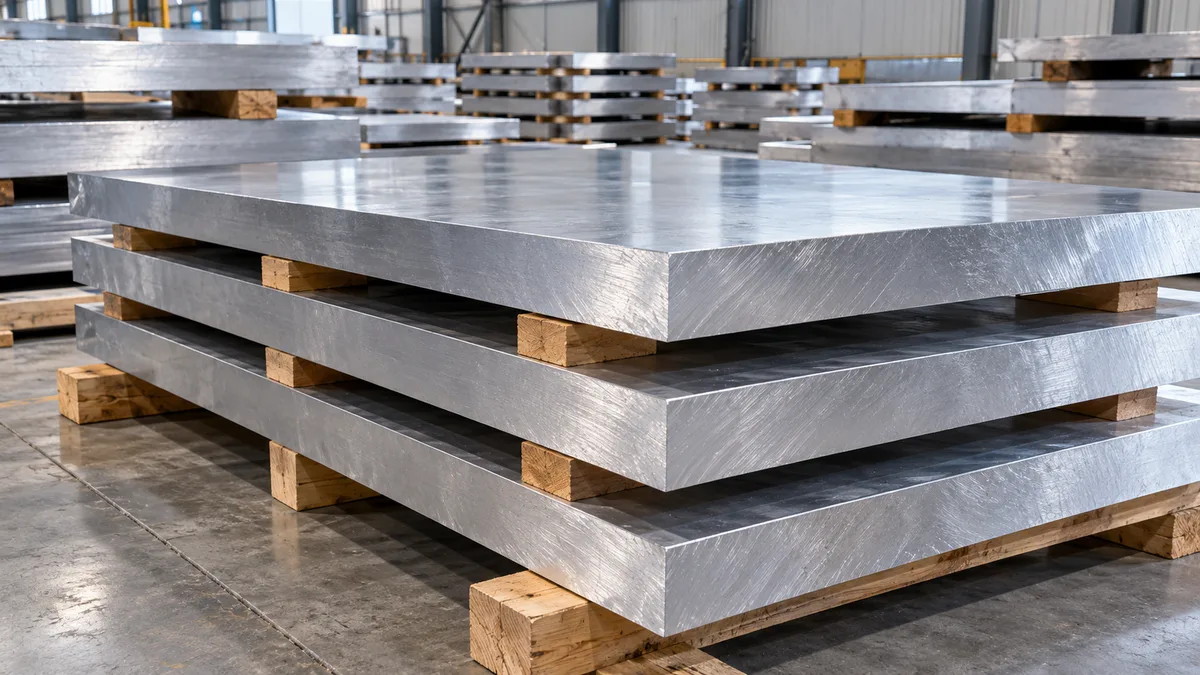
- Family
- Al-Cu-Mg-Si (heat-treatable)
- Related grades
- AK6, AK8, AV, D16
- Forms
- Sheet, plate, coil, strip
- Standards
- GOST 4784, 21631, 17232
What AKM aluminium alloy is
In the Russian and CIS designation system, the letters of a grade describe its alloying elements. "A" stands for aluminium, "K" (from kremniy) for silicon and "M" (from med') for copper, so AKM signals an aluminium alloy containing silicon and copper, with magnesium and manganese as further additions. Alloys of this type are heat-treatable: they gain most of their strength from solution treatment, quenching and ageing.
The closest widely documented relatives are AK6 (GOST number 1360) and AK8 (1380), the classic Russian forging alloys. AK8 corresponds closely to the international alloy 2014, while AK6 has a lower copper content and sits between 2014 and the 6xxx alloys. The copper and magnesium form strengthening precipitates on ageing, silicon promotes the Mg2Si phase and improves fluidity during hot working, and manganese refines grain and adds strength.
AKM appears on drawings and specifications from Russian, Kazakh, Belarusian and Ukrainian engineering practice, and on spare parts for equipment designed to those standards. Buyers outside the CIS often meet it when sourcing replacement parts or when a project requires GOST certification. Because GOST editions have changed over time and some grade names are used inconsistently in trade, the first step on any AKM order is to confirm which standard and edition defines the grade on your drawing.
Composition of AKM and related GOST grades
Exact limits for AKM must be taken from the edition of the standard named on your order, and each Metline delivery reports the actual analysis on the mill certificate. For orientation, the table shows the registered composition of the closest related GOST alloys from GOST 4784, so you can see where the Al-Cu-Mg-Si family sits.
| Element (wt %) | AK6 (1360) | AK8 (1380) | AV (1340) | D16 (1160) |
|---|---|---|---|---|
| Copper (Cu) | 1.8 – 2.6 | 3.9 – 4.8 | 0.1 – 0.5 | 3.8 – 4.9 |
| Magnesium (Mg) | 0.4 – 0.8 | 0.4 – 0.8 | 0.45 – 0.9 | 1.2 – 1.8 |
| Silicon (Si) | 0.7 – 1.2 | 0.6 – 1.2 | 0.5 – 1.2 | ≤ 0.5 |
| Manganese (Mn) | 0.4 – 0.8 | 0.4 – 1.0 | 0.15 – 0.35 | 0.3 – 0.9 |
| Iron (Fe) | ≤ 0.7 | ≤ 0.7 | ≤ 0.5 | ≤ 0.5 |
| Nearest international grade | between 2014 and 6061 | 2014 | 6151 / 6061 | 2024 |
Limits as registered in GOST 4784 for the related grades; minor elements (Zn, Ti, Ni, Cr) and their limits are omitted for clarity. AKM itself is supplied to the limits of the standard on the order.
Properties and GOST temper designations
GOST uses letter suffixes rather than the T-codes of the Aluminum Association. Knowing them avoids most ordering errors, because a sheet ordered "AKM" without a temper letter may be supplied in a different condition from the one on the drawing.
| GOST suffix | Meaning | Nearest EN / AA temper |
|---|---|---|
| M | Annealed (soft) | O |
| T | Solution treated and naturally aged | T4 |
| T1 | Solution treated and artificially aged | T6 |
| T2, T3 | Over-aged variants for corrosion or stress resistance | T7x |
| N, N2, N3, N4 | Cold worked (hard, half hard and intermediate) | H18, H14, etc. |
| No suffix / GK | As fabricated or hot rolled, without heat treatment | F, H112 |
| A, B (cladding) | Normal or technological cladding on sheet | Alclad |
In the annealed condition, alloys of the AKM type are soft and formable. After solution treatment and artificial ageing they reach strengths comparable to the 2xxx forging alloys, well above 6061-T6, while retaining reasonable elongation. The guaranteed tensile strength, proof stress and elongation for each thickness band are set by the sheet or plate standard and printed on the certificate; ask for those values for the exact thickness you need rather than using a single figure for all sizes.
Like other copper-bearing alloys, AKM has lower general corrosion resistance than 5xxx and 6xxx grades. Parts for humid or marine service are usually anodised, painted or ordered with cladding.
GOST standards for AKM sheet, plate and strip
| Standard | Scope |
|---|---|
| GOST 4784 | Wrought aluminium and aluminium alloys: grades and chemical composition (current edition 2019) |
| GOST 1131 | Wrought aluminium alloys in ingots: grades |
| GOST 21631 | Sheets of aluminium and aluminium alloys: dimensions, tolerances and properties |
| GOST 17232 | Plates of aluminium and aluminium alloys |
| GOST 13726 | Strips of aluminium and aluminium alloys |
| GOST 1497 | Metals: methods of tensile testing |
A GOST order therefore normally cites two standards: one for the grade (GOST 4784 or the relevant composition standard) and one for the product form. Industry standards (OST) from aerospace and defence ministries add further grades and test requirements. Our GOST standard buyer's guide explains how the system fits together.
Supply range for AKM and related GOST alloys
Typical supply range
- Sheet
- 0.5 – 10.5 mm thick; widths 1,000 – 2,000 mm; lengths 2,000 – 7,000 mm
- Plate
- 10 – 60 mm and thicker on request; widths up to 2,500 mm; lengths up to 12,000 mm
- Coil
- 0.3 – 6 mm thick; widths 500 – 1,500 mm
- Strip
- 0.3 – 3 mm thick; slit widths 20 – 500 mm
- Tempers
- M, T, T1 and others to the order standard
- Processing
- Cut-to-size blanks, saw and waterjet cutting, PVC film
- Documents
- Mill certificate (EN 10204 3.1) with chemistry and mechanical results; RoHS and REACH declarations on request
Availability of a particular GOST grade varies; where AKM is not available, we can propose a documented equivalent for your approval.
Equivalents and when substitution is acceptable
There is no single official cross-reference for AKM. The right substitute depends on what the part needs, and any substitution should be approved by the design authority.
| Need on the drawing | Candidate grades | Comment |
|---|---|---|
| Highest strength, forging-type alloy | 2014 / EN AW-2014 (≈ AK8) | Stronger than AK6-type alloys; lower corrosion resistance |
| Moderate copper, good forgeability | 2014A, 6061, 6151 | Choose by required strength and weldability |
| Weldability and corrosion resistance | 6061, 6082 | Lower strength but much better in humid service |
| High strength sheet with fatigue resistance | 2024 / D16 | Different chemistry; check formability and cladding needs |
Where AKM-type alloys are used
- Machinery and equipment: strong machined parts, frames and housings built to GOST drawings
- Transport: brackets, structural components and spare parts for vehicles and rolling stock designed to CIS standards
- Aerospace and defence: forged and machined fittings, where alloys of the AK6 and AK8 type are traditional choices
- Forgings and stampings: the Al-Cu-Mg-Si family hot-works well into complex die forgings
- Replacement parts: maintenance of equipment originally manufactured in the CIS, where certified like-for-like material is required
How to order AKM from Metline
- SpecifyGrade (AKM), temper suffix, grade and product standards with editions, thickness, width, length and quantity.
- ReviewWe check the specification and confirm availability, or propose a documented equivalent for your approval.
- QuoteWe confirm tolerances, certification and delivery terms (EXW, FOB, CIF or DAP).
- Process and inspectMaterial is cut to size if required and inspected for dimensions and surface.
- ShipExport-packed on pallets or in wooden cases, with mill certificate and packing list.
References and standards
- GOST 4784-2019 – Aluminium and wrought aluminium alloys: grades
- GOST 21631 – Sheets of aluminium and aluminium alloys: specifications
- GOST 17232 – Plates of aluminium and aluminium alloys: specifications
- The Aluminum Association – International Alloy Designations and Chemical Composition Limits
- ASM Handbook, Vol. 2 – Properties and Selection: Nonferrous Alloys and Special-Purpose Materials
AKM aluminium (aluminum) alloy: frequently asked questions
What does AKM mean in a GOST aluminium grade?
In the Russian designation system, A stands for aluminium, K for silicon and M for copper. AKM therefore indicates an aluminium-silicon-copper alloy, with magnesium and manganese, in the heat-treatable family.
What is the equivalent of AKM aluminium alloy?
There is no official one-to-one equivalent. Depending on the strength and corrosion resistance needed, 2014, 2014A, 6061 or 6151 may be suitable, but the design authority should approve any substitution.
Is AKM heat-treatable?
Yes. Like AK6 and AK8, it is strengthened by solution treatment, quenching and ageing. The temper is shown by GOST suffixes such as M (annealed), T (naturally aged) and T1 (artificially aged).
Which GOST standards apply to AKM sheet and plate?
The grade is defined in a composition standard such as GOST 4784, while sheet is supplied to GOST 21631, plate to GOST 17232 and strip to GOST 13726. Always quote the edition.
Can AKM be welded?
Copper-bearing heat-treatable alloys of this type are difficult to fusion weld and lose strength near the weld. Mechanical fastening is usually preferred; if welding is essential, consider a weldable 6xxx substitute.
Do you ship GOST aluminum grades internationally?
Yes. Metline supplies GOST and international aluminium grades worldwide, with mill certificates, cutting to size and export packing.
Sourcing AKM or another GOST alloy?
Send the grade, temper, standards, sizes and quantity. We will confirm availability or a documented equivalent, with certification and a delivered price.





