Rectangular / square ports
The most common design. Easy to extrude and inspect, with a good balance of flow area and wall strength.



Micro-channel tube is a flat aluminium extrusion divided into many small parallel ports, brazed to louvred fins to make compact, light heat exchangers. It is the standard tube for vehicle air-conditioning condensers and is now widely used in radiators, heat pumps and EV battery cooling. Metline supplies micro-channel tube in 1050, 1100, 3003 and 3102, bare or coated, in coils or cut lengths, to heat-exchanger makers worldwide.
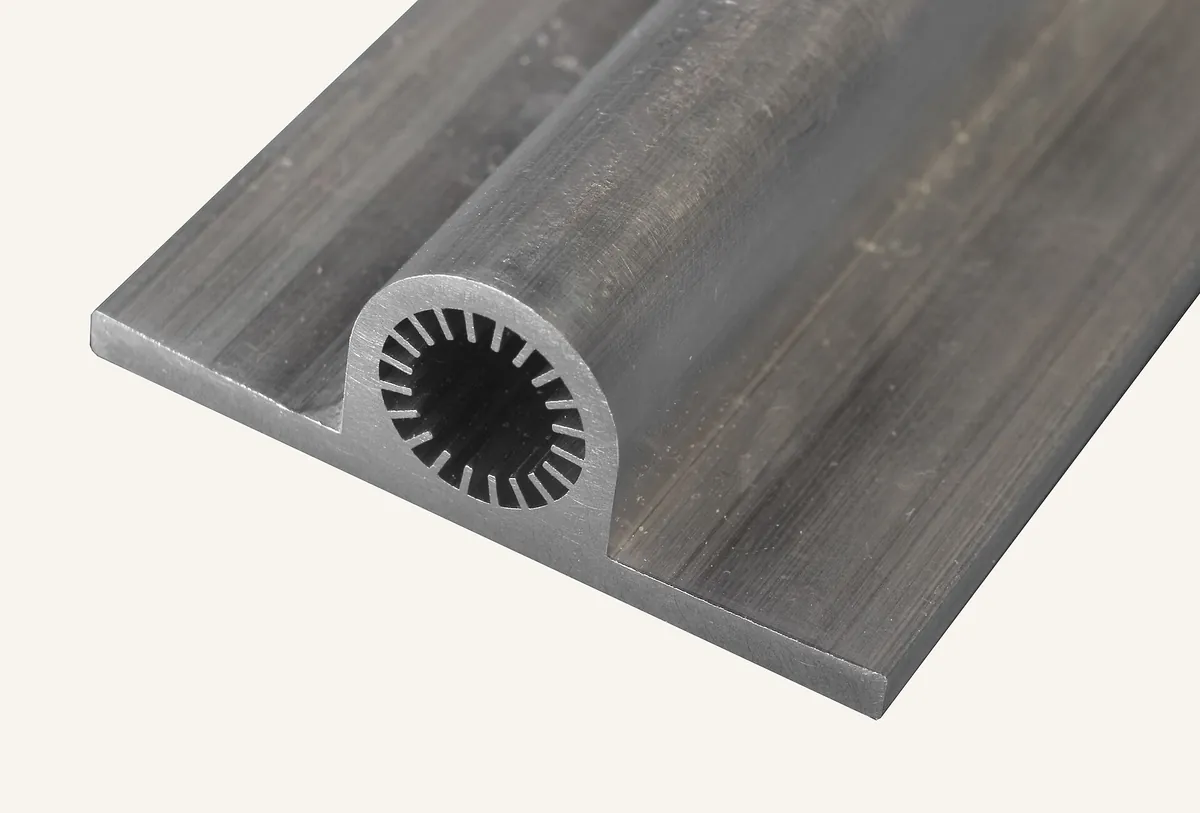
A micro-channel tube, also called a multi-port extrusion (MPE) or parallel-flow tube, looks like a thin aluminium ribbon. Inside, thin webs divide it into a row of small ports, each with a hydraulic diameter typically around 0.5 – 1 mm. Refrigerant or coolant flows through the ports while air flows across fins brazed to the flat outer faces.
Small ports give a very high ratio of internal surface area to volume, and they let thin walls carry high pressure. Compared with a round-tube-and-fin design of the same duty, a micro-channel exchanger is typically smaller, lighter and needs less refrigerant charge. Air-side pressure drop is also lower, because the flat tube presents a slim profile to the airflow.
That is why micro-channel tube replaced round copper tube in vehicle condensers decades ago and has since spread to radiators, evaporators, heat-pump outdoor coils and stationary HVAC equipment. In electric vehicles, flat multi-port tubes and wider MPE sections carry coolant along battery modules, where a slim profile and a flat contact face are exactly what pack designers need.
The most common design. Easy to extrude and inspect, with a good balance of flow area and wall strength.
Better pressure resistance for a given wall, used in higher-pressure and CO2 systems.
Increase internal surface area for better heat transfer, at the cost of higher pressure drop and harder extrusion.
Small ribs inside each port enlarge the wetted surface; common in high-efficiency condensers.
Thicker webs or end walls where tubes must resist stone impact, crushing during assembly or very high pressure.
Sections 60 mm wide or more for battery cooling, often bent into a serpentine that runs between cell rows.
Related tube types made from clad strip rather than extrusion include folded B-type tube and HF welded tube, used mainly in radiators and heater cores. See our B-type tube guide and welded tube page.
Micro-channel tube must extrude through very fine dies at high speed, so softer alloys with low alloy content dominate. Stronger 3xxx alloys are chosen where pressure, corrosion life or post-braze strength demands it.
| Alloy | Main composition | Character | Typical use |
|---|---|---|---|
| 1050 | Al ≥ 99.50 % | Excellent extrudability and thermal conductivity | Condensers, battery cooling tube |
| 1100 | Al ≥ 99.00 %, Cu 0.05 – 0.20 % | Slightly stronger; copper makes it marginally more noble | Condensers and radiators, often zinc-coated |
| 1197 | High-purity aluminium (about 99.97 %) | Very low impurities for uniform corrosion behaviour | Long-life tube with zinc diffusion layer |
| 3102 | Mn 0.05 – 0.40 % | Small Mn addition: more strength while keeping extrudability; good corrosion behaviour | Condensers and evaporators |
| 3003 | Mn 1.0 – 1.5 %, Cu 0.05 – 0.20 % | Highest strength of the group; harder to extrude | High-pressure tube, CO2 systems, radiators |
Long-life tube alloys are often modified with small, controlled additions of manganese, titanium or zinc diffusion from a surface coating. Agree the chemistry and corrosion test with the heat-exchanger maker.
Micro-channel tube is supplied as extruded (H112), sometimes described as H12 when lightly sized. After brazing at about 600 °C the tube is annealed, so heat-exchanger design should use O-temper strength for the finished core.
| Alloy | Temper | Tensile strength (min.) | Yield strength (min.) | Elongation A50 (min.) |
|---|---|---|---|---|
| 1050 | H112 | 60 MPa | 20 MPa | 23 – 25 % |
| 1100 | H112 | 75 MPa | 20 MPa | 20 % |
| 3102 | H112 | about 75 – 80 MPa | about 30 MPa | about 22 % |
| 3003 | H112 | 95 MPa | 35 MPa | 20 % |
| Dimension | Typical range |
|---|---|
| Width (W) | 6.0 – 60.0 mm; wide MPE up to several hundred mm |
| Height (H) | Up to about 3.5 mm for standard tube |
| Flat wall thickness (t1) | 0.15 – 0.45 mm |
| Web (rib) thickness (t2) | 0.15 – 0.45 mm |
| Side wall thickness (t3) | 0.30 – 0.80 mm |
| Port hydraulic diameter | about 0.5 – 1.0 mm |
| Number of ports | From a few to more than 20 in standard tube; up to about 80 in wide MPE |
| Supply form | Detail |
|---|---|
| Straight lengths | 50 – 6000 mm, plain or with necked (reduced) ends for header insertion |
| Coils | ID about 400 – 550 mm, OD about 700 – 1500 mm, coil width about 300 – 1000 mm |
Typical cross-section tolerances agreed for condenser tube are shown below. Height is held tightest because it decides fin fit and header slot fit.
| Width | Height | Flat wall | Webs | Side wall |
|---|---|---|---|---|
| ±0.05 mm | ±0.02 mm | ±0.05 mm | ±0.08 mm | ±0.08 mm |
| Length or feature | Tolerance |
|---|---|
| Length ≤ 1000 mm | ±0.5 mm |
| Length > 1000 – 2000 mm | ±1.5 mm |
| Length > 2000 – 6000 mm | ±2.0 mm |
| Necked end width / height (positioning) | ±0.05 / ±0.03 mm |
| Neck length (positioning) | ±0.3 mm |
| Straightness | ≤ 0.3 mm per 300 mm; ≤ 1.0 mm per metre overall |
| Twist | ≤ 1.0 mm per metre |
Coatings applied in line after extrusion serve two purposes: corrosion protection of the thin tube walls, and brazing preparation so that less flux or filler is needed later.
| Coating | What it is | Purpose | Typical use |
|---|---|---|---|
| Zinc arc spray | Thin zinc layer sprayed on the flat faces at the press | Diffuses into the surface during brazing, forming a zinc-rich sacrificial layer that stops pitting from perforating the tube | Condensers and radiators exposed to road salt |
| Flux coating | Potassium fluoroaluminate (NOCOLOK-type) flux bonded with a binder | Removes oxide in the furnace without spraying flux on the whole core | CAB-brazed cores with bare fins or clad fins |
| Si-flux coating | Flux mixed with silicon powder, sometimes with zinc | Silicon reacts with the tube surface to form filler metal in situ, so bare (unclad) fins can be used | Cost-reduced cores with bare fins |
| Bare | No coating; clean, oil-free surface | Lowest cost; flux sprayed on assembled core | Indoor HVAC, protected locations |
| E-coat (after brazing) | Electrophoretic paint on the finished exchanger | Extra barrier against aggressive environments | Coastal, industrial and heavy-duty duty |
Zinc load and flux load are measured in grams per square metre and agreed with the brazer. Too little zinc gives poor protection; too much can drive excessive corrosion of fins and fillets. Flux coatings are checked for adhesion so that they survive cutting and core assembly.
Ports must be continuous and leak-free over the whole coil. Eddy-current inspection at the press detects wall defects; finished cores are helium- or pressure-decay tested.
Each tube design is burst-tested to a pressure set by the system maker, normally several times the maximum operating pressure. CO2 systems run several times higher pressures than R134a or R1234yf and need heavier walls, round ports or 3003-type alloys.
Acidified salt spray (SWAAT, ASTM G85 Annex A3) and neutral salt spray (ASTM B117) are the usual tests, run on brazed samples for the hours the OEM specifies.
Ports must be free of extrusion debris and the outer surface free of oil, which would prevent flux wetting and leave unbrazed fins.
Width, height and wall thickness are measured continuously or by frequent sampling; profile projectors check port geometry.
Each coil carries a label linking it to the cast, extrusion run and test results on the EN 10204 3.1 certificate.
| Application | Typical tube | Notes |
|---|---|---|
| Air-conditioning condenser | 1100 / 3102, zinc-sprayed, 12 – 20 mm wide | The classic micro-channel application |
| Engine radiator | 3003 or long-life alloys, wider tube | Lower pressure, larger hydraulic diameter |
| Evaporator (micro-channel type) | 3102 / 1100, with condensate drainage design | Also used with plate-type evaporators |
| Heat-pump exchangers | 3003 / 3102, robust ports | Reversible operation; may run as condenser and evaporator |
| EV battery cooling | Wide MPE or serpentine tube in 1050 / 3003 | Flat contact face along cell rows |
| Inverter, motor and charger cooling | Flat tube or MPE | Compact liquid cooling |
| Stationary HVAC and refrigeration | Condenser and gas-cooler tube | Lower refrigerant charge, lighter coils |
In a typical condenser, flat tubes run between two vertical header pipes, with louvred brazing-clad fins between the tubes. The whole core, including headers, tubes, fins and side plates, is brazed in one pass in a CAB furnace at about 600 °C. Our condenser header pipe guide covers the header side.
| Factor | Micro-channel (all aluminium) | Round tube and fin (Cu or Al tube) |
|---|---|---|
| Heat transfer per unit volume | High | Moderate |
| Weight | Low | Higher, especially with copper |
| Refrigerant charge | Lower | Higher |
| Air-side pressure drop | Lower | Higher |
| Joining | Single furnace braze | Mechanical expansion plus brazed bends |
| Repairability | Limited; usually replaced | Easier to repair |
| Galvanic risk | Low (single metal family) | Higher with copper tube and aluminium fins |
A flat aluminium extrusion divided into many small parallel ports. Brazed to fins, it forms compact heat exchangers such as vehicle condensers and radiators.
Mainly 1050, 1100 and 3102 for their extrudability and conductivity, and 3003 where higher strength or pressure rating is needed. High-purity 1197 is used for some long-life designs.
Zinc diffuses into the surface during brazing and forms a sacrificial layer. Corrosion then spreads sideways in that layer instead of pitting through the thin wall.
Yes. It can be bent across its width (hard-way bends in serpentine coils) or along its flat face with suitable tooling and radii. Annealed or soft alloys bend more easily; the port design decides the minimum radius.
Yes, with designs rated for the much higher pressures of CO2: thicker walls, round or reinforced ports and often 3003-type alloys.
Wide multi-port tubes or serpentine tubes run alongside cell rows, carrying coolant. The flat face gives good thermal contact with the cells or a thermal interface pad.
In coils for in-line straightening and cutting, or as straight cut lengths with plain or necked ends.
Send the section drawing, alloy, coating and volume. We will reply with feasibility, certification and a delivered price.






