Porous aluminium foam sheet is solid aluminium with 60–90 % of its volume replaced by gas cells, giving a rigid, non-combustible plate that weighs a fraction of solid metal. Open-cell foam absorbs sound and lets air or fluid pass; closed-cell foam insulates, blocks sound and soaks up impact energy. This guide explains how to choose between them, what the property data mean, and how to specify foam panels for supply from Metline.
Aluminium foam is a cellular metal: a continuous aluminium skeleton surrounding a network of pores. It keeps the things that make aluminium useful (stiffness, non-combustibility, corrosion resistance, recyclability) while adding properties solid metal does not have, such as sound absorption, low thermal conductivity and the ability to crush progressively and absorb a large amount of energy at a nearly constant force.
Two numbers describe any foam: porosity (the share of the volume that is empty, usually 60–90 %) and cell size (the average pore diameter, usually 0.5–10 mm). Density follows from porosity. A foam with 90 % porosity has a density of about 0.27 g/cm³, roughly one tenth of solid aluminium (2.70 g/cm³) and light enough to float on water. Most commercial plate falls between 0.2 and 0.7 g/cm³ for closed-cell grades, with denser open-cell grades used where strength or filtration matters.
The other key distinction is whether the cells are connected. In open-cell foam the pores link to each other and to the surface, so sound waves, air and liquids can enter. In closed-cell foam each pore is sealed by thin cell walls, so the plate is airtight, buoyant and a good insulator. The two behave so differently that they should be treated as separate materials when you specify them.
Types
Open-cell vs closed-cell aluminium foam
Characteristic
Open-cell foam
Closed-cell foam
Pore structure
Interconnected pores open to the surface
Sealed pores separated by thin walls
Typical density
About 0.25 – 1.05 g/cm³
About 0.2 – 0.7 g/cm³
Typical porosity
About 60 – 75 %
About 75 – 90 %
Typical cell size
About 0.5 – 10 mm (set by the process)
About 3 – 8 mm
Sound
Absorbs sound inside the pores
Reflects and insulates; limited absorption unless perforated or drilled
Air and fluid
Permeable: used for filters, silencers, flame arresters and heat exchangers
Impermeable and buoyant
Thermal role
Heat dissipation: high surface area for forced-air or liquid cooling
Thermal insulation
Mechanical role
Higher-density grades carry load; used in filters and diffusers
Energy absorption, crash and blast protection, sandwich cores
Noise barriers, rail and vehicle panels, crash boxes, fire doors, ship interiors
Open-cell foam is commonly offered in three cell-size classes (large, medium and small), and as panels open on one face or on both faces. A panel open on both faces absorbs sound from both sides and lets air through; a panel open on one face has a closed back skin and is used as a wall or ceiling lining. Closed-cell foam can be supplied with its natural cast skin, with the skin machined off to expose the cells, or perforated to add sound absorption.
Property data
Typical properties of aluminium foam plate
Foam properties depend strongly on density, cell size and process, so published figures vary between producers. The ranges below are typical values for commercial plate, used for first selection. Final design values should come from the test report for the specific grade and density you order.
Property
Open-cell plate
Closed-cell plate
Test basis
Density
0.25 – 1.05 g/cm³
0.25 – 0.70 g/cm³
Mass ÷ volume
Porosity
60 – 70 %
75 – 90 %
1 − (foam density ÷ 2.70)
Compressive (plateau) strength
Rises sharply with density; dense grades reach tens of MPa
About 3 – 17 MPa, depending on density
ISO 13314
Bending strength
Higher than closed-cell at equal thickness for dense grades
About 3 – 15 MPa
Three-point bend
Sound absorption coefficient
About 0.5 – 0.85 (20 mm plate, 2 kHz)
About 0.4 – 0.8 when perforated or drilled
ISO 354 / ISO 10534-2
Thermal conductivity
Far below solid aluminium
Of the order of a few W/m·K, versus about 200+ W/m·K for solid aluminium
Steady-state method
Electromagnetic shielding
Producers report 60 – 90 dB for thick plate
Producers report 60 – 90 dB for thick plate
Frequency-dependent test
Reaction to fire
Non-combustible metal
Non-combustible metal
EN 13501-1 classification for coated products
Plateau strength scales roughly with relative density to the power 1.5, so a small change in density changes strength a lot. Always quote density with any strength figure.
The compressive stress–strain curve of a closed-cell foam is what makes it valuable for protection. After a short elastic region, the cells buckle and collapse one layer after another at a nearly flat "plateau" stress, until the foam is crushed to about 30–40 % of its original thickness and stiffens. The area under that plateau is the energy absorbed. Designers pick the density so that the plateau stress keeps the force on the protected structure, or on a vehicle occupant, below a safe limit while the stroke absorbs the required energy.
Production
How aluminium foam sheet and plate are produced
Melt foaming with blowing agent
A metal hydride (usually titanium hydride, TiH2) is stirred into molten aluminium thickened with calcium. The hydride releases hydrogen and the melt rises like bread. The block is cooled and sliced into plate. Produces fine, uniform closed cells; a slow-release blowing agent gives more time for even foaming.
Gas injection
Air or another gas is blown into an aluminium melt containing ceramic particles (such as SiC or Al2O3) that stabilise the bubbles. The foam is drawn off continuously as a slab. Cost-effective for large closed-cell panels with coarser cells.
Powder metallurgy
Aluminium powder and a blowing agent are compacted into a dense precursor, which expands when heated in a mould. Suited to shaped parts, foam-filled tubes and foam cores bonded metallurgically to aluminium skins.
Infiltration (space holder)
Molten aluminium is pressed into a bed of removable particles, typically salt grains, which are dissolved out afterwards. Gives open-cell foam with a cell size set by the particle size, from fine to coarse.
Investment casting and sintering
A polymer foam pattern is replicated in aluminium, or aluminium powder or fibres are sintered. Produces very regular open-cell structures for heat exchangers and filters.
Hollow spheres
Aluminium or ceramic hollow spheres are bonded or cast into a matrix to make a syntactic or sphere foam with very uniform cells.
Melt-foamed material shows a slight density gradient from top to bottom, because gravity drains liquid metal down the cell walls before the foam solidifies. Producers control this with melt viscosity and foaming time, and by slicing plate from the uniform middle of the block. If density uniformity matters for your design, ask for density measured on samples from several positions.
Supply
Sizes, finishes and how to specify foam plate
Typical supply range
Form
Sheet, plate and block; cut panels; foam cores and foam sandwich panels
Thickness
Commonly about 5 – 50 mm for panels; thicker blocks for energy-absorbing parts
Panel size
Cut to size from larger slabs; agree maximum panel size with the grade
Surface
Natural skin, skin removed, perforated, painted or powder-coated, laminated to sheet
Processing
Saw cutting, waterjet, CNC routing, drilling, bonding to skins
Foam panels are made to order. State the property you need (sound absorption, insulation, energy absorption) as well as the size, so the right type and density can be matched.
Choose the typeOpen-cell for sound absorption, ventilation, filtration and heat dissipation; closed-cell for insulation, impact absorption and stiff light cores.
Set density and cell sizeHigher density raises strength and stiffness; finer cells give more uniform behaviour and better acoustic absorption at high frequency.
Fix thickness and sizeAcoustic absorption at low frequency improves with thickness and an air gap behind the panel.
Specify surface and edgesNatural skin, open faces, perforation pattern, coating colour and edge trimming.
Agree testsDensity, compression to ISO 13314, sound absorption to ISO 354 or ISO 10534-2, and fire classification where required.
Working with foam
Cutting, joining and finishing foam panels
Cutting
Band saws, circular saws with fine-tooth carbide blades, and waterjet all cut foam cleanly. Support the panel close to the cut so thin cell walls are not torn.
Drilling and fixing
Drill with sharp bits at moderate feed. Use large washers, inserts or bonded bushes, because cell walls cannot take high point loads from screws.
Sandwich panels
Bonding aluminium sheet to both faces of a closed-cell core produces a very stiff, light panel. Structural adhesives are common; powder-metallurgy foams can be bonded metallurgically to skins.
Coating
Spray paint and powder coating are both used. On acoustic panels, use a thin coat that does not close the open pores, or the absorption falls.
Corrosion
Aluminium foam resists normal indoor and outdoor atmospheres. In marine or polluted environments, choose a coated finish and avoid trapping water in open cells.
Recycling
Foam is aluminium plus a small amount of additive and can be remelted with aluminium scrap at end of life.
Applications
Where porous aluminium foam plate is used
Sector
Typical foam parts
Foam type
Building and acoustics
Ceiling and wall absorbers for halls, gyms, stations and plant rooms; fire doors and fire partitions; elevator cab panels
Open-cell for absorption, closed-cell for doors and partitions
Road and rail noise
Noise barrier panels along highways and urban rail lines; under-floor and wall panels in rail cars
Closed-cell, often perforated
Automotive
Crash boxes, foam-filled tubes and beams, engine-bay and floor noise insulation, battery protection
Closed-cell
Marine
Cabin linings and engine-room absorbers that do not absorb moisture or release fibres; buoyant structural cores
Open- and closed-cell
Aerospace and space
Impact-protection and buffer structures, thermal-control parts
Closed-cell and open-cell
Electronics
EMI shielding enclosures and partitions, heat-dissipating open-cell inserts
Both
Industrial and environmental
Silencers, flame arresters, filters, catalyst supports and diffusers
Open-cell
Defence and protection
Blast- and impact-absorbing layers in protective panels and transport cases
Closed-cell
In most of these uses aluminium foam is chosen because it combines several functions in one panel. A rail car floor panel, for example, can be stiff, light, sound-insulating and non-combustible at the same time, where a conventional design might need a structural panel plus a separate mineral-wool layer. That combination, rather than any single property, is usually what justifies foam over cheaper single-purpose materials.
Comparison
Aluminium foam compared with honeycomb and mineral wool
Factor
Aluminium foam
Aluminium honeycomb
Mineral wool / polymer foam
Stiffness-to-weight as a core
Good, isotropic
Excellent in the through-thickness direction
Low
Energy absorption
Excellent, in any direction
Excellent along the cell axis only
Poor
Sound absorption
Good (open-cell)
Low unless perforated
Good
Moisture and fibres
None
None
Absorbs moisture / sheds fibres (wool)
Fire
Non-combustible
Non-combustible core; depends on adhesive
Wool non-combustible; polymer foams combustible
Machinability and shaping
Easy to cut and shape in 3D
Easy to cut; limited 3D shaping
Easy
Relative cost
Higher
Medium
Low
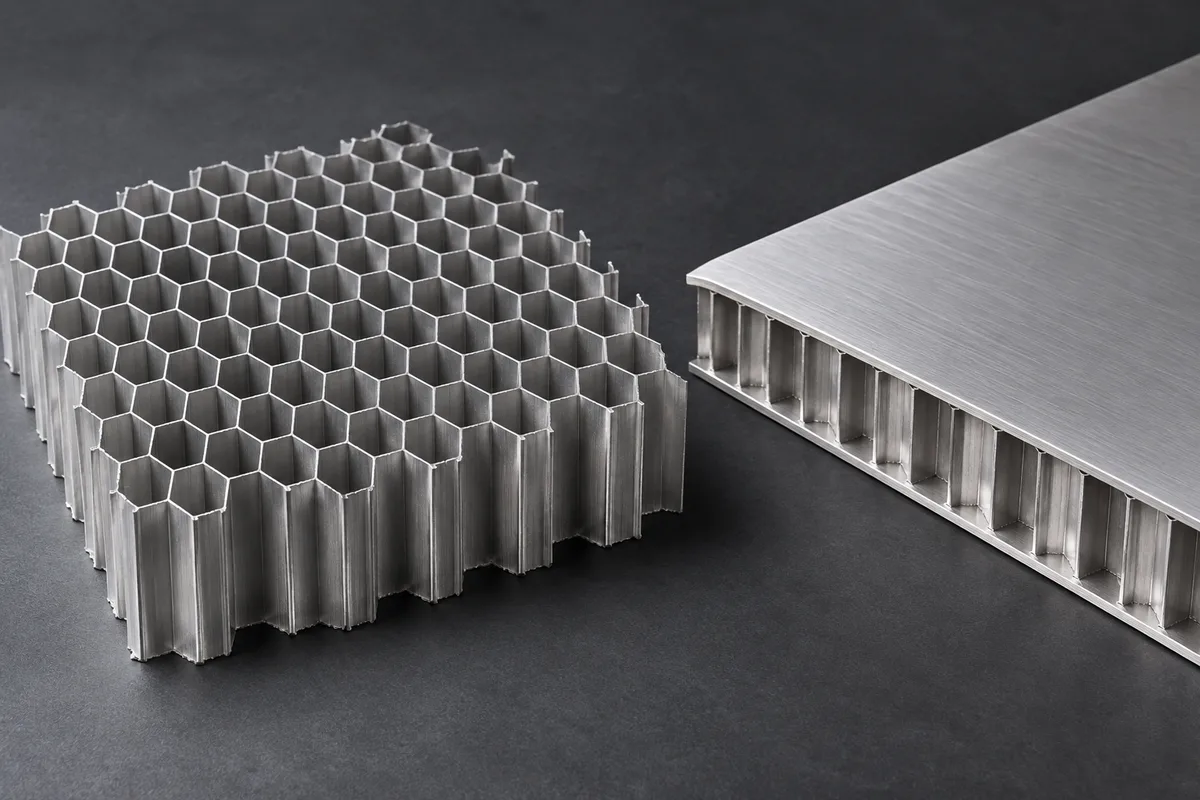
For flat panels where stiffness per kilogram is the main goal, aluminium honeycomb is usually the more efficient core. Foam earns its place when loads come from several directions, when the panel must absorb sound or impact, or when the core must be shaped or fill a closed section such as a crash tube.
Buyer checklist
Common mistakes when buying foam plate
Quoting strength without density. A strength figure means nothing unless the density it was measured at is stated; compare grades at the same density.
Using closed-cell foam as a sound absorber. Unperforated closed-cell plate reflects most sound. For absorption, use open-cell foam or perforated closed-cell panels with an air gap behind.
Ignoring the density gradient. Melt-foamed blocks are slightly denser at the bottom. For energy-absorbing parts, ask where in the block the plate was cut and request density checks.
Screwing directly into the cells. Point loads crush the cell walls. Plan bonded inserts, through-bolts with large washers, or adhesive joints from the start.
Sealing open pores with heavy paint. A thick coating turns an absorber into a reflector. Specify the coating with the acoustic test.
Comparing price per square metre only. Foam often replaces two or three layers (structure, insulation, fire barrier). Compare the cost of the whole build-up, not one layer.
A short sample trial avoids most of these problems. Ask for a sample panel of the proposed density and finish, check it with your fixing method and, for acoustic or impact work, test it in the real mounting arrangement before committing to the full quantity.
Related
Related foam and sandwich-panel guides
Metline publishes separate guides on each main use of aluminium foam. For a broader introduction, start with the aluminium foam overview.
ISO 13314 – Mechanical testing of metals: ductility testing, compression test for porous and cellular metals
ISO 354 – Acoustics: measurement of sound absorption in a reverberation room
ISO 10534-2 – Acoustics: determination of acoustic properties in impedance tubes, transfer-function method
EN 13501-1 – Fire classification of construction products and building elements
Ashby, M.F. et al. – Metal Foams: A Design Guide (Butterworth-Heinemann)
FAQ
Porous aluminium (aluminum) foam plate: FAQ
What is the difference between open-cell and closed-cell aluminium foam?
Open-cell foam has interconnected pores, so it absorbs sound and lets air or liquid through. Closed-cell foam has sealed pores, so it is airtight and buoyant, insulates against heat and sound, and absorbs impact energy. Choose by function, not by appearance.
How light is aluminium foam?
Most closed-cell plate weighs 0.2–0.7 g/cm³, about one quarter to one tenth of solid aluminium. A 1 m² panel 20 mm thick at 0.4 g/cm³ weighs about 8 kg.
Is aluminium foam fireproof?
Aluminium foam is a non-combustible metal and does not give off toxic smoke. Like all aluminium it softens and melts at high temperature (around 600–660 °C), so for fire doors and partitions it is used within a tested system. Coated panels need their own fire classification.
How is aluminium foam cut and installed?
With ordinary saws, waterjet or CNC routers. Panels are fixed with bonded inserts, large washers, clips or adhesives, because thin cell walls cannot take concentrated screw loads.
Can aluminium foam be painted without losing sound absorption?
Yes, if the coating is thin enough not to close the open pores. Heavy paint layers seal the surface and reduce absorption, so acoustic panels use light spray coats or factory finishes.
How do I choose the right foam density?
Start from the job. For impact absorption, pick the density whose plateau stress keeps transmitted force below the limit while absorbing the required energy. For acoustics, cell size and thickness matter more than density. For sandwich cores, higher density gives more shear strength.
Specifying aluminium foam plate?
Send the application, foam type, density, thickness and panel size. We will match a grade, provide test data and quote delivered to your site.