Aluminium honeycomb panel
Hexagonal cells of 3003, 5052 or 5056 foil, bonded between skins with structural adhesive film or by brazing. Typical panel thickness 6 – 50 mm. Excellent flatness and stiffness, non-combustible metal construction.



An aluminium sandwich panel bonds two thin aluminium skins to a light core, so it is far stiffer than a solid sheet of the same weight. The core decides almost everything else: honeycomb for the best stiffness-to-weight, corrugated for economical all-metal facades, aluminium foam for impact and acoustic absorption, and polymer or mineral-filled cores for composite cladding panels. This guide compares each type on structure, weight, fire class, cost and application.
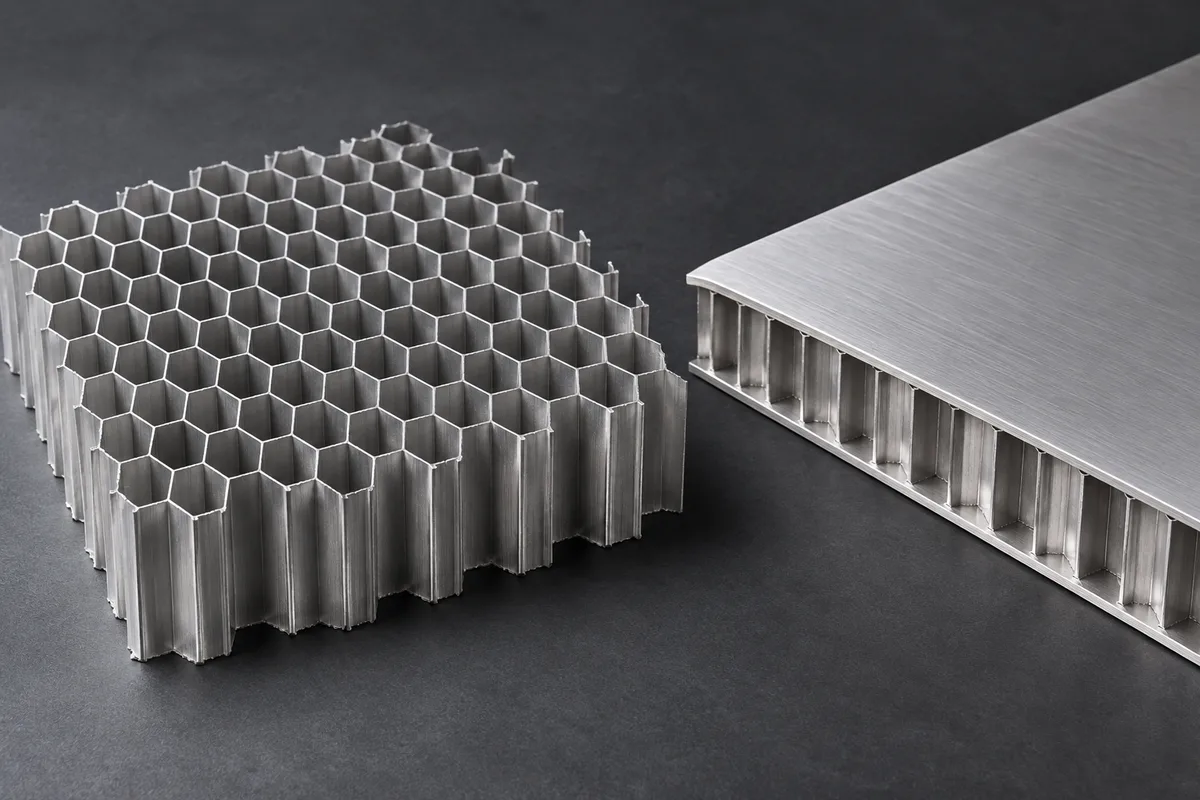
A sandwich panel works like an I-beam spread into a sheet. The two aluminium skins act as the flanges and carry bending as tension and compression; the core acts as the web, holding the skins apart and carrying shear. Because bending stiffness grows with the square of the distance between the skins, a thick, light core multiplies stiffness at almost no weight cost.
A quick calculation shows the effect. Two 1 mm aluminium skins on an 18 mm aluminium honeycomb core give a 20 mm panel weighing about 6.5 – 7 kg/m². A solid aluminium sheet of the same weight is only about 2.5 mm thick. The sandwich panel is well over 100 times stiffer in bending, which is why it can span between widely spaced supports without visible deflection or oil-canning.
All aluminium sandwich panels share the skins’ advantages: corrosion resistance, a surface that can be coil-coated, anodised or printed, easy cutting and full recyclability of the metal. Their differences come from the core: its material, geometry and how it is bonded to the skins. Those choices determine fire performance, impact resistance, acoustic behaviour, formability and price.
Hexagonal cells of 3003, 5052 or 5056 foil, bonded between skins with structural adhesive film or by brazing. Typical panel thickness 6 – 50 mm. Excellent flatness and stiffness, non-combustible metal construction.
A formed aluminium sheet with a sinusoidal, trapezoidal or cone-shaped profile bonded between skins. Thinner (often 3 – 10 mm) and cheaper than honeycomb, with good bendability.
A closed-cell aluminium foam core joined to aluminium skins, either adhesively or by metallurgical bonding during foaming. Absorbs impact energy and sound; heavier than honeycomb.
A core of formed aluminium cups, beads or dimples, giving a very thin all-metal panel (from about 4 mm) for facades and interiors where honeycomb is too thick.
Two 0.2 – 0.5 mm skins on a 2 – 6 mm core of polyethylene, fire-retardant mineral-filled polymer or A2 mineral. The most common cladding and signage panel worldwide.
Aluminium skins with a thick insulating core (PIR, mineral wool) for cold rooms, cleanrooms and building envelopes, where thermal insulation is the main requirement.
Honeycomb core is made by printing adhesive lines on aluminium foil, stacking and curing the sheets into a block, slicing it and then expanding it into hexagonal cells. Cell size (commonly 3/16 – 3/4 in, or 4 – 19 mm), foil thickness and alloy set the core density, typically 30 – 130 kg/m³ for commercial and aerospace grades. Denser core gives higher crush and shear strength.
| Item | Typical specification |
|---|---|
| Skin alloys | 3003, 3105, 5005 or 5052 for architectural; 5052, 6061 or 2024 for transport and aerospace |
| Skin thickness | 0.5 – 1.0 mm for interiors and ceilings; 1.0 – 1.5 mm for facades; thicker for floors and decks |
| Core alloys | 3003 for building; 5052 and 5056 for transport and aerospace |
| Panel thickness | 6, 10, 12, 15, 20, 25 mm and up to about 50 mm or more |
| Bonding | Structural epoxy or polyurethane film adhesive; brazed panels for high temperature and fire |
| Standard sizes | 1220 × 2440, 1250 × 2500, 1500 × 3000 mm; longer panels on request |
| Surface | PVDF or polyester coil coating, anodised, brushed, mirror, wood or stone grain, perforated |
| Fire classification | Commonly A2-s1,d0 to EN 13501-1 for metal-core panels; confirm on the test report |
Some catalogues quote skin thicknesses of a few hundredths of a millimetre; that is foil-core gauge, not skin gauge. Facade honeycomb panels use skins of roughly 1 mm.
Honeycomb panels are the default for metro and rail car interiors, aircraft floors and galleys, ship cabins and bulkheads, cleanroom walls, elevator cars, exhibition systems and large architectural facade and soffit panels. Because the core is anisotropic (stronger in the ribbon direction), panel orientation should follow the main span. See our honeycomb sandwich panel guide and honeycomb core specification for depth on core grades.
A corrugated core panel replaces the honeycomb with a continuous formed sheet, usually 0.2 – 0.5 mm aluminium, rolled into a wave or cone pattern and bonded between skins of 0.5 – 1.0 mm. The result is an all-aluminium panel with no plastic core and a much simpler manufacturing route than expanded honeycomb.
| Item | Typical specification |
|---|---|
| Skin alloys | 3003, 3105, 5005, 5052 |
| Core alloys | 1050, 1060, 3003 |
| Skin thickness | 0.5 – 1.0 mm |
| Core sheet thickness | 0.2 – 0.5 mm |
| Panel thickness | 3 – 25 mm (4 – 8 mm most common for facades) |
| Areal weight | About 4 – 6 kg/m² for common 4 – 6 mm facade panels |
| Bonding | Thermosetting two-component adhesive or polyurethane; brazed versions exist |
| Fire classification | A2-s1,d0 achievable because the core is metal; confirm per product |
Corrugated panels are stiffest across the flutes and somewhat less stiff along them, so long spans should run across the corrugation. They bend and roll into curves more easily than honeycomb panels because the core does not crush as readily, which makes them popular for curved facades, column covers and vehicle side walls. Our sandwich wall panel guide compares corrugated and honeycomb walls for facade systems.
Aluminium foam is made by injecting gas into molten aluminium or by heating a compacted powder with a foaming agent, giving a closed-cell metal sponge with a density commonly between about 0.2 and 0.8 g/cm³. Bonded between aluminium skins it forms an AFS panel that is heavier than honeycomb but isotropic, crushes progressively under impact and absorbs sound.
Under compression the cells collapse at a nearly constant stress over a long stroke, so foam panels absorb crash, blast and drop energy well. Used in vehicle crash boxes, battery enclosures and protective structures.
Open-surface or perforated foam panels absorb sound; sealed panels block it. Used in noise barriers, machine enclosures and building acoustics.
All-metal foam panels do not burn or release smoke. Adhesive-bonded versions are limited by the adhesive, so brazed or metallurgically bonded AFS is chosen for heat.
The continuous metal skin and cell walls attenuate electromagnetic interference, useful for equipment rooms and enclosures.
Foam panels can be sawn, milled and drilled, though fixings need inserts or bonded bushes because the foam has low bearing strength.
Rail and road vehicles, defence, marine decks and bulkheads, nuclear and industrial protection, architectural features.
For deeper information on foam itself, see our foam aluminium guide.
ACP is the thinnest and most widely used aluminium sandwich: two coil-coated skins, typically 0.3 – 0.5 mm, continuously laminated to a 2 – 5 mm core. Total thicknesses of 3, 4 and 6 mm are standard. It is flat, light, easy to rout and fold into cassettes, and comes in any colour, metallic, wood or stone finish.
| Core type | Typical make-up | Typical EN 13501-1 class | Where it fits |
|---|---|---|---|
| PE core | Low-density polyethylene | Combustible; low Euroclass (often D to F) | Signage, interiors, low-rise use where codes allow |
| FR core | Polymer heavily filled with mineral (often about 70 %) | B-s1,d0 | Many facades below code height thresholds |
| A2 core | Mostly mineral (about 90 %) with a small binder fraction | A2-s1,d0 | High-rise and public buildings where codes require limited combustibility |
Fire classes depend on the tested product and fixing system. Always check the classification report and local building code. Following the Grenfell Tower fire in 2017, many jurisdictions banned PE-core ACP on tall buildings.
Skin alloy for ACP is usually 3003 or 5005 (sometimes 1100 or 3105) in an H-temper, coated with PVDF for exterior use or polyester for interior and signage. Our ACP skin coil page covers the coated sheet used by panel producers.
| Property | Honeycomb | Corrugated | Foam (AFS) | ACP (FR / A2) |
|---|---|---|---|---|
| Typical thickness | 6 – 50 mm | 3 – 25 mm | 8 – 40 mm | 3 – 6 mm |
| Stiffness per kg | Highest | High (direction-dependent) | Moderate | Moderate |
| Flatness over large sizes | Excellent | Very good | Good | Good, oil-canning risk on wide panels |
| Impact / energy absorption | Good (one-directional crush) | Fair | Excellent (isotropic) | Fair |
| Sound | Some absorption; perforated versions better | Good reflection and damping | Good absorption | Limited |
| Fire (EN 13501-1) | A2 typical | A2 typical | A1/A2 if all-metal | B (FR) or A2 (mineral) |
| Bending / curving | Possible, needs care | Easy | Limited | Easy (rout and fold) |
| Relative cost | Higher | Medium | Highest | Lowest |
| Recyclability | Metal fully recyclable | Metal fully recyclable | Metal fully recyclable | Skins recyclable; core separated |
Values are typical ranges for comparison; specific products and test reports govern.
As a rule, start with ACP when the panel is small, flat and mainly decorative and the building code allows its core. Move to corrugated or honeycomb when the panel is large, must be non-combustible, or must span further between supports. Choose foam only when impact, blast or acoustic absorption justifies its weight and cost.
Fluoropolymer coil coating (often 70 % PVDF resin) for exterior facades; long colour and gloss retention. Usually two or three coats.
Economical for interiors, ceilings and signage. Shorter outdoor life than PVDF.
Hard, metallic surface on 5005 skins for premium facades and interiors.
Decorative metallic finishes for lifts, interiors and retail.
Wood and stone grain by transfer printing; RAL and custom colour matching.
Stucco or pattern embossing for grip and texture; perforated skins for acoustic panels.
Panels can be cut by saw, router or waterjet; ACP and corrugated panels are routed on the back skin and folded into trays or cassettes. Honeycomb panels need edge closure (folded skin, extruded edge profile or potting compound) and inserts where fixings carry load. Laser cutting is generally avoided on polymer-core panels. Metline can supply panels cut to size and the aluminium extrusions used as edge profiles and sub-frames.
Panel selection is only half the job; most problems on site come from movement, fixing and moisture. Aluminium expands by about 0.024 mm per metre for every degree Celsius, so a 4 m facade panel that sees a 60 °C swing between a winter night and a summer afternoon changes length by close to 6 mm. Fixing systems must let each panel slide on at least one edge, usually through slotted holes or hook-on cassette brackets.
Wind load decides panel thickness and support spacing. Facade engineers check bending stress in the skins, shear stress in the core and deflection, typically limited to span/100 to span/200 depending on the code and the visual requirement. For honeycomb and corrugated panels the core shear strength often governs short, heavily loaded spans, while skin stress governs long spans.
| Design check | What controls it | Typical response |
|---|---|---|
| Deflection under wind | Panel thickness and skin gauge | Thicker core first; thicker skins if stresses are high |
| Thermal movement | Panel length and colour (dark colours run hotter) | Slotted fixings, open or gasketed joints of 10 – 20 mm |
| Fixing pull-out | Insert or edge detail, not the core | Bonded inserts, folded cassette returns or edge extrusions |
| Moisture | Edge sealing and drainage | Closed edges, drained and ventilated cavity behind the panel |
| Galvanic contact | Steel or copper fixings in contact with skins | Stainless or aluminium fixings with isolating washers |
For floors and decks in vehicles and ships, the critical cases are point loads from heels, trolley wheels and equipment feet. A denser core or a thicker top skin resists local indentation better than simply increasing overall thickness. Where panels will be walked on or loaded by trolleys, ask for core crush strength and a local indentation test result, not just the panel’s overall bending data, and consider an anti-slip embossed or tread-pattern top skin.
ACP is a thin (3 – 6 mm) panel with a polymer or mineral core and very thin skins, used mainly for cladding and signage. A honeycomb panel has thicker skins on an aluminium honeycomb core, is much stiffer for its weight, can span further and is normally non-combustible.
All-metal honeycomb, corrugated and foam panels typically reach A2-s1,d0 (some foam panels A1) because the core does not burn; the adhesive is the limiting factor. PE-core ACP is combustible, FR-core ACP is typically B-s1,d0 and mineral-core ACP A2-s1,d0. Always confirm on the test report.
A 20 mm panel with 1 mm skins weighs roughly 6.5 – 7 kg/m², and a 10 mm panel with 0.7 mm skins around 4.5 kg/m². The skins make up most of the weight, so skin thickness has more effect than core thickness.
ACP is the lowest-cost option, followed by corrugated core panels. Honeycomb panels cost more, and aluminium foam sandwich panels are the most expensive per square metre.
Yes. ACP and corrugated panels curve and fold easily. Honeycomb panels can be roll-curved to moderate radii or made curved during bonding. Foam panels are the least formable.
Yes. Metline supplies aluminium sandwich panels, honeycomb core and coated skin coil worldwide from Mumbai, with mill certificates and export packing.
Send the core type, thickness, finish and fire requirement. Our team will recommend a build-up and quote a delivered price.





