


Standard Aluminium Extrusions & Profiles
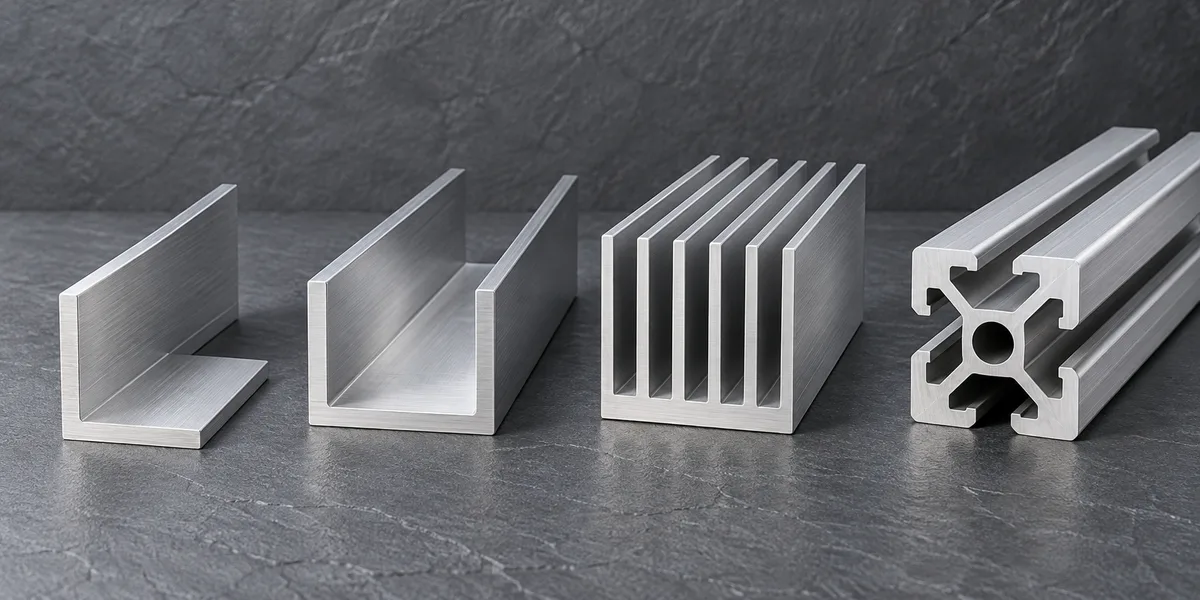
Standard aluminium extrusions are catalogue shapes, such as angles, channels, I-beams, tees, Z sections, tubes, bars and T-slot framing, made from existing dies to recognised dimensions. Because no new tooling is needed they are the quickest and most economical way to buy extruded aluminium. Metline supplies the full range of standard profiles in all common alloys and tempers, cut and finished to order, worldwide.
- Shapes
- 15+ standard families
- Main alloys
- 6063 · 6061 · 6082 · 6005A
- Tooling
- Existing dies, no die charge
- Standards
- ASTM B221 · B308 · EN 755
What counts as a standard extrusion?
An extrusion is made by pushing a heated aluminium billet through a steel die. When the die already exists and the shape follows a published or widely stocked dimension, the profile is "standard". When a die is made specially for your cross-section, it is "custom".
Standard profiles fall into two groups. Structural shapes, such as Aluminum Association channels and I-beams, American Standard channels and beams, and equal and unequal angles, have dimensions and section properties published in the Aluminum Design Manual and in ASTM B308 (for 6061-T6). Commercial and architectural shapes, such as small angles, channels, tees, Z bars, trims and tubes, follow common catalogue sizes in inches or millimetres that many extruders share.
For most engineering and building projects a standard shape will do the job, and it brings real advantages: shorter supply times, no tooling cost or approval cycle, published section properties for design, and easy replacement in future. Custom profiles become worthwhile when they remove machining or assembly steps, combine several parts into one, or when volumes are high enough to spread the die cost.
Standard profile families we supply
Angles
Equal and unequal, sharp or radiused corners, from small trims to structural angles.
U channels
Architectural and structural channel, AA and American Standard.
C channels
Lipped channels for slide tracks and strut systems.
I-beams and H-sections
AA standard and American Standard beams, wide-flange sections.
T bars
Equal and unequal tees for frames, glazing and stiffeners.
Z bars
Zed sections for cladding rails and panel hanging.
F, J, H and hat channels
Panel, edge and joining channels for building and transport.
Y and G sections
Panel-joint trims and handle profiles.
Tubes
Round, square and rectangular tube, seamless or porthole.
Bars
Round, square, hexagon and flat bar.
T-slot framing
10 and 15 series (inch), 20, 30, 40 and 45 mm metric systems.
Box sections
Rectangular and square hollow sections for frames.
Alloy options for standard extrusions
| Alloy | Character | Typical standard profiles |
|---|---|---|
| 6063 / 6060 | Excellent extrudability and surface, best anodising, medium strength | Architectural angles, channels, tees, trims, tubes |
| 6061 | Structural strength, good machinability and weldability | Structural shapes to ASTM B308, bars, tubes |
| 6082 | Highest strength 6xxx alloy, European structural standard | Structural angles, channels, beams, bars |
| 6005 / 6005A | Medium-high strength with good extrudability | T-slot framing, thinner structural sections |
| 1050 / 1070 / 1100 | Pure aluminium: high conductivity, very formable | Busbars, electrical and chemical profiles |
| 3003 / 3103 | Moderate strength, very good corrosion resistance and formability | Heat-exchanger tube and HVAC profiles |
| 2024 | High strength and fatigue resistance (aerospace) | Bars, angles and stringers |
| 7075 | Highest strength, not weldable, costly | Aerospace bars and shapes |
| Alloy and temper | Standard and size band | Tensile strength, min. | Yield strength (0.2 %), min. | Elongation, min. |
|---|---|---|---|---|
| 6060-T5 | EN 755-2, wall ≤ 5 mm | 160 MPa | 120 MPa | 8 % |
| 6063-T5 | ASTM B221, ≤ 12.5 mm | 150 MPa (22 ksi) | 110 MPa (16 ksi) | 7 – 8 % |
| 6063-T6 | ASTM B221 / EN 755-2 | 205 – 215 MPa (30 ksi) | 170 MPa (25 ksi) | 8 % |
| 6061-T6 / T6511 | ASTM B221 / B308 | 260 MPa (38 ksi) | 240 MPa (35 ksi) | 8 % |
| 6005A-T6 | EN 755-2, open profile ≤ 5 mm | 270 MPa | 225 MPa | 8 % |
| 6082-T6 | EN 755-2, open profile ≤ 5 mm | 290 MPa | 250 MPa | 8 % |
Specified minimums for extruded profiles; thicker walls fall into different bands. Typical values run 10 – 20 % higher (6061-T6 typically 310 MPa tensile, 276 MPa yield). Design to the minimums and the actual figures on the mill certificate.
| Alloy | Si | Fe | Cu | Mn | Mg | Cr | Zn | Ti |
|---|---|---|---|---|---|---|---|---|
| 6060 | 0.30 – 0.6 | 0.10 – 0.30 | 0.10 | 0.10 | 0.35 – 0.6 | 0.05 | 0.15 | 0.10 |
| 6063 | 0.20 – 0.6 | 0.35 | 0.10 | 0.10 | 0.45 – 0.9 | 0.10 | 0.10 | 0.10 |
| 6061 | 0.40 – 0.8 | 0.7 | 0.15 – 0.40 | 0.15 | 0.8 – 1.2 | 0.04 – 0.35 | 0.25 | 0.15 |
| 6005A | 0.50 – 0.9 | 0.35 | 0.30 | 0.50 | 0.40 – 0.7 | 0.30 | 0.20 | 0.10 |
| 6082 | 0.7 – 1.3 | 0.50 | 0.10 | 0.40 – 1.0 | 0.6 – 1.2 | 0.25 | 0.20 | 0.10 |
Single values are maximums. Others 0.05 % each, 0.15 % total; aluminium is the remainder. Limits follow the Aluminum Association registrations and EN 573-3.
Standards for standard profiles
| Subject | North America | Europe / international |
|---|---|---|
| Extruded products: material and properties | ASTM B221 (B221M) | EN 755-1, EN 755-2 |
| Structural shapes | ASTM B308 (6061-T6 structural profiles) | EN 755-2 with EN 1999 design |
| Seamless tube | ASTM B241 / B429 (pipe) | EN 755-7 / EN 755-8 |
| Dimensional tolerances | ANSI H35.2 | EN 755-3 to -9; EN 12020-2 precision profiles |
| Composition | Aluminum Association registrations | EN 573-3; ISO 209 |
| Aerospace | AMS-QQ-A-200 series, AMS specifications | EN aerospace series |
| Design data | Aluminum Design Manual | EN 1999 (Eurocode 9) |
Tell us the standard written on your drawing. We supply and certify to it, and each shipment carries an EN 10204 3.1 mill test certificate with the chemistry and tensile results of the lot.
Sizes, lengths, finishes and processing
Supply range
- Size
- From small trims a few millimetres across to structural sections several hundred millimetres deep, depending on the press and die
- Lengths
- Mill lengths, commonly around 6 m or 12, 20 and 25 ft; cut to length on request
- Tempers
- F, O, T4, T5, T52, T6, T6511 and others to suit the alloy
- Finishes
- Mill, anodised (clear and colours), powder coated, brushed, polished, wood grain
- Processing
- Precision cutting, mitring, drilling, punching, CNC machining, bending, welding and assembly
Weight is calculated from the cross-sectional area: kg/m = area in mm² × 0.0027 for 6xxx alloys. Published structural shapes list area and weight directly; for small commercial shapes we can calculate weight from the drawing. See also the aluminium weight calculator.
Standard T-slot framing series
| Series | Basic size | Typical slot | Use |
|---|---|---|---|
| 10 series | 1 in modules (1010, 1020, 1030…) | 0.256 in | Light machine frames, guards, workstations |
| 15 series | 1.5 in modules (1515, 1530…) | 0.320 in | Heavier frames and structures |
| 2020 / 2040 | 20 mm modules | 6 mm | 3D printers, small automation |
| 3030 / 3060 | 30 mm modules | 8 mm | Enclosures, light machinery |
| 4040 / 4080 | 40 mm modules | 8 or 10 mm | Machine bases, conveyors |
| 45 series | 45 mm modules | 10 mm | Heavy frames and gantries |
Slot dimensions differ between systems; confirm the system family before buying fasteners and connectors.
Industries using standard extrusions
- Building and construction: window and door sub-frames, curtain-wall support, trims, handrails, stair nosings
- Transport: truck and trailer bodies, bus and rail interiors, caravan frames
- Machinery and automation: T-slot frames, guards, conveyors, fixtures
- Electrical and electronics: busbars, enclosures, heat-spreading channels and cable trunking
- Energy: solar mounting rails, battery frames, LED lighting profiles
- Marine: deck fittings, rub-rails, gangways and docks in 6061 and 6082
- Signs, displays and furniture: frames, shelving, retail fixtures
How to order standard extrusions
- List shapesShape, size (and series for structural or T-slot sections), alloy, temper, finish, length and quantity for each line.
- QuoteWe confirm availability, standard, tolerances and delivery terms (EXW, FOB, CIF or DAP).
- ProcessCutting, machining and finishing as specified.
- InspectDimensions, straightness, finish; EN 10204 3.1 certificate with each lot.
- ShipBundled and crated with protective wrapping, by sea or air.
References and standards
- ASTM B221 – Extruded bars, rods, wire, profiles and tubes (aluminium and its alloys)
- ASTM B308/B308M – 6061-T6 standard structural profiles
- EN 755 series – Aluminium and aluminium alloys: extruded rod/bar, tube and profiles
- ANSI H35.2 – Dimensional Tolerances for Aluminum Mill Products
- The Aluminum Association – Aluminum Design Manual
Standard aluminium (aluminum) extrusions: FAQs
What is the difference between standard and custom extrusions?
Standard extrusions use existing dies and catalogue dimensions, so there is no tooling cost or approval cycle. Custom extrusions need a new die made to your drawing, which pays off when the profile integrates features or volumes are high.
Which alloy should I choose for a standard profile?
6063 for architectural and decorative shapes, 6061 or 6082 for structural members, 6005A for T-slot and thin structural sections, and 1xxx or 3xxx alloys for electrical and heat-exchanger uses.
Are section properties available for standard shapes?
Yes. Aluminum Association and American Standard structural shapes have published dimensions, areas and section properties in the Aluminum Design Manual, and ASTM B308 covers 6061-T6 structural profiles.
Can standard extrusions be anodised or powder coated?
Yes. Any standard profile can be supplied anodised, powder coated, brushed or polished, and protected with film.
Can I mix different profiles in one order?
Yes. Mixed orders of angles, channels, tubes, bars and framing sections are common and are consolidated into one shipment.
Need standard aluminium profiles?
Send your list of shapes, sizes and quantities. We will reply with availability, certification and a delivered price.





