Chemistry
Spectrometer analysis of samples taken during casting, reported per cast (drop) against the agreed aim and limit ranges. Hydrogen content of the melt may also be recorded.



A rolling slab, also called a sheet ingot or rolling ingot, is a large rectangular block of aluminium cast by the direct-chill (DC) process and used as feedstock for hot rolling mills. It is not finished sheet or plate: it still has to be scalped, homogenised and rolled. Metline sources rolling slabs in the alloy, size and quality class your mill specifies and ships them worldwide with full cast documentation.
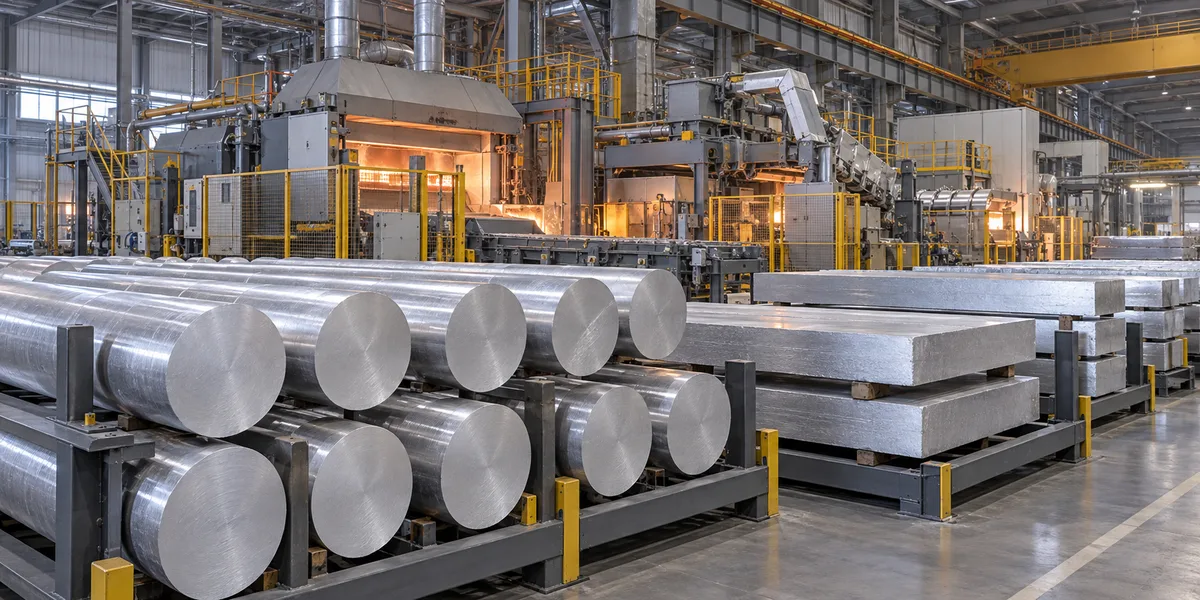
Every coil of aluminium sheet, foil and can stock, and almost every plate, starts life as a rolling slab. Molten metal of the correct chemistry is cast vertically through a water-cooled mould, solidified by direct water spray as it descends, and cut to length. The result is a rectangular ingot that can weigh well over ten tonnes and is shaped to fit the entry of a hot reversing mill.
Because the slab is the first solid form of the metal, its quality limits everything that follows. Inclusions, hydrogen porosity, cracks or segregation that enter the slab will show up later as surface streaks on anodised sheet, pinholes in foil, laminations in plate or failed ultrasonic tests on aerospace stock. For that reason slabs are bought against a rolling mill's own purchase specification, not against a sheet or plate standard.
The terms are used interchangeably in the trade: European cast houses tend to say "rolling ingot" or "rolling slab", North American mills "sheet ingot". Extrusion billet (round logs for presses) and remelt ingot (small pigs for foundries) are different products made in the same cast houses; see the related section for both.
Scalping and homogenising may be done by the cast house or by the rolling mill. The purchase order should say which, because it changes the delivered weight, the surface condition and the acceptance tests.
| Alloy family | Typical alloys | Rolled into | Casting notes |
|---|---|---|---|
| 1xxx commercial purity | 1050, 1060, 1070, 1100, 1235, 8011 | Foil, fin stock, lithographic sheet, electrical strip | Low iron and silicon control; very clean metal for foil gauges |
| 3xxx Al-Mn | 3003, 3004, 3104, 3105 | Can body stock, roofing, cookware, brazing core | Large primary intermetallics need careful homogenising |
| 5xxx Al-Mg | 5052, 5083, 5182, 5754 | Marine plate, can ends, automotive sheet, tank plate | High Mg increases oxidation and cracking risk; beryllium traces or protective atmosphere often used |
| 6xxx Al-Mg-Si | 6061, 6082, 6016 | General engineering plate, automotive body sheet | Mg/Si ratio held tight for consistent ageing response |
| 2xxx and 7xxx | 2024, 7075, 7050, 7475 | Aerospace and tooling plate | Crack-sensitive; slow, controlled casting, stress-relief treatment and strict ultrasonic acceptance |
| Clad and multi-alloy | 4xxx clad on 3xxx core | Brazing sheet | Liners may be roll-bonded or co-cast |
Chemistry is fixed at casting and cannot be corrected later, so the composition limits on the slab order are normally a narrowed version of the Aluminum Association or EN 573-3 range. A mill making can stock, for example, will hold magnesium and manganese far tighter than the standard 3104 limits allow, because small shifts change earing and strength in the finished sheet.
There is no catalogue size for a rolling slab. The cross-section is designed around a particular mill: its maximum entry thickness, roll barrel width and the coil weight it is set up to produce. The ranges below show what is common across the industry and are not a stock list.
Weight is calculated from the actual section, not a perfect rectangle, because cast corners are radiused and mould faces are profiled to compensate for contraction. As a rough guide, a 600 × 1,800 × 6,000 mm envelope is 6.48 m³, or about 17.5 tonnes at 2.70 t/m³; the real slab will weigh slightly less. Scalping 10 mm from each rolling face of that slab removes roughly 0.6 tonne of metal, which returns to the cast house as scrap.
| Envelope (mm) | Volume (m³) | Theoretical mass at 2.70 t/m³ (t) |
|---|---|---|
| 450 × 1,250 × 4,000 | 2.25 | 6.1 |
| 500 × 1,500 × 5,000 | 3.75 | 10.1 |
| 600 × 1,800 × 6,000 | 6.48 | 17.5 |
| 600 × 2,000 × 7,000 | 8.40 | 22.7 |
| 700 × 2,300 × 8,000 | 12.88 | 34.8 |
A slab has no tensile test, because its mechanical properties tell you nothing about the finished rolled product. Acceptance rests on four areas, each of which should be written into the purchase specification.
Spectrometer analysis of samples taken during casting, reported per cast (drop) against the agreed aim and limit ranges. Hydrogen content of the melt may also be recorded.
Ultrasonic scanning or sectioned slices to check for cracks, porosity, oxide films and inclusions. Aerospace and can-stock mills set the strictest limits.
Thickness, width, length, squareness of sawn ends, straightness and face profile, measured at agreed points.
Freedom from cold shuts, bleed-outs, laps, deep folds and surface cracks that scalping will not remove.
Macro-etched slices to confirm uniform, fine equiaxed grains and no feathery or columnar zones.
Each slab marked with cast number, slab position in the drop and alloy, carried through to the coil records.
Certification is normally an inspection document to EN 10204 3.1 listing the cast analysis and the results of agreed internal-quality checks. Ask for the document before shipment, not after unloading.
None in practice. Both terms describe the same DC-cast rectangular ingot used as hot-rolling feedstock. "Sheet ingot" is more common in North America, "rolling slab" or "rolling ingot" in Europe and Asia.
The outer layer of a DC-cast ingot contains oxide, surface folds and a segregated shell zone. If it were rolled in, these would become surface defects on the sheet. Milling the rolling faces removes this layer before homogenising and rolling.
No. Strength is created by rolling, heat treatment and ageing at the mill. A slab is ordered and accepted on chemistry, internal soundness, geometry and surface condition.
It depends on the mill. Slabs commonly weigh between about 5 and 30 tonnes. Calculate from the actual cross-section and length at 2.70 t/m³, remembering that rounded corners and profiled faces make the real slab lighter than a perfect rectangle.
Homogenising is a long, high-temperature soak that evens out the chemical segregation formed during solidification and conditions intermetallic particles so the metal rolls and finishes well. It can be done by the cast house or the rolling mill; the order should state which.
Yes. Metline sources rolling slabs to the purchaser's specification and ships them worldwide with cast documentation, packed and secured for break-bulk or container transport.
Send your purchase specification, alloy, section, length and tonnage. We will reply with sourcing options, inspection documents and a delivered price.





