


Aluminium Foundry Alloy Ingots
Aluminium foundry alloy ingots are pre-alloyed ingots that foundries remelt to pour castings, so the melt reaches the right chemistry without alloying at the furnace. The main families are Al-Si-Mg alloys such as A356.2 and AlSi7Mg for heat-treated castings, and Al-Si-Cu alloys such as A380, ADC12 and AlSi9Cu3(Fe) for high-pressure die casting. Metline supplies primary and secondary foundry ingots to EN 1676, ASTM B179 and JIS H2118 for foundries worldwide.
- Families
- Al-Si-Mg, Al-Si-Cu, Al-Si
- Grades
- A356.2, A380, ADC12, AlSi9Cu3
- Form
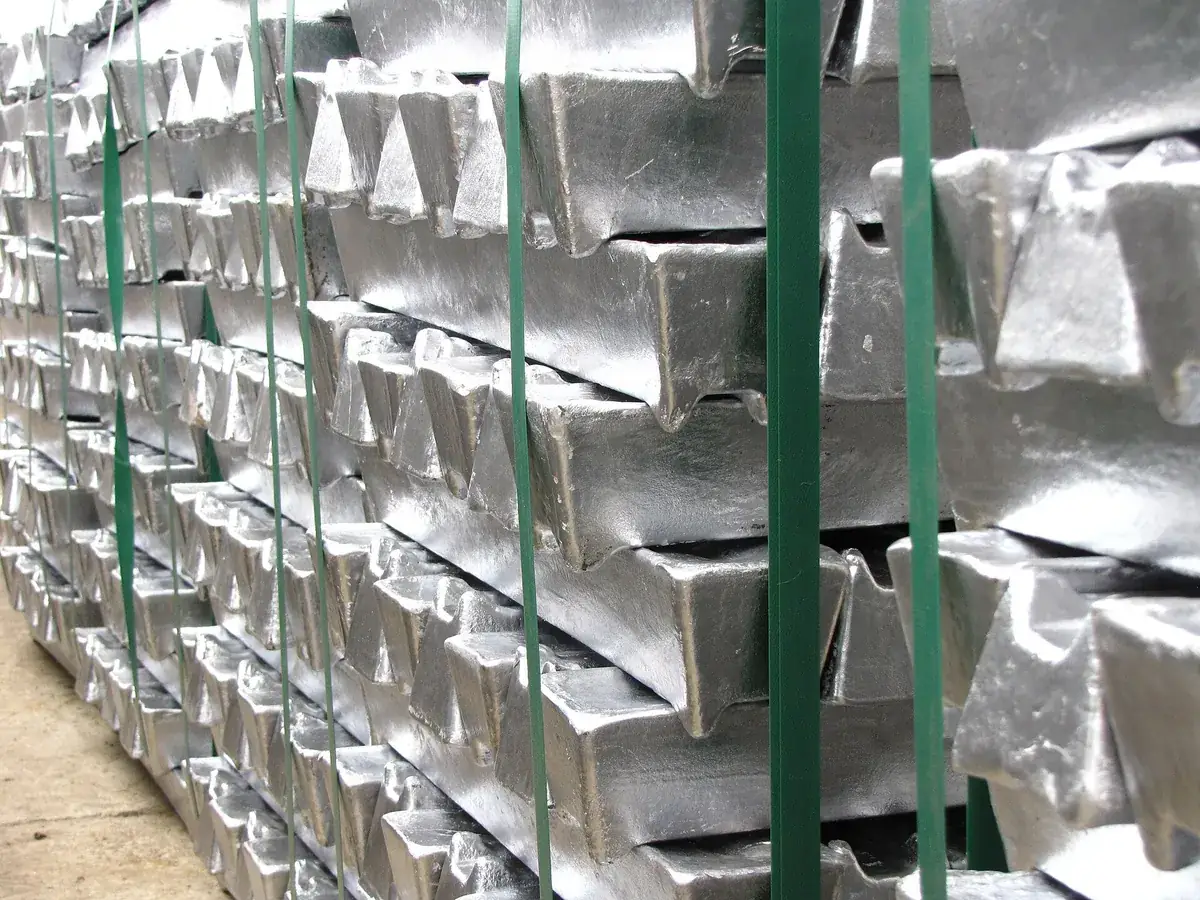
- Notched ingots in strapped bundles
- Standards
- EN 1676 · ASTM B179 · JIS H2118
What are foundry alloy ingots?
A foundry needs metal of the exact casting chemistry in the furnace. Buying pre-alloyed ingot is faster, more consistent and cleaner than adding silicon, copper and magnesium to pure aluminium on site, and it lets the foundry concentrate on melt treatment and casting.
Foundry ingots are produced either from primary aluminium, giving low iron and tight impurity control for safety-critical and heat-treated castings such as wheels and suspension parts, or from secondary (recycled) aluminium, which is economical for die castings where iron and copper are tolerated or even useful. The ingots are cast in small notched shapes so they stack, store and charge easily, and are strapped into bundles.
Ingot designations differ slightly from casting designations. In the Aluminum Association system the digit after the point shows the product: A356.0 is the casting, A356.2 the ingot. In Europe, ingots are EN AB- alloys (EN 1676) and castings EN AC- alloys (EN 1706). Ingot limits are tighter, especially for iron, to leave room for pick-up from tools, crucibles and returns during melting.
Main elements of common foundry ingots (wt %)
| Ingot alloy | Main equivalents | Si | Cu | Mg | Character |
|---|---|---|---|---|---|
| A356.2 | EN AB-42100 (AlSi7Mg0.3), LM25 (close) | 6.5 – 7.5 | ≤ 0.10 | 0.30 – 0.45 | Low Fe primary alloy for heat-treated castings |
| A357.2 | EN AB-42200 (AlSi7Mg0.6) | 6.5 – 7.5 | ≤ 0.05 | 0.45 – 0.70 | Higher-strength aerospace and premium castings |
| AlSi10Mg | EN AB-43000 / 43100 | 9.0 – 11.0 | ≤ 0.10 | 0.20 – 0.45 | Thin-walled gravity and die castings |
| A380.1 | ADC10, LM24 (close) | 7.5 – 9.5 | 3.0 – 4.0 | ≤ 0.10 | The North American die-casting workhorse |
| ADC12 | JIS H2118 / H5302; A383 (close) | 9.6 – 12.0 | 1.5 – 3.5 | ≤ 0.3 | Asia's main die-casting alloy |
| AlSi9Cu3(Fe) | EN AB-46000 | 8.0 – 11.0 | 2.0 – 4.0 | 0.05 – 0.55 | Europe's main die-casting alloy |
| AlSi12 | EN AB-44100 / 44300, A413, LM6 | 10.5 – 13.5 | low | low | Eutectic: best fluidity and pressure tightness |
| 319.1 | AlSi6Cu4, LM21 / LM4 (similar) | 5.5 – 6.5 | 3.0 – 4.0 | ≤ 0.10 | Engine blocks, cylinder heads, manifolds |
Main elements only, rounded from Aluminum Association, EN 1676 and JIS limits; iron, zinc, manganese, titanium and impurity limits differ by grade and by ingot or casting form. Equivalents are approximate; always order to one named standard.
Typical properties of castings made from these ingots
Ingots have no mechanical properties of their own that matter; what counts is the casting. The values below are typical for separately cast test bars and depend heavily on casting method, section size, melt quality and heat treatment.
| Alloy and condition | Tensile strength | Yield strength | Elongation |
|---|---|---|---|
| A356-T6, permanent mould | About 260 MPa | About 185 MPa | About 5 % |
| A356-T6, sand cast | About 230 MPa | About 165 MPa | 3 – 4 % |
| A380, die cast (F) | About 320 MPa | About 160 MPa | About 3.5 % |
| A413, die cast (F) | About 295 MPa | About 145 MPa | About 2.5 % |
| 319-T6, sand cast | About 250 MPa | About 165 MPa | About 2 % |
High-pressure die castings are normally used in the as-cast (F) condition because entrapped gas can blister during solution treatment. Where high ductility or crash performance is needed, foundries use low-iron Al-Si-Mg-Mn alloys cast by vacuum die casting and then heat-treat them.
Ingot shapes, bundles and identification
Typical supply form
- Ingot
- Notched ingots, commonly about 5 – 10 kg each, sized for charging by hand or machine
- Bundle
- Stacked and steel-strapped bundles of around 0.5 – 1 t, with spaces for forklift tines
- Identification
- Alloy and cast number marked on bundles; colour codes by agreement
- Other forms
- Sows, T-bars or liquid metal for large foundries, by arrangement
Ingot weight, bundle weight and marking can be adapted to your furnace and handling equipment.
What to check when buying foundry ingot
- Chemistry per cast: spectrometer analysis of every heat, including trace elements such as Sr, Na, P, Ca and Pb that affect modification and porosity
- Iron and manganese: for structural castings keep Fe low; in die-casting alloys a Mn/Fe ratio of about 0.5 helps form less harmful iron phases
- Modification and grain refinement: state whether ingot should be pre-modified with strontium or contain a titanium-boron grain refiner
- Cleanliness: low oxide and inclusion content, checked by reduced-pressure tests or porous-disc filtration on the remelt
- Dross and moisture: dry, clean ingots avoid hydrogen pick-up and dross formation when charged
Ask for the certificate to report the full analysis against the ingot standard named on your order, not just the main elements. If your customer specifies castings to EN 1706 or ASTM B26/B108/B85, check that the ingot limits leave enough margin for the chemistry changes your melting practice causes.
Standards for foundry ingots and castings
| Standard | Scope |
|---|---|
| EN 1676 | Alloyed ingots for remelting (EN AB- designations) |
| EN 1706 | Castings: chemical composition and mechanical properties (EN AC- designations) |
| ASTM B179 | Aluminum alloys in ingot and molten forms for castings from all casting processes |
| ASTM B26 / B108 / B85 | Sand, permanent-mould and die castings |
| JIS H2118 / H5302 | Die-casting ingots and die castings (ADC grades) |
| IS 617 / BS 1490 (legacy LM grades) | Indian and former British casting alloy designations |
Where castings from these ingots go
- Automotive: wheels, knuckles and subframes (A356); engine blocks, transmission cases and housings (A380, AlSi9Cu3, ADC12)
- EV and electronics: motor housings, inverter cases, battery housings and heat sinks
- Machinery: pump and valve bodies, compressor parts, gearboxes
- Building and consumer: fittings, lighting, furniture parts, cookware
- Aerospace and defence: premium A357 castings for structural and instrument parts
References and standards
- EN 1676 – Alloyed ingots for remelting: specifications
- EN 1706 – Castings: chemical composition and mechanical properties
- ASTM B179 – Aluminum Alloys in Ingot and Molten Forms for Castings from All Casting Processes
- JIS H2118 – Aluminium alloy ingots for die castings
- The Aluminum Association – Designations and Chemical Composition Limits for Aluminum Alloys in the Form of Castings and Ingot (Pink Sheets)
Aluminium (aluminum) foundry alloy ingots: FAQ
What is the difference between A356.0 and A356.2?
A356.0 is the casting composition; A356.2 is the ingot composition. The ingot has tighter iron and impurity limits so the casting still meets A356.0 after pick-up during melting.
Is ADC12 the same as A380?
They are close but not identical. ADC12 has more silicon (9.6 – 12 %) and less copper (1.5 – 3.5 %) than A380 (7.5 – 9.5 % Si, 3 – 4 % Cu). ADC12 is closer to A383. Many die casters can switch with process adjustments, but the specification should name one.
What is the European equivalent of A380?
The nearest is EN AB/AC-46000, AlSi9Cu3(Fe). It has similar silicon and copper but different iron and zinc limits.
Should I buy primary or secondary foundry ingot?
Primary ingot suits heat-treated, safety-critical castings that need low iron and high ductility. Secondary ingot is cheaper and well suited to high-pressure die castings, where its iron content helps reduce die soldering.
Can ingots be supplied pre-modified with strontium?
Yes. Al-Si-Mg ingots can be supplied with strontium modification and titanium-boron grain refiner when ordered, which saves additions at the furnace.
Sourcing foundry alloy ingots?
Send the alloy, standard, tightened limits and monthly quantity. We will reply with availability, certification and a delivered price.






