Pinholes
Counted against light per square metre. They increase sharply below about 12 µm and depend on metal cleanliness and rolling practice.



Aluminium foil is aluminium rolled thinner than about 0.2 mm, used wherever a light, formable and complete barrier to light, oxygen and moisture is needed: household wrap, food containers, blister packs, lids, cable wrap, battery electrodes and heat-exchanger fins. The main alloys are 1235, 8011, 8079 and 8021, with 3003 and 8006 for containers. Metline supplies plain and converter-ready foil rolls to EN 546 and ASTM B479 worldwide.
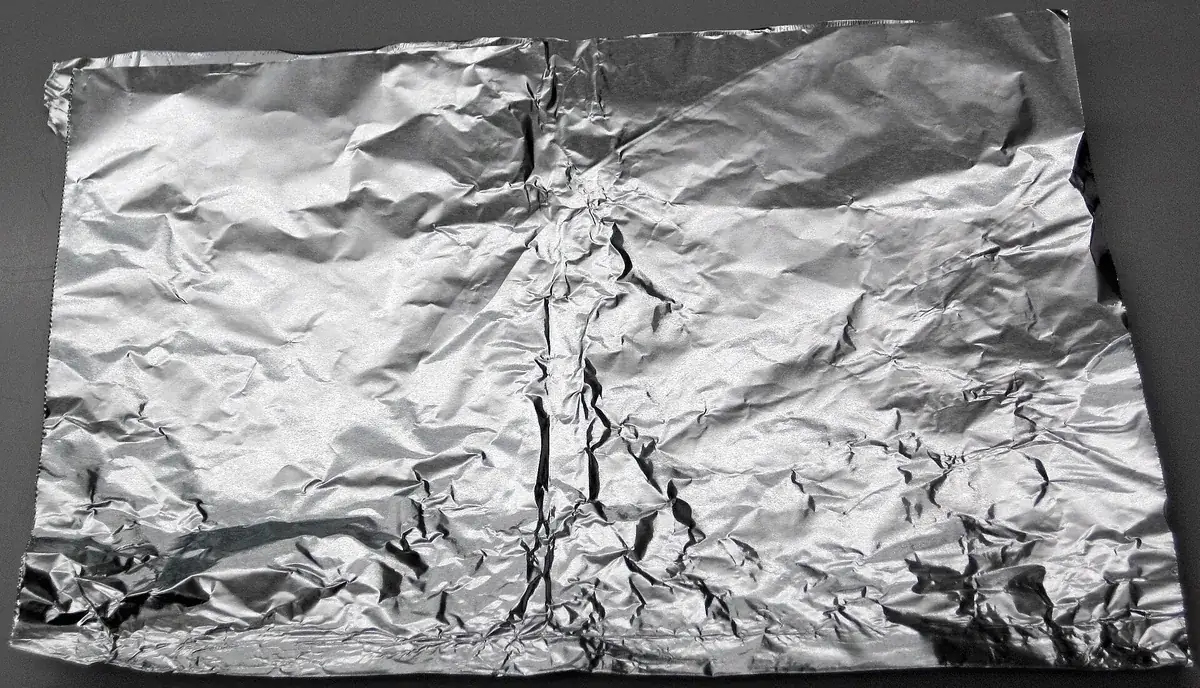
Foil is the thinnest product a rolling mill makes. Standards put the upper limit at about 0.2 mm (200 µm); thicker material is sheet or strip. Household foil is typically 9 – 25 µm, while the thinnest converter foils go down to about 6 µm.
Foil is rolled from foil stock (usually 0.3 – 0.7 mm coil) through several passes on a foil mill. For the last pass, two strips are rolled together, which is why household foil has one bright side, that touched the polished rolls, and one matt side, that touched the other strip. The finished foil is slit and either annealed to soft O temper, which also burns off rolling oil, or left hard (H18) for applications that need stiffness, such as blister lids.
Rolled foil of about 17 µm and above is effectively impermeable to gases, water vapour and light. Thinner gauges may contain a small number of pinholes, which is why barrier laminates use foil with polymer layers and why alloy choice matters at thin gauges.
| Alloy | Composition | Strengths | Typical uses |
|---|---|---|---|
| 1235 | ≥ 99.35 % Al | Very ductile, high conductivity | Household foil, laminates, cable wrap, battery foil |
| 1145 / 1100 | ≥ 99.45 % / ≥ 99.0 % Al | Pure and formable | Flexible packaging, insulation, fin stock |
| 8011 | Al-Fe-Si | Higher strength than 1235, good formability | Household and container foil, lids, pharmaceutical blisters, fins |
| 8079 | Al-Fe (low Si) | Very good ductility, low pinholes at thin gauges | Thin packaging foil, laminates, cigarette foil |
| 8021 | Al-Fe-Mn | High strength and puncture resistance | Cold-form blister (Alu-Alu), battery pouch laminates |
| 3003 / 8006 | Al-Mn / Al-Fe-Mn | Higher strength and stiffness | Semi-rigid food containers and trays |
| Temper | Condition | Typical tensile strength | Used for |
|---|---|---|---|
| O | Fully annealed, soft, clean and dry | 60 – 110 MPa (by alloy) | Household foil, laminates, containers, cold-form blister |
| H22 / H24 | Partially annealed | 100 – 150 MPa | Container foil, lids, fins |
| H18 / H19 | Full hard, as rolled | 150 – 200 MPa | Blister lidding, capacitor and battery foil, cable wrap |
Typical ranges for 1235 and 8011 foil around 20 – 50 µm; elongation is low at thin gauges and depends strongly on alloy. EN 546-2 gives the specified limits by alloy, temper and gauge.
| Application | Typical gauge | Typical alloy and temper |
|---|---|---|
| Household foil | 9 – 25 µm | 8011-O, 1235-O |
| Flexible packaging laminate | 6 – 12 µm | 1235-O, 8079-O |
| Pharmaceutical blister lid (PTP) | 20 – 25 µm | 8011-H18, 8021-H18 |
| Cold-form blister (Alu-Alu) | 45 – 60 µm | 8021-O, 8079-O |
| Lidding and induction seals | 30 – 50 µm | 8011-O / H22 |
| Food containers | 30 – 200 µm | 8011, 3003, 8006 in O, H22, H24 |
| Battery current collector | 10 – 20 µm | 1060, 1070, 1235 in H18 |
| Air-conditioner fin foil | 90 – 200 µm | 8011, 1100, 3102 in H22 – H26 |
Foil area per kilogram is 1 / (gauge × density). One kilogram of 10 µm foil covers about 37 m²; one kilogram of 20 µm foil about 18.5 m².
Counted against light per square metre. They increase sharply below about 12 µm and depend on metal cleanliness and rolling practice.
Annealed foil must be free of rolling oil so inks, lacquers and adhesives bond; checked with the water or alcohol brush wettability tests described in EN 546-4.
Usually around ±5 – 8 % on thin foil, tighter for battery and capacitor foil.
Edge waves and centre buckles cause wrinkles on laminators and coaters.
Tensile strength, elongation and burst strength matter for blister, container and battery foil.
Free from oil stains, streaks, corrosion and roll marks; bright-side reflectivity for decorative uses.
| Standard | Scope |
|---|---|
| EN 546-1 to -4 | Foil: technical conditions, mechanical properties, tolerances and special properties |
| ASTM B479 | Annealed and intermediate-temper aluminium foil for flexible barrier, food contact and other uses |
| ASTM B373 | Aluminium foil for capacitors |
| EN 602 | Chemical composition of wrought products for food contact |
| EN 573-3 | Chemical composition of wrought alloys |
1235 is almost pure aluminium (at least 99.35 % Al) and is very soft and conductive. 8011 contains iron and silicon, which make it stronger and stiffer, so it is preferred for containers, lids and blister packs.
In the final pass two foils are rolled together. The sides touching the polished steel rolls come out bright; the sides touching each other are matt. Both sides perform the same.
Standard household foil is about 10 – 13 µm and heavy-duty foil about 18 – 25 µm.
Foil of roughly 17 µm and thicker is essentially pinhole-free and a complete barrier. Thinner foils may have a few pinholes, so they are laminated with plastic films for barrier packaging.
Hard (H18) 1060, 1070 or 1235 foil about 10 – 20 µm thick, with tight gauge and surface cleanliness control, is used as the cathode current collector.
Yes. Foil can be supplied as jumbo or slit rolls on your core size, plain or treated, with a certificate for each lot.
Send the alloy, gauge, width, temper and end use. We will reply with availability, certification and a delivered price.






