Chemical analysis
Spectrometer analysis of the melt (and optionally of the slab), reported against the Aluminum Association, EN 573-3 or GB/T 3190 limits, plus any tighter customer limits.



Aluminium slab is a large rectangular ingot, direct-chill (DC) cast and usually homogenised, that is hot rolled into plate and sheet, forged, or sawn into thick blocks for machining. Its internal quality, meaning freedom from cracks, porosity, oxide inclusions and segregation, decides the yield and reliability of everything made from it. This guide covers the alloys, the defects that matter, the inspections to specify and the sizes and weights to expect when you buy slab.
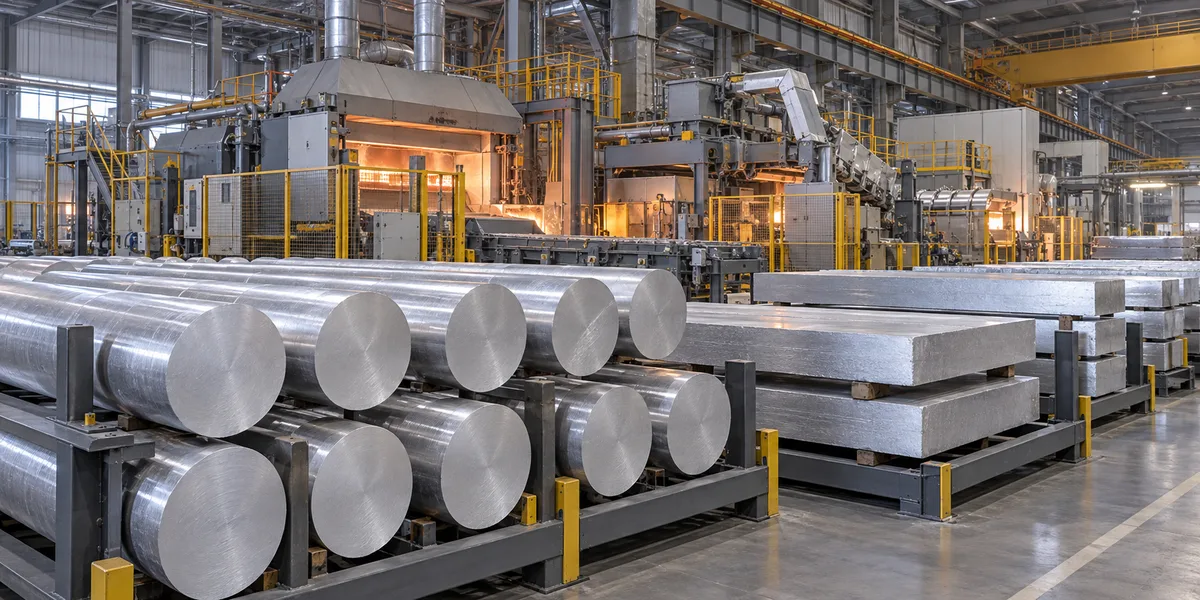
Slab, also called rolling ingot, sheet ingot or flat ingot, is the starting point for rolled aluminium. Molten metal of a controlled composition is cast vertically into a water-cooled rectangular mould; as the solid shell forms, the starter block descends and water sprays directly onto the emerging ingot. The result is a rectangular slab several metres long with a fine, relatively uniform cast structure.
Three groups of buyers use slab. Rolling mills hot roll it into plate, sheet and coil. Forging shops use sections of thick slab as stock for open-die and closed-die forgings, especially in 2xxx and 7xxx alloys where large cross-sections are needed. Machining and mould makers buy sawn slab blocks when they need a section thicker than rolled plate can provide, or when they accept cast properties in exchange for size.
For standard sheet and plate production the commercial specification of a rolling slab is well established; our rolling slab and sheet ingot specification guide covers that side. This page focuses on high-integrity slab: material for high-strength alloys, thick plate, forgings and fatigue-critical parts, where internal soundness and traceability matter as much as chemistry.
| Alloy | Character | Typical downstream products |
|---|---|---|
| 7075 | Al-Zn-Mg-Cu, very high strength after heat treatment | Plate and blocks for moulds, structural and defence parts, forgings |
| 7050 | High strength with better toughness and stress-corrosion resistance in thick sections | Thick aerospace plate (T7451), forgings |
| 7005 / 7003 / 7020 | Medium-high strength, weldable | Transport structures, sports and bicycle components |
| 7A04 / 7A09 (GB) | Chinese-standard high-strength 7xxx grades | Forgings and plate to GB specifications |
| 2014 | Al-Cu-Si-Mn, high strength, good forgeability | Forgings, heavy-duty structural plate |
| 2618 | Al-Cu-Mg-Ni-Fe, retains strength at elevated temperature | Pistons, compressor parts, hot-section components |
| 2A12 / 2A70 (GB) | GB equivalents in the 2024 / 2618 families | Plate and forgings to GB specifications |
| 4032 | Al-Si with Cu, Mg, Ni; low thermal expansion and good wear resistance | Forged pistons and wear parts |
| 5083 | Al-Mg, non-heat-treatable, weldable, seawater and cryogenic resistant | Marine plate, LNG and pressure vessels |
| 5052 / 5056 / 5A06 | Al-Mg grades of increasing magnesium content | Sheet and plate, welded structures, wire |
| 6061 / 6082 | Al-Mg-Si, heat-treatable, general engineering | Plate, tooling plate and blocks |
High-strength 7xxx and 2xxx alloys are the most demanding to cast. 7050 and 7075 have a long freezing range and contract strongly, so they are prone to hot tearing during solidification and to cold cracking from thermal stress after casting. Large 7xxx slabs are therefore cast at controlled speeds, often stress-relieved or homogenised promptly after casting, and inspected more thoroughly than 5xxx or 6xxx slabs.
High-magnesium 5xxx alloys such as 5083 oxidise readily in the melt, so melt cleanliness and filtration matter. 4032 and 2618 are often used as forging stock, where a fine, uniform cast structure improves forgeability and final properties.
| Defect | What it is | Consequence downstream | Control |
|---|---|---|---|
| Hot tears and cracks | Separations formed during or just after solidification | Open up during rolling or forging; scrap or catastrophic slab splitting | Casting speed, cooling, grain refinement, prompt stress relief |
| Porosity | Gas or shrinkage voids | Fatigue crack initiation, blisters, UT rejection | Hydrogen removal, feeding, cast speed |
| Oxide films and inclusions | Entrained oxide skins, refractory or salt particles | Laminations, surface streaks after anodising, fatigue failures | Clean melt handling, filtration |
| Macrosegregation | Composition variation across the slab section | Uneven heat treatment response and properties | Casting practice, mould design, melt flow control |
| Coarse or feathery grains | Abnormal grain structure in the cast slab | Poor workability, inconsistent mechanical properties | Grain refiner addition, temperature control |
| Surface segregation and cold folds | Enriched or folded surface layer | Rolling defects if not removed | Scalping depth, mould technology |
No single test finds all of these. Chemistry confirms the alloy and impurity levels, ultrasonic testing finds internal voids, cracks and large inclusions, macro-etching of a cross-section reveals grain structure and segregation patterns, and metallographic sections show porosity and constituent particle size. High-integrity orders typically combine several of them.
Spectrometer analysis of the melt (and optionally of the slab), reported against the Aluminum Association, EN 573-3 or GB/T 3190 limits, plus any tighter customer limits.
Immersion or contact UT of the slab or of sawn blocks, with acceptance classes agreed with the buyer. Aerospace orders often reference AMS-STD-2154 or ASTM B594 class definitions used for the wrought product.
Etched transverse slices show grain size, grain shape and any feathery grains or segregation bands. Grain size can be rated against an agreed chart.
Metallographic or density-based porosity checks, and melt cleanliness measurements such as hydrogen content, where specified.
Thickness, width, length, flatness of scalped faces, squareness of sawn ends and visual surface inspection.
Cast number, furnace and casting records, homogenisation chart and an EN 10204 3.1 certificate tying every slab or block to its cast.
State the inspection plan in the enquiry. Testing adds cost and time, and the right level depends on the downstream product: commercial sheet ingot needs much less than slab destined for aerospace plate or forgings.
Slab weight is volume multiplied by density. The table gives calculated weights for common cross-sections at three densities: 2.70 g/cm³ (6xxx), 2.66 g/cm³ (5083) and 2.81 g/cm³ (7075). For 7050 use about 2.83 and for 2014 about 2.80.
| Thickness × width × length (mm) | Volume (m³) | Weight at 2.70 (t) | Weight at 2.66 (t) | Weight at 2.81 (t) |
|---|---|---|---|---|
| 300 × 1200 × 4500 | 1.62 | 4.4 | 4.3 | 4.6 |
| 400 × 1300 × 5000 | 2.60 | 7.0 | 6.9 | 7.3 |
| 405 × 1560 × 5500 | 3.47 | 9.4 | 9.2 | 9.8 |
| 420 × 1620 × 6000 | 4.08 | 11.0 | 10.9 | 11.5 |
| 480 × 1660 × 6000 | 4.78 | 12.9 | 12.7 | 13.4 |
| 500 × 1630 × 6000 | 4.89 | 13.2 | 13.0 | 13.7 |
| 600 × 2000 × 6000 | 7.20 | 19.4 | 19.2 | 20.2 |
| 620 × 2640 × 4500 | 7.37 | 19.9 | 19.6 | 20.7 |
| 700 × 1550 × 7000 | 7.59 | 20.5 | 20.2 | 21.3 |
| 700 × 2050 × 8000 | 11.48 | 31.0 | 30.5 | 32.3 |
These weights explain why slab logistics need planning. A single large slab can weigh well over ten tonnes, so lifting equipment, container or breakbulk shipment and lashing must be agreed in advance. Sawn blocks for forging or machining are much easier to handle and ship.
| Product | Shape | Main use | Next process |
|---|---|---|---|
| Slab (rolling ingot) | Large rectangular DC-cast ingot | Feedstock for rolling, heavy forgings, thick blocks | Hot rolling, forging, sawing and machining |
| Extrusion billet | Round DC-cast log | Feedstock for extrusion and some forgings | Extrusion, forging, bar production |
| Remelt ingot | Small notched ingot or sow | Melting stock for casthouses and foundries | Remelting and casting |
| Forging block | Forged rectangular block | Thick parts needing wrought properties | Machining |
| Rolled plate | Hot-rolled, heat-treated plate | Direct cutting, machining and welding | CNC machining, welding, forming |
A useful rule: if your part fits within the thickness of available rolled plate or a forged block, those wrought products offer better and more consistent properties than cast slab, because hot working closes porosity and breaks up the cast structure. Choose sawn slab when the section is larger than plate or forgings allow, or when the part is lightly stressed and the lower cost of cast material is attractive.
Slab is a cast ingot, typically 300 – 700 mm thick, with a cast structure. Plate is made by hot rolling slab and then heat treating it, which closes porosity and refines the structure, so plate has better and more consistent properties. Slab is bought by mills, forgers and machinists who need very large sections.
7050 and 7075 freeze over a wide temperature range and contract strongly, which makes them prone to hot tearing during casting and to cold cracking from thermal stress afterwards. Casting speed, grain refinement and prompt stress relief or homogenisation are used to control this.
Rolling slab is normally homogenised and scalped before hot rolling, and slab for forging or machining is usually homogenised. Condition can be as cast, homogenised, scalped or sawn to blocks; specify it in the order.
Yes. Slabs and sawn blocks can be ultrasonically inspected to an acceptance class agreed with the buyer. UT finds internal voids, cracks and large inclusions; macro-etch and grain size tests complement it.
Multiply volume by density. A 480 × 1,660 × 6,000 mm slab is 4.78 m³, so about 12.9 t at 2.70 g/cm³ or 13.4 t in 7075. Large slabs regularly exceed ten tonnes.
Yes, slab can be supplied to GB/T 3190 compositions as well as Aluminum Association and EN grades. Give the standard and grade on the enquiry.
Tell us the alloy, size, downstream process and inspection plan. Our team will reply with availability and a delivered price.





