Narrow forging window
Aluminium alloys forge over a narrow temperature band; dies are preheated, typically to a few hundred °C, to avoid chilling the surface.



Aluminium forging stock is the billet that a forge heats and shapes into die forgings, open-die parts and rolled rings. It is supplied either as homogenised direct-chill cast logs, which are economical for large or less critical parts, or as extruded or rolled bar, whose worked grain structure suits aerospace and safety parts. Common grades are 6061, 6082, 2014, 2618, 4032, 7075 and 7050. Metline supplies both routes, cut and inspected, to forges worldwide.
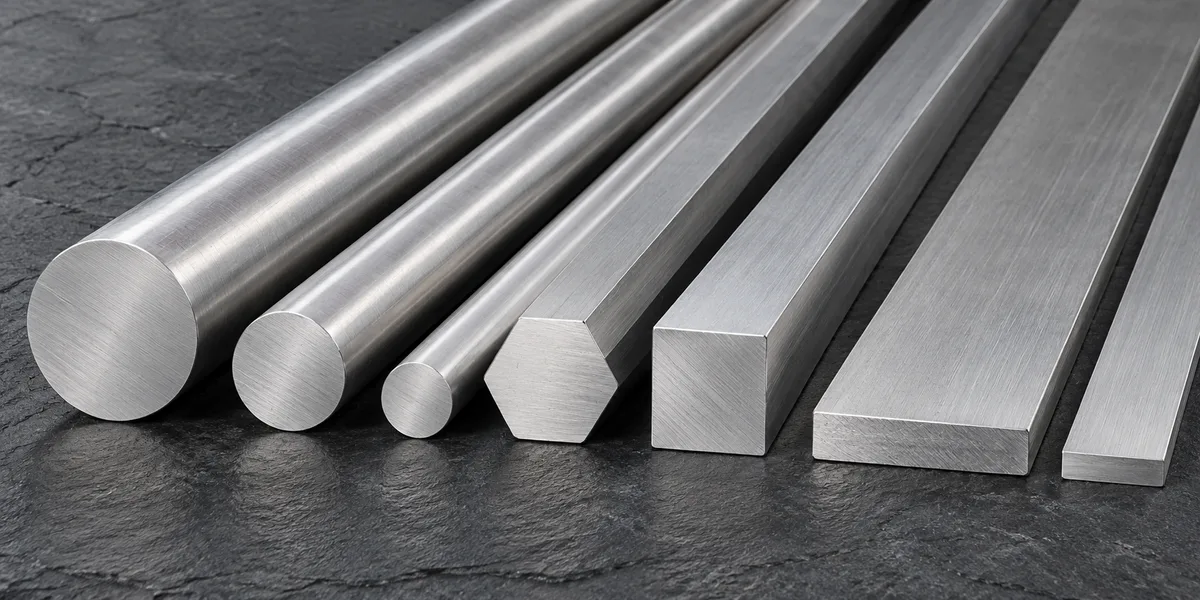
A forging is only as good as the metal it is pressed from. Porosity, coarse grains, oxide films or segregation in the stock carry through into the forging, where they can become cracks, laps or weak spots. That is why forging stock is bought to its own specification, separate from the finished forging.
Cast forging stock is a round DC-cast log, grain-refined, homogenised to dissolve segregation and, for better surfaces, often scalped or turned. It is the cheapest route for large-section forgings, rolled rings and automotive parts where the forging itself provides most of the working. Wrought forging stock is extruded or rolled bar. The extra hot working closes porosity and breaks up the cast structure, giving more uniform properties and better ultrasonic response; most aerospace specifications call for it.
In both cases the forge reheats the stock, typically to around 400 – 500 °C depending on the alloy, and shapes it in one or more operations. After forging, heat-treatable alloys are solution treated, quenched and aged to the final temper, usually T6, T61, T652 or T73 types. The properties of the finished part come from this whole sequence, not from the stock alone.
| Alloy | Family | Forged temper | Typical forged parts |
|---|---|---|---|
| 6061 | Al-Mg-Si | T6 | Automotive suspension arms, fittings, valve bodies, bicycle parts |
| 6082 | Al-Mg-Si-Mn | T6 | European automotive chassis parts, rail and machinery |
| 6151 | Al-Mg-Si | T6 | Complex die forgings with good surface finish |
| 2014 | Al-Cu | T6 / T652 | Aircraft fittings, wheels, heavy-duty truck parts |
| 2618 | Al-Cu-Mg-Ni-Fe | T61 | Pistons, compressor wheels, parts working at 150 – 250 °C |
| 4032 | Al-Si | T6 | Forged pistons with low thermal expansion and wear resistance |
| 7075 | Al-Zn-Mg-Cu | T6, T73, T7352 | Aircraft structural forgings, defence parts |
| 7050 | Al-Zn-Mg-Cu-Zr | T74, T7452 | Thick aerospace forgings needing toughness and stress-corrosion resistance |
Forged properties depend on section size and temper. For orientation, typical longitudinal values in the forged and heat-treated condition are about 310 MPa tensile for 6061-T6, about 480 MPa for 2014-T6 and about 500 – 570 MPa for 7075-T6/T73 types. ASTM B247 and AMS specifications give the minimums by thickness and direction.
Diameter and cut length are matched to your blank weight and die; we confirm with each quotation.
Blank weight per metre for round stock is shown below at 2,800 kg/m³, which suits 2xxx and 7xxx alloys; for 6xxx alloys multiply by 0.964 (2,700 kg/m³).
| Diameter (mm) | Weight 2xxx / 7xxx (kg/m) | Weight 6xxx (kg/m) |
|---|---|---|
| 100 | 22.0 | 21.2 |
| 150 | 49.5 | 47.7 |
| 200 | 88.0 | 84.8 |
| 250 | 137.4 | 132.5 |
| 300 | 197.9 | 190.9 |
| 400 | 351.9 | 339.3 |
| 500 | 549.8 | 530.1 |
| 600 | 791.7 | 763.4 |
| Check | Purpose |
|---|---|
| Chemical analysis per cast | Confirms alloy limits; tighter Fe and Si windows are common for aerospace grades |
| Homogenisation record | Shows cast logs were soaked to remove segregation |
| Macro-etch slice | Reveals grain size, shell zone, cracks, cold shuts and porosity |
| Ultrasonic testing | Detects internal discontinuities; to AMS-STD-2154 or ASTM B594 classes |
| Hydrogen content | High hydrogen causes porosity and blisters after heat treatment |
| Surface condition | Laps and cracks in the skin fold into the forging |
| Test forging (optional) | Forged and heat-treated sample to confirm achievable properties |
For aerospace work, the stock is traceable to cast and heat-treatment lot, and the ultrasonic class is stated on the order. For commercial forgings, chemistry, macro-etch and surface checks are usually enough. Always tie acceptance to the forging standard you will certify against, because the forge cannot test away a defect that was in the stock.
| Standard | Scope |
|---|---|
| EN 603-1 / -2 / -3 | Wrought (extruded and rolled) forging stock: delivery conditions, properties of test forgings, tolerances |
| EN 586 | Aluminium forgings: delivery conditions, properties and tolerances |
| ASTM B247 | Aluminum-alloy die forgings, hand forgings and rolled ring forgings |
| SAE AMS specifications | Alloy-specific forging specs, e.g. AMS 4133 (2014), AMS 4126 (7075) |
| AMS-STD-2154 / ASTM B594 | Ultrasonic inspection of wrought aluminium products |
| EN 10204 | Type 3.1 inspection certificate |
Aluminium alloys forge over a narrow temperature band; dies are preheated, typically to a few hundred °C, to avoid chilling the surface.
Some alloys, notably 6xxx, can form coarse recrystallised grains at the surface after solution treatment. Controlling strain and stock structure reduces it.
Forging aligns the grain to the part contour. Orient the stock so the working direction suits the main stress path.
Thick sections quench slowly; 7050 and 7175 hold strength better in heavy sections than 7075.
Cast stock is a homogenised DC-cast log; extruded stock has been hot worked through a die, which closes porosity and refines the grain. Extruded stock gives more uniform properties and is required by most aerospace specifications; cast stock is cheaper and suits large or commercial forgings.
6061 and 6082 are the most common for automotive and general forgings because they forge easily and resist corrosion. 2014 and 7075 are used for high-strength aircraft parts, 2618 and 4032 for pistons and hot parts.
Internal porosity, cracks or inclusions in the stock become defects in the forging. Ultrasonic testing finds them before the expensive forging and heat-treatment steps.
Usually not. Stock is supplied homogenised (cast) or as-fabricated (F) or annealed (wrought). The forging is heat treated after shaping to reach T6 or T7x properties.
Yes. Logs and bars can be saw-cut to the length that gives your blank weight, with square, deburred ends.
Send the alloy, route, diameter, blank weight and inspection requirements. We will reply with availability, certification and a delivered price.





