Clamping
Clamp lightly and evenly; heavy clamping on a flat plate can induce distortion that springs back when released.



Aluminium tooling plate is plate made for dimensional stability rather than maximum strength: cast and stress-relieved, or rolled, stretched and precision milled, so that it stays flat when machined. It saves facing operations on jigs, fixtures, base plates and machine parts. Metline supplies cast tooling plate, precision-milled rolled plate and high-strength mould plate, cut to size, to customers worldwide.
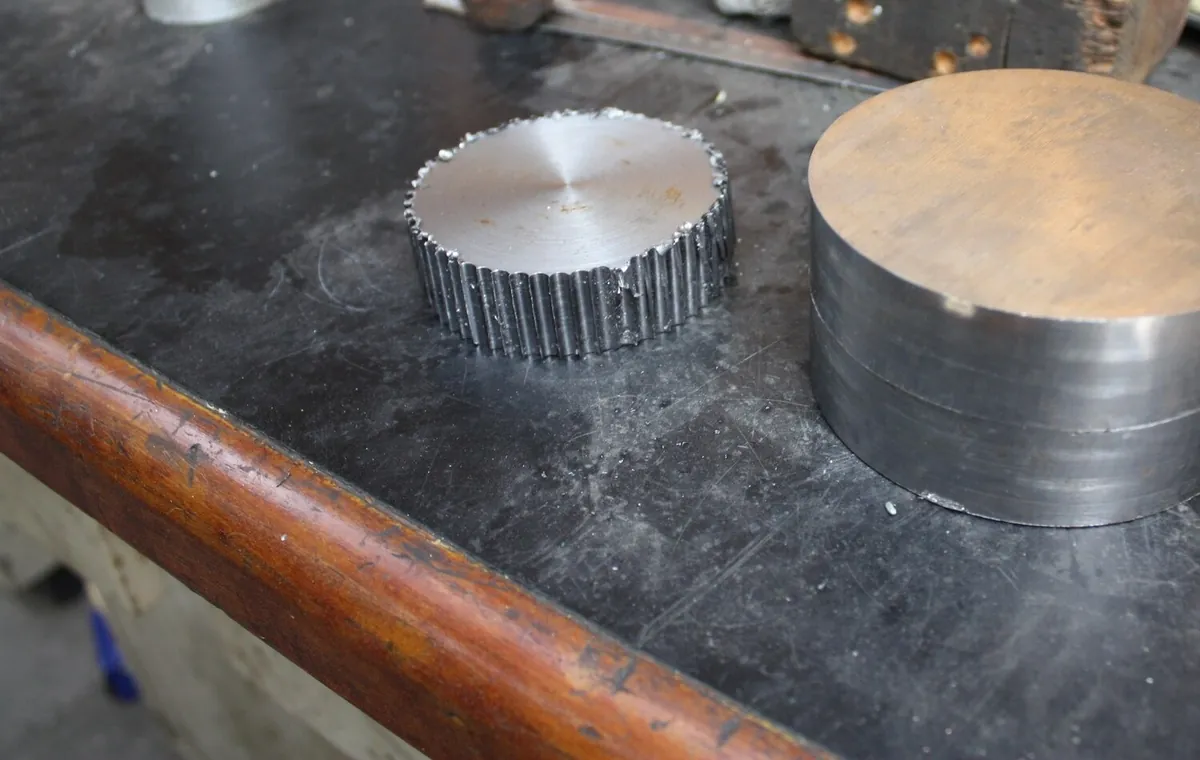
Ordinary rolled plate is supplied to standard thickness and flatness tolerances and still carries some residual stress, even after stretching. When a machinist removes a lot of metal from one side, those stresses rebalance and the part can bow. Tooling plate is designed to avoid that problem and to arrive already close to final thickness with a finished face.
There are two main routes. Cast tooling plate is cast as a thick slab, stress-relieved by heat treatment and then milled on both faces to a tight thickness tolerance; because it was never rolled or quenched, it has almost no residual stress and stays exceptionally flat. Precision rolled plate is standard rolled plate, usually 6061-T651, 7075-T651 or 5083, that has been fly-cut or milled on both faces to a precise thickness, combining a fine surface with the full strength of a wrought alloy.
A third family, mould plate, uses high-strength 7xxx alloys (7075, 7021, 7022 and similar) or 2xxx and 6xxx thick plate, rolled or forged in thick gauges for plastic-injection and blow moulds, where strength, polishability and thermal conductivity matter.
| Property | Cast tooling plate (5083-type) | Precision milled 6061-T651 | Precision milled 7075-T651 | Mould plate (7021 / 7022 type) |
|---|---|---|---|---|
| Typical tensile strength | about 240 – 280 MPa | 310 MPa | 572 MPa | about 500 – 600 MPa |
| Typical yield strength | about 110 – 130 MPa | 276 MPa | 503 MPa | about 420 – 520 MPa |
| Hardness | about 65 – 75 HB | about 95 HB | about 150 HB | about 150 – 170 HB |
| Residual stress | Very low | Low (stretched) | Low (stretched) | Low to moderate |
| Flatness after machining | Excellent | Good | Good | Good |
| Anodising | Fair, can look mottled | Excellent | Good, hard anodise | Good |
| Weldability | Good (for repairs) | Good | Poor | Poor |
| Best for | Jigs, base plates, vacuum tables, inspection plates | Fixtures and structural machined parts | High-load tooling and parts | Injection and blow moulds |
Cast tooling plate properties are typical producer data-sheet values and vary between products; rolled plate values are typical Aluminum Association / ASM data. Always check the data sheet and certificate for the plate you buy.
Tooling plate is bought on its tolerances. Typical values from producer data sheets for milled cast plate are a thickness tolerance of about ±0.1 mm across most gauges, and flatness of roughly 0.4 mm for thin plate (under about 12.7 mm), tightening to about 0.13 mm for thicker plate, measured over a defined length. Surface roughness on the milled faces is typically below about Ra 0.4 µm.
| Characteristic | Cast tooling plate (typical) | Standard rolled plate (EN 485-3 / ASTM B209) |
|---|---|---|
| Thickness tolerance | about ±0.1 mm, or tighter on request | Much wider; increases with thickness (several tenths of a millimetre on thick plate) |
| Flatness, thick plate | about 0.13 mm (per producer data) | Several millimetres per metre allowed |
| Faces | Milled both sides, film protected | Mill finish, rolled |
| Residual stress | Very low | Reduced by stretching (T651) but present |
| Saw-cut blanks | Commonly ±0.5 – 1 mm | Commonly ±0.5 – 1 mm |
Because there is no single international standard for cast tooling plate, the flatness, thickness and surface figures on your order should be stated explicitly, with the measuring length and method, rather than assumed from a product name.
Cast 5083-type plate weighs about 2.66 kg/m² per mm; 6061 is 2.70 and 7075 about 2.81. The table uses 2.66 for cast plate.
| Thickness (mm) | kg per m² (cast 5083) | 500 × 500 mm blank (kg) | 1000 × 1000 mm blank (kg) | 1220 × 2440 mm plate (kg) |
|---|---|---|---|---|
| 5 | 13.30 | 3.33 | 13.30 | 39.6 |
| 6 | 15.96 | 3.99 | 15.96 | 47.5 |
| 8 | 21.28 | 5.32 | 21.28 | 63.3 |
| 10 | 26.60 | 6.65 | 26.60 | 79.2 |
| 12 | 31.92 | 7.98 | 31.92 | 95.0 |
| 15 | 39.90 | 9.98 | 39.90 | 118.8 |
| 20 | 53.20 | 13.30 | 53.20 | 158.4 |
| 25 | 66.50 | 16.62 | 66.50 | 198.0 |
| 30 | 79.80 | 19.95 | 79.80 | 237.5 |
| 40 | 106.40 | 26.60 | 106.40 | 316.7 |
| 50 | 133.00 | 33.25 | 133.00 | 395.9 |
| 60 | 159.60 | 39.90 | 159.60 | 475.1 |
| 80 | 212.80 | 53.20 | 212.80 | 633.5 |
| 100 | 266.00 | 66.50 | 266.00 | 791.8 |
Clamp lightly and evenly; heavy clamping on a flat plate can induce distortion that springs back when released.
Even on low-stress plate, remove material symmetrically where possible and finish in a final light pass.
Cuts freely with sharp carbide; chips are short and the plate does not move. Keep tools sharp to avoid smearing on the softer surface.
Produce a bright finish at high speeds; 7075 gives the best surface for precision features and threads.
Flood or mist coolant controls heat; thermal growth is about 23 µm per metre per °C, which matters on large plates.
Leave the protective film on until final machining to avoid scratching reference faces.
Cast tooling plate is cast, stress-relieved and milled, so it has almost no residual stress and stays very flat when machined, but it is only about half as strong as 6061-T651 in yield. 6061-T651 is stronger and anodises better but can move more under heavy one-sided machining.
Cast 5083-type tooling plate can be welded, mainly for repairs and attachments, with 5xxx filler wire. Welding adds heat and stress, so finish-machine critical faces after welding.
Producer data sheets for milled cast plate typically quote around 0.13 mm flatness for thicker plate and about 0.4 mm for thin plate, with thickness tolerance of about ±0.1 mm. State the required figures and measuring length on the order.
Yes, but cast plate tends to give a less uniform, sometimes mottled anodised appearance. For decorative or colour-critical anodising, use precision-milled 6061-T651.
High-strength 7xxx plate such as 7075-T651 or dedicated 7021/7022-type mould plate offers the strength, hardness and polishability moulds need, with much better heat conduction than tool steel.
Yes. Tooling plate is supplied as full plates or saw-cut blanks, and can be CNC-profiled, drilled and tapped on request, with export packing.
Send the plate type, thickness, blank sizes, tolerances and quantity. We will reply with options, certification and a delivered price.






