6060
Fastest-pressing alloy for windows, doors and thin decorative sections. Lower strength than 6063.



Aluminium extrusion billet is a round, direct-chill cast and homogenised log that extruders cut to length, heat and press through a die to make profiles, bars and tubes. Most billet is 6060, 6063, 6005A, 6061 or 6082, with 2xxx and 7xxx billet for high-strength work, in diameters from about 6 to 16 inches. Metline supplies full logs and cut billets to EN 486 and agreed chemistry windows for extruders worldwide.
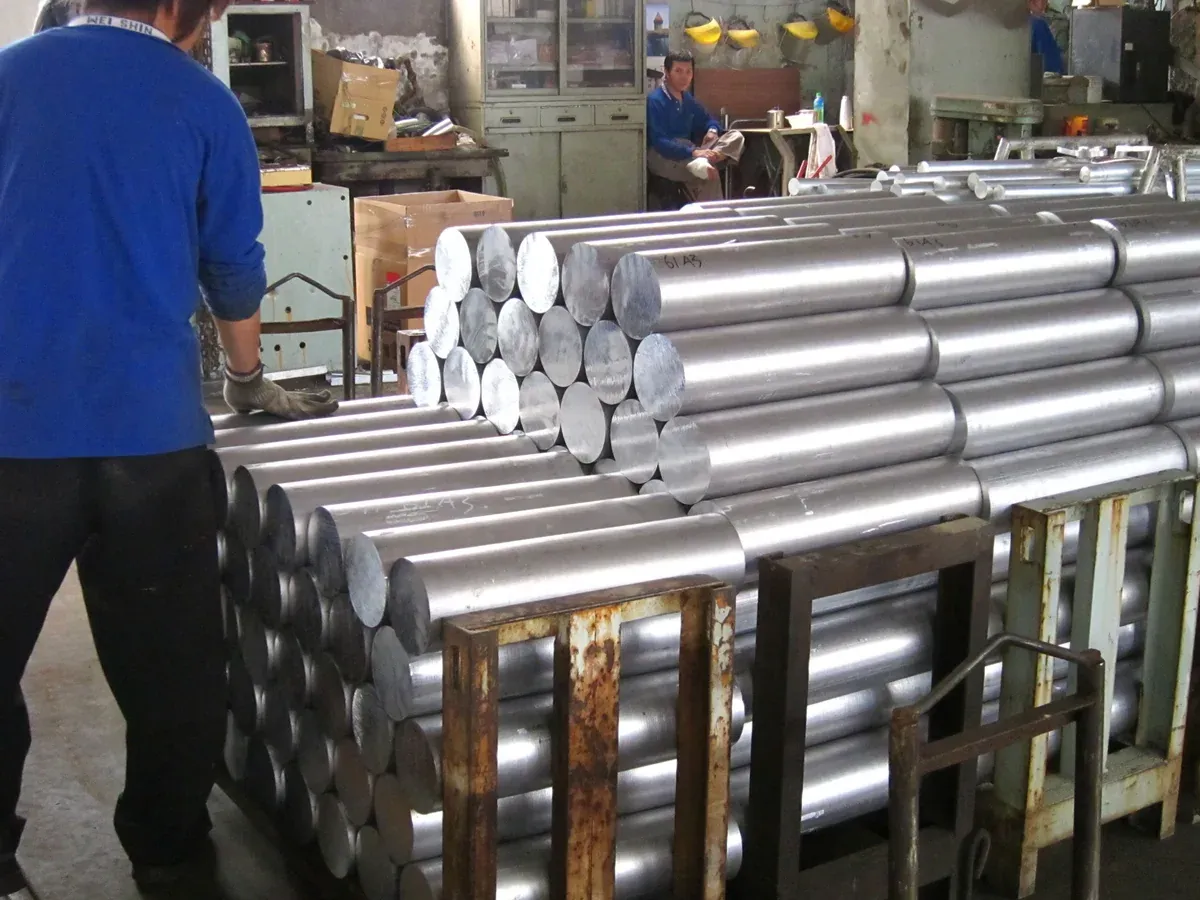
Every extruded profile starts life as a billet. Its chemistry decides the final strength and finish of the profile, and its internal structure decides how fast it can be pressed, how much pressure it needs and how many surface defects the extruder will fight. Good billet is one of the cheapest ways for an extrusion plant to raise output.
Billet is produced by direct-chill (DC) casting: molten aluminium, refined, degassed, filtered and grain-refined with Al-Ti-B, is poured into short water-cooled moulds, and the solidifying logs are lowered into a pit while water sprays the surface. Modern hot-top and air-slip moulds reduce the shell zone and inverse segregation at the surface, giving a smoother log that needs no scalping.
The cast logs are then homogenised: held at a high temperature, typically in the range of about 560 – 590 °C for 6063, for several hours. This evens out segregation, dissolves coarse Mg2Si, and transforms plate-shaped β-AlFeSi particles into rounded α-AlFeSi, which deforms more easily. Controlled cooling afterwards leaves the magnesium and silicon in a form that redissolves quickly in the extrusion press. Logs are finally ultrasonically or visually inspected, cut to length and stamped for traceability.
The registered limits below are wide. Extruders usually set narrower internal windows for magnesium and silicon to balance strength against press speed; for example, a lean 6063 for fast architectural extrusion and a richer 6063 for T6 frames.
| Alloy | Si | Fe max | Cu | Mn | Mg | Cr max |
|---|---|---|---|---|---|---|
| 6060 | 0.30 – 0.6 | 0.10 – 0.30 | ≤ 0.10 | ≤ 0.10 | 0.35 – 0.6 | 0.05 |
| 6063 | 0.20 – 0.6 | 0.35 | ≤ 0.10 | ≤ 0.10 | 0.45 – 0.9 | 0.10 |
| 6005A | 0.50 – 0.9 | 0.35 | ≤ 0.30 | ≤ 0.50 | 0.40 – 0.7 | 0.30 |
| 6061 | 0.40 – 0.8 | 0.7 | 0.15 – 0.40 | ≤ 0.15 | 0.8 – 1.2 | 0.04 – 0.35 |
| 6082 | 0.7 – 1.3 | 0.50 | ≤ 0.10 | 0.40 – 1.0 | 0.6 – 1.2 | 0.25 |
Aluminum Association and EN 573-3 limits. Zn and Ti limits and "others" are omitted for space; full limits appear on the certificate. 6005A also requires Mn + Cr of 0.12 – 0.50 %.
Fastest-pressing alloy for windows, doors and thin decorative sections. Lower strength than 6063.
The global workhorse for architectural, furniture, heat sink and general profiles with an excellent anodised finish.
Thin-walled structural and transport profiles, solar frames and rail sections that need more strength than 6063.
Structural profiles, tube and bar in North America and Asia; harder to press than 6063.
Structural bar, tube and profiles in Europe and India; manganese gives fine grain and higher strength.
2014, 2024, 7020, 7075 and similar billets for aerospace, defence and transport parts; slower pressing and closer inspection.
Billet diameter is fixed by the extrusion press container, so order the diameter your container takes. Logs are cast long and either shipped full length for hot-log shearing or cut to billet lengths. The table gives weight per metre at 2,700 kg/m³.
| Diameter (mm) | Nominal (in) | Weight (kg per metre) |
|---|---|---|
| 152 | 6 | 49.0 |
| 178 | 7 | 67.2 |
| 203 | 8 | 87.4 |
| 229 | 9 | 111.2 |
| 254 | 10 | 136.8 |
| 305 | 12 | 197.3 |
| 356 | 14 | 268.8 |
| 406 | 16 | 349.5 |
Diameter tolerance and straightness are agreed to suit your container clearance and billet loader.
| Check | Why it matters |
|---|---|
| Chemistry per cast | Sets strength, quench sensitivity and anodising response |
| Homogenisation verification | Confirms β to α AlFeSi transformation and Mg2Si state |
| Grain size | Fine, equiaxed grain avoids streaks and improves surface after etching |
| Surface and shell zone | Thick segregated shells cause blisters and pick-up on profiles |
| Hydrogen and inclusions | Gas and oxide films cause blisters and die-line defects |
| Ultrasonic test | Detects internal cracks and porosity; standard for 2xxx and 7xxx billet |
| Straightness and ends | Affects loading, container fit and butt welding of billets |
Ask for macro-etched slices and microstructure reports when qualifying a new source, and agree the frequency of chemistry checks per cast. Billet should be stored dry; condensation and corrosion on the surface carry into the extrusion as defects.
| Standard | Scope |
|---|---|
| EN 486 | Aluminium and aluminium alloys: extrusion ingots, specifications |
| EN 573-3 | Chemical composition of wrought alloys |
| Aluminum Association Teal Sheets | Registered alloy designations and chemical limits |
| ASTM B221 / EN 755-2 | Properties of the extruded products made from the billet |
| EN 10204 | Type 3.1 inspection certificate |
Mechanical properties are not specified for billet itself, because strength is developed only after extrusion, quenching and ageing. Acceptance of billet rests on chemistry, structure and defects; acceptance of profiles rests on the product standard.
As-cast logs have segregated alloying elements and needle-like β-AlFeSi particles. Homogenising evens out the chemistry and turns those particles into rounded α-AlFeSi, so the billet extrudes faster, at lower pressure and with a better surface.
A log is the full-length cast bar, often 6 – 7 m long. A billet is a shorter piece cut from the log to the length one press cycle needs. Some plants buy logs and cut them hot with a shear; others buy billets ready cut.
6063 is by far the most widely extruded alloy worldwide, followed by 6060 in Europe and 6061, 6082 and 6005A for structural profiles.
An 8 in (203 mm) billet weighs about 87 kg per metre at 2,700 kg/m³, so a 1-metre billet is about 87 kg.
Yes, 2xxx and 7xxx billet such as 2014, 2024 and 7075 can be supplied, normally with ultrasonic inspection and tighter chemistry control.
Send the alloy, diameter, length and monthly quantity. We will reply with availability, certification and a delivered price.






