Hard tempers (H14 – H19)
Stiff, flat sheet for punched louvres, folded reflectors and parts that must keep their shape. Limited bend radius.



Mirror reflector aluminium sheet is high-purity aluminium rolled bright and then anodised or vacuum-coated so it reflects light efficiently, either as a sharp mirror or as a soft, diffuse surface. It is the standard material for luminaire reflectors, solar concentrators, daylight tubes and decorative trim. Metline supplies reflector sheet and coil by reflectance class, finish and temper, protected and cut to size, worldwide.
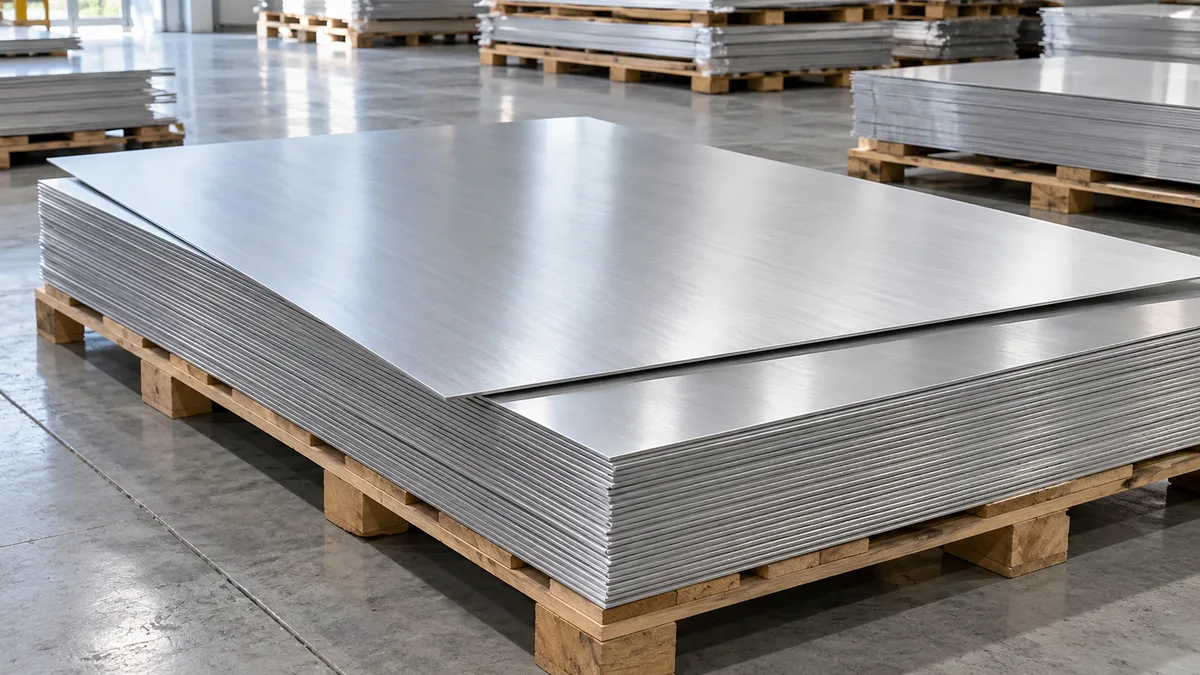
Aluminium is one of the best reflectors of visible light, infrared and especially ultraviolet. A clean, smooth high-purity aluminium surface reflects about 90 % of visible light, and it keeps reflecting well into the UV, where silver falls away. Reflector sheet turns that property into a stable industrial product by controlling purity, rolling, brightening and a protective surface layer.
Two families dominate. Anodised reflector sheet is bright-rolled high-purity aluminium that is chemically or electrochemically brightened and then given a thin, clear anodic layer to protect it. Its total reflectance typically peaks in the mid-80s per cent, because the oxide layer absorbs and scatters a little light. PVD-enhanced sheet adds a vacuum-deposited layer of very pure aluminium (or silver) on an anodised base, topped by transparent oxide layers that boost reflection, reaching about 95 % for enhanced aluminium and higher for silver-based systems.
Brightness to the eye is not a reliable guide. What matters is total reflectance, the share of it that is specular or diffuse, and how the surface behaves under the light source, temperature and humidity of the application. For that reason reflector sheet is specified by measured optical class, not just "mirror finish".
| Surface system | Typical total reflectance | Character | Typical use |
|---|---|---|---|
| Bright-rolled, unanodised | High when new; falls as the surface oxidises | Specular, but tarnishes and scratches easily | Short-life or protected components |
| Brightened and anodised (specular) | about 83 – 87 % | Mirror-like, durable, easy to clean | Office and industrial luminaire reflectors, louvres |
| Anodised semi-specular / matt | about 80 – 86 % | Controlled spread, reduces glare and hot spots | Downlights, wall washers, diffuse reflectors |
| PVD-enhanced aluminium | about 95 % | High reflectance with protective oxide stack | High-efficiency LED reflectors, solar and daylight systems |
| PVD silver-based | about 97 – 98 % | Highest visible reflectance; protected silver layer | Premium reflectors and light pipes |
Indicative values measured to DIN 5036-3. Actual figures depend on the product, surface and test geometry; ask for the measured value for the batch and finish you will receive.
Reflectance and the quality of the brightened surface rise with purity, because iron- and silicon-rich particles scatter light and leave pits after brightening. Reflector sheet therefore uses 99.85 % aluminium or purer; 5005 and other bright-trim alloys are used where some strength and a decorative anodised finish matter more than peak reflectance.
| Element (wt %) | 1085 (EN AW-1085) | 1050 (reference) |
|---|---|---|
| Silicon (Si) | ≤ 0.10 | ≤ 0.25 |
| Iron (Fe) | ≤ 0.12 | ≤ 0.40 |
| Copper (Cu) | ≤ 0.03 | ≤ 0.05 |
| Manganese (Mn) | ≤ 0.02 | ≤ 0.05 |
| Magnesium (Mg) | ≤ 0.02 | ≤ 0.05 |
| Zinc (Zn) | ≤ 0.03 | ≤ 0.05 |
| Titanium (Ti) | ≤ 0.02 | ≤ 0.03 |
| Aluminium | ≥ 99.85 | ≥ 99.50 |
Stiff, flat sheet for punched louvres, folded reflectors and parts that must keep their shape. Limited bend radius.
Balance of flatness and formability for bent and roll-formed reflectors.
For spinning and deep-drawing round reflector cones, often before anodising.
Weight is 2.70 kg per m² for every millimetre of thickness: a 1,000 × 2,000 × 0.5 mm sheet weighs about 2.7 kg. Use the sheet weight calculator for other sizes.
Shear, punch or laser cut with the protective film left on. Laser cutting needs a film rated for lasers so it does not melt into the surface.
Anodic and PVD layers are thin and hard; tight bends can craze them. Respect the supplier's minimum bend radius and bend with the film on.
Spinning and deep drawing are done on soft, often unanodised sheet, with brightening and anodising afterwards, or on special formable reflector grades.
Wear clean gloves. Fingerprints and oils reduce reflectance and can etch anodised surfaces over time.
Use mild, neutral cleaners and soft cloths. Avoid alkaline or abrasive cleaners, which attack the anodic layer.
Check the maximum service temperature of the surface system, especially near high-intensity lamps.
Total reflectance is measured with an integrating-sphere instrument to DIN 5036-3 and is the headline figure on most datasheets. Diffuse reflectance is measured with the specular component excluded; the difference between the two describes how mirror-like the surface is. ISO 7668 covers specular reflectance and gloss of anodised aluminium at defined angles, and solar applications use solar-weighted reflectance, for example to ASTM E903.
For purchasing, agree the measurement method, the acceptance value and the sampling frequency, and ask for the measured result per coil or batch. A datasheet maximum is not a delivery guarantee.
Anodised specular reflector sheet typically reaches about 83 – 87 % total reflectance (DIN 5036-3). PVD-enhanced aluminium reaches about 95 %, and silver-based PVD systems about 97 – 98 %. Always ask for the measured value for the finish you buy.
High-purity aluminium such as 1085 (99.85 %), 1090 or 1199 (99.99 %), because fewer impurity particles give a brighter, clearer surface after brightening. 5005 and similar alloys are used for decorative anodised trim where strength matters more than peak reflectance.
Specular sheet reflects light like a mirror, at a defined angle, for precise beam control. Diffuse or semi-specular sheet spreads the reflected light to soften glare and hot spots. Both can have similar total reflectance; the difference is the direction of the reflected light.
Yes, within the minimum bend radius for the surface system. The anodic or PVD layer can craze at tight bends, so bend with the film on, along the recommended direction, and test the bend on a sample first.
Yes. Silver reflects visible light better but its reflectance drops sharply in the ultraviolet, while aluminium stays highly reflective. That is why UV curing and disinfection reflectors use aluminium surfaces.
Yes. Metline supplies reflector aluminium in coils, slit strip and cut sheets with protective film, packed flat for export to customers worldwide.
Send the reflectance class, finish, thickness and size. We will reply with availability, test data and a delivered price.





