Plain mirror sheet
Mirror-rolled sheet supplied with protective film. The most economical option for decorative panels and interior trim that are not exposed to weather.



Aluminium mirror sheet is sheet or coil with a surface so smooth that it reflects light like glass, produced by rolling with polished rolls, by chemical or electrochemical brightening and anodising, or by vacuum coating. Depending on the process, total light reflectance runs from roughly 80 % to 98 %. This guide explains the grades, finishes and reflectance levels, and how to choose the right mirror sheet for lighting, solar, decorative and appliance work.
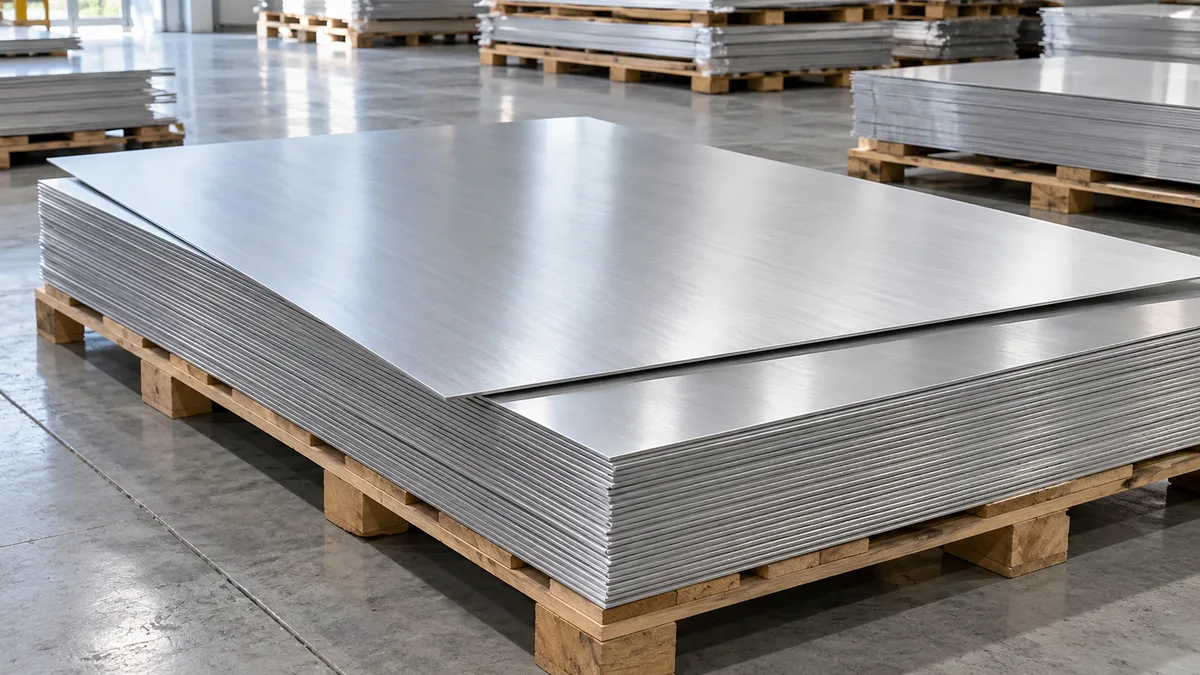
Pure aluminium reflects more visible light than almost any other common metal, which is why it is used for telescope mirrors, lamp reflectors and solar concentrators. A mirror sheet simply exposes that property by making the surface smooth enough that light bounces off in one direction (specular reflection) instead of scattering.
Two numbers describe a mirror sheet. Total reflectance is the share of incoming light reflected in all directions. Specular reflectance (or its complement, diffuse reflectance) shows how much of that light leaves at the mirror angle. A satin reflector can have high total reflectance but low specularity, so it spreads light; a true mirror keeps both high, so it directs light precisely. Lighting designers and solar engineers specify both, because the beam pattern of a luminaire or the focus of a concentrator depends on specularity, not just brightness.
Purity matters. Iron and silicon particles in the metal disturb the surface during rolling and brightening, so the highest-reflectance products start from high-purity alloys such as 1085 or 1090. More alloyed grades such as 3003 or 5005 are used where the sheet must be stronger or more formable and a slightly lower reflectance is acceptable.
| Route | How it works | Typical total reflectance | Main uses |
|---|---|---|---|
| Mirror rolling (bright rolling) | Final cold-rolling passes with highly polished work rolls give a glossy, mirror-like surface without further treatment | About 80 – 86 % | Decorative panels, appliance trim, signage, lamp housings |
| Brightening + anodising | Rolled sheet is chemically or electrochemically brightened, then given a thin, clear anodic film to protect the surface | About 85 – 88 % | Lighting reflectors and louvres, decorative and interior use |
| PVD-enhanced coating | A reflective layer (high-purity aluminium or silver) and transparent oxide layers are vacuum-deposited on anodised coil | About 92 – 98 % | High-efficiency luminaires, solar concentrators, daylight systems |
| Coated mirror sheet | Mirror-rolled or anodised sheet is roll-coated with a clear or tinted lacquer (PE or PVDF) | Varies with coating | Coloured mirror panels, composite panel skins, decorative interiors |
Reflectance ranges are typical of products on the market; the actual value depends on alloy, process and test method and is stated on the product data sheet.
Mechanical polishing of individual sheets or parts (grinding, buffing with progressively finer compounds) is also used, mostly for finished parts and small batches. It produces excellent appearance but is slow and costly, and polished surfaces need a lacquer or anodic film to keep their shine. Electropolishing, in which the part is the anode in an acid electrolyte, smooths the surface on a microscopic scale and is the basis of the continuous brightening lines used for reflector coil.
| Alloy | Typical tempers | Typical thickness | Character | Typical uses |
|---|---|---|---|---|
| 1050 / 1060 | O, H14, H16, H18, H24 | About 0.1 – 3 mm | Good reflectance, easy to form, economical | Decorative sheet, lamp housings, signage |
| 1070 | H14, H16, H18 | About 0.2 – 1.5 mm | Higher purity, better brightening response | Reflectors, coated mirror coil |
| 1085 / 1090 | H14, H18, H24 | About 0.2 – 1.0 mm | Highest specularity after brightening | Anodised and PVD reflector coil, solar |
| 3003 / 3105 | H14, H16, H18, H24 | About 0.2 – 2 mm | Stronger and stiffer, slightly lower reflectance | Appliance panels, decorative cladding, caps |
| 5005 / 5052 | H32, H34 | About 0.5 – 3 mm | Good strength and anodising response | Architectural panels, vehicle and marine trim |
Temper is chosen by the forming the sheet will see. A reflector that is spun or deep drawn needs a softer temper (O, H22 or H24), while a flat panel or a louvre blade that must stay rigid uses H16 or H18. Remember that forming stretches the surface and lowers specularity slightly, especially with tight radii, so reflectors are designed with forming in mind.
Mirror-rolled sheet supplied with protective film. The most economical option for decorative panels and interior trim that are not exposed to weather.
Brightened and anodised for a harder, cleaner and more durable surface that resists fingerprints and light abrasion. Available in natural silver and in dyed colours such as gold, bronze, black and blue.
Clear or tinted PE or PVDF lacquer over a mirror base gives coloured mirror effects and better weather resistance for signage and decorative facades.
Orange-peel, hammered, stucco or diamond patterns rolled into mirror sheet give a sparkling, diffused reflection used in lamp reflectors and decorative ceilings.
Multi-layer vacuum coatings lift total reflectance to the mid- or high-90s for efficient luminaires and solar optics. See the high-reflectivity guide for detail.
Mirror circles for spun reflectors and cookware lids, and thin coil for the face skins of mirror composite panels.
For luminaires, the reflector material often matters as much as the light source. Moving from a 86 % anodised reflector to a 95 % PVD-coated one can raise the light output of a multi-reflection fixture noticeably, because each bounce loses less light. For a single-bounce decorative trim, the cheaper mirror-rolled sheet is usually enough.
Mirror sheet is supplied with a protective film that should stay on through cutting, bending and assembly. Use film rated for laser cutting if parts will be laser profiled. Bend with clean, polished tooling or with protective film on the dies, and avoid dragging sheets across each other. Remove film soon after installation, as film left in direct sunlight for long periods can leave adhesive residue.
Clean mirror surfaces with mild neutral detergent and a soft cloth, then rinse and dry. Avoid alkaline or acid cleaners, abrasive pads and solvents that attack coatings. Anodised and PVD-coated surfaces resist fingerprints and cleaning far better than bare rolled mirror, which is one reason they are preferred for luminaires that are serviced regularly.
Mirror-rolled sheet typically reflects about 80 – 86 % of visible light, brightened and anodised reflector sheet about 85 – 88 %, and PVD-enhanced reflector coil about 92 – 98 %. Always compare values measured by the same test method.
Total reflectance counts all reflected light; specular reflectance counts only light reflected at the mirror angle. A high-specular surface directs light precisely, while a diffuse surface spreads it.
High-purity alloys such as 1085 and 1090 give the highest specularity after brightening and anodising. 1050 and 1070 suit rolled mirror and decorative use; 3003 and 5005 are used where strength or formability matters more.
Plain mirror-rolled sheet dulls outdoors. For exterior use choose anodised or PVDF-coated mirror sheet, or PVD-coated grades designed for solar applications, and check their weathering data.
Yes, if the temper suits the operation. Use O, H22 or H24 tempers for spinning and drawing, keep the protective film on, and expect a small loss of specularity on tightly formed areas.
With mild neutral detergent, a soft cloth and clean water, then dry. Avoid abrasive pads, strong acids, alkalis and aggressive solvents.
Send the alloy, finish, thickness, reflectance target and quantity. We will reply with options and a delivered price.





