Cutting
Slit, sheared, laser or punched. Keep tools sharp and clean to avoid edge burrs and coating chips; leave the protective film on.



High-reflectivity aluminium sheet is a bright-rolled, high-purity aluminium substrate with an anodised or vacuum-deposited (PVD) optical coating that reflects most of the light falling on it: roughly 86 – 90 % for anodised grades and up to about 98 % for PVD-enhanced grades. It is used for luminaire reflectors, LED backlights, daylighting systems, solar concentrators and UV curing lamps. This guide explains the coating types, how reflectance is measured and how to choose a grade; Metline supplies reflective sheet and coil worldwide, slit or cut to size.
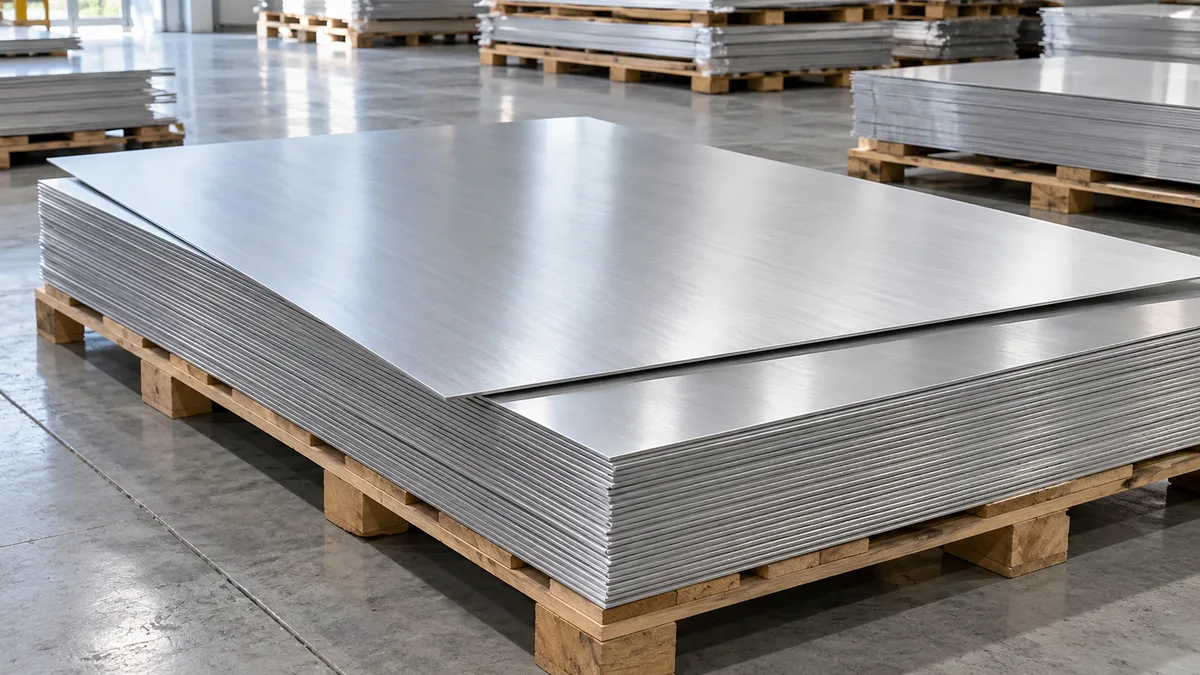
Freshly deposited pure aluminium reflects about 91 – 92 % of visible light and keeps that performance well into the ultraviolet, which no other common metal does. A reflective sheet takes advantage of this, but it must also survive handling, forming, heat and humidity, so the bright metal is always protected by an oxide or a transparent coating.
A reflective sheet is built in layers. The base is a rolled aluminium strip, usually of high purity (99.7 – 99.9 % Al) so that few intermetallic particles break up the surface. The strip is rolled with polished work rolls to a mirror-bright finish. It is then either chemically or electrolytically brightened and anodised to give a thin, clear protective oxide, or it is coated in a vacuum line with a sequence of thin films: a reflective metal layer (high-purity aluminium or silver) followed by dielectric layers whose thicknesses are tuned so that reflected light waves reinforce one another.
The result is measured as total reflectance (all reflected light, whatever its direction) and specular reflectance (light reflected at the mirror angle). A luminaire that must shape a precise beam needs high specular reflectance; a diffuse light box or backlight needs high total reflectance with a matt or hammered surface.
| Type | Construction | Typical total reflectance | Best for |
|---|---|---|---|
| Bright-rolled mill finish | High-purity strip rolled bright, no coating | Starts high but tarnishes; not stable | Temporary or indoor non-critical parts |
| Anodised specular | Bright-rolled, electro-brightened, clear anodised | About 85 – 88 % | General luminaires, downlight reflectors, louvres |
| Anodised high-purity (99.9 % +) | As above on a purer substrate | About 87 – 90 % | Higher-efficiency reflectors at moderate cost |
| PVD-enhanced aluminium | Anodised base + pure Al layer + dielectric stack | About 95 % | High-efficiency LED luminaires, daylight systems |
| PVD silver-based | Silver reflective layer + protective dielectric stack on aluminium | Up to about 98 % | Backlights, light guides, demanding optical use |
| UV-optimised | Pure Al reflective layer with thin UV-transparent protection | High in the 250 – 400 nm band | UV curing, disinfection, phototherapy, photochemistry |
| Diffuse and textured | Matt, hammered or embossed surfaces with any of the above | Similar total, low specular | Wide, glare-free distribution |
Reflectance figures are typical values for flat, unformed material measured with an integrating sphere. Forming stretches the coating and can lower reflectance by a few percent; ask for data on the formed condition if your reflector is deep-drawn.
Ordinary anodised reflectors cannot go much above 90 %, because the anodic oxide both absorbs a little light and creates interference losses. PVD-enhanced grades get past this limit with optical multilayers. Silver-based layers give the highest visible reflectance but need careful sealing to prevent tarnish; aluminium-based enhanced layers are slightly lower in the visible range but more stable and far better in the ultraviolet.
| Alloy | Aluminium content | Character as a reflector base |
|---|---|---|
| 1085 / 1090 | 99.85 – 99.90 % | Very few surface particles; brightest anodised finish; the usual base for high-grade specular sheet |
| 1070 | 99.7 % | Good brightness at lower cost; common for general reflectors |
| 1050 | 99.5 % | Economical base for diffuse and less critical reflectors |
| 3003 | Al-Mn alloy | Stronger and stiffer; used where the reflector is self-supporting or formed |
| 5052 | Al-Mg alloy | Highest strength of the common bases; good for large panels and parts that must hold shape |
Tempers range from soft (O) for deep drawing and spinning to H14 – H18 for flat or lightly bent parts. A harder temper keeps large panels flat and resists dents; a softer temper allows deeper forming without cracking the coating. Thickness is typically 0.25 – 3.0 mm, with 0.3 – 0.8 mm most common for luminaire reflectors, in widths up to about 1,250 mm.
Total reflectance is normally measured with an integrating-sphere photometer against a calibrated standard, following methods such as DIN 5036-3, and weighted to the sensitivity of the human eye. Solar reflectance uses a different, sun-weighted spectrum (for example ASTM E903), so a solar figure cannot be compared directly with a lighting figure.
Slit, sheared, laser or punched. Keep tools sharp and clean to avoid edge burrs and coating chips; leave the protective film on.
Bend and draw with polished or film-covered tools. Respect the minimum bend radius given for the grade, especially for PVD types.
Use rivets, clinching, tabs or adhesives. Welding destroys the optical surface locally.
Wear gloves; fingerprints and oils reduce reflectance and can etch the surface over time.
Anodised grades tolerate typical luminaire temperatures well; check the rated maximum for PVD grades in hot fittings.
Dust with compressed air or a soft cloth and mild neutral cleaner; never use abrasives or alkaline cleaners.
Metline supplies the reflective aluminium sheet and coil, slit or cut to blanks; the finished reflectors and fittings are made by luminaire and system manufacturers.
Common mistakes are paying for 98 % sheet in a single-bounce reflector where an anodised grade would perform almost as well, using silver-based sheet in a UV lamp, and removing the protective film before forming.
Anodised specular grades typically reach about 85 – 90 % total reflectance. PVD-enhanced aluminium grades reach about 95 %, and silver-based PVD grades up to about 98 %, measured on flat material with an integrating sphere.
Total reflectance counts all reflected light; specular reflectance counts only the light reflected at the mirror angle. Specular grades shape beams precisely, while diffuse grades spread light evenly.
A UV-optimised grade with a pure aluminium reflective layer and a thin UV-transparent protective coating. Silver-based and conventional anodised sheet reflect UV much less efficiently.
Yes, within the minimum bend radius and forming limits of the grade. Anodised grades in soft tempers form well; PVD coatings may lose a few percent of reflectance when strongly stretched.
Most reflectors use 0.3 – 0.8 mm sheet. Thinner material suits small reflectors and backlights; thicker 3003 or 5052 suits large self-supporting panels.
Yes. Metline supplies reflective aluminium as coil, slit strip and cut sheet worldwide, with protective film and reflectance data on request.
Send the reflectance grade, finish, thickness, width and quantity. Metline will recommend a grade and reply with a delivered price.





