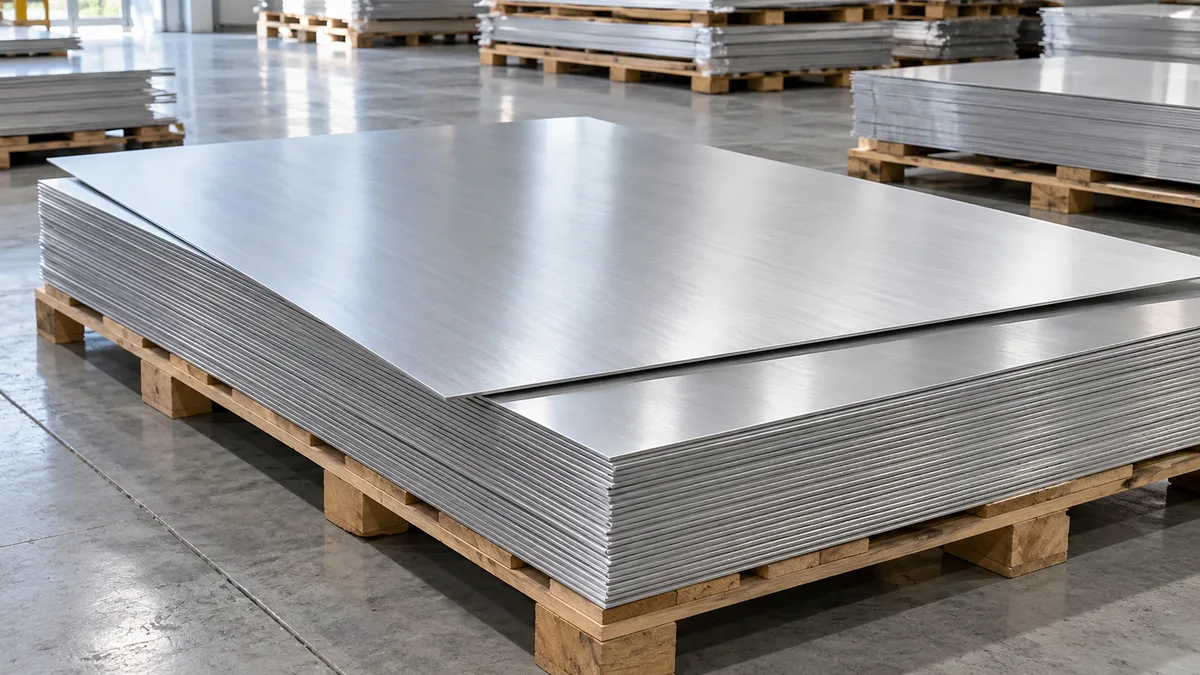
Ultra-thin mirror aluminium is bright-rolled, high-purity aluminium in gauges from about 0.08 mm, finished by anodising or vacuum coating to give total light reflectance from around 86 % up to 95 %. At 0.08 mm it uses about 84 % less metal than a 0.5 mm mirror sheet, which makes it attractive for reflector liners, laminates and decorative films. This guide explains grades, finishes, measurement and where thin gauges work best.
Mirror aluminium is sheet or coil whose surface has been rolled on polished work rolls to an extremely smooth, bright finish and then protected or enhanced so that it reflects light specularly, like a mirror. "Ultra-thin" refers to gauges well below the 0.3 – 1.0 mm normally used for luminaire reflectors, down to about 0.08 mm.
At 0.08 mm the material is, strictly, in foil territory: EN 546 treats aluminium thinner than 0.2 mm as foil, and ASTM uses a limit of about 0.15 mm. In practice it is still sold as "mirror sheet" because it is made by the same bright-rolling and finishing routes and is used for the same optical purposes, either self-supporting in small parts or laminated to a carrier.
The economic case is simple. Aluminium weighs 2.70 kg per square metre per millimetre, so a 0.08 mm sheet weighs 0.216 kg/m² against 1.35 kg/m² for 0.5 mm. Thin gauges cost more per kilogram to roll and finish, but far less metal is needed per square metre of reflective surface, so for laminated or lined products the cost per square metre is often much lower.
Surface technology
How the mirror finish is made
Type
How it is produced
Typical total reflectance
Notes
Bright-rolled, coated
Mirror rolling of 1xxx alloy, then a clear lacquer or protective film
About 80 – 86 %
Economical; used for decoration, signage and general reflectors
Anodised mirror
High-purity (e.g. 99.85 %) bright-rolled coil, chemically or electrolytically brightened, then thinly anodised
About 85 – 88 %
Hard, durable oxide layer; the standard luminaire reflector material
PVD-enhanced aluminium
Anodised substrate plus a vacuum-deposited pure aluminium layer and dielectric reflection-enhancing layers
About 95 %
Highest reflectance of all-aluminium systems; used in high-efficiency lighting and daylight systems
Silver-based PVD
Silver reflective layer under protective layers on an aluminium carrier
About 98 %
Shown for comparison; the reflective layer is not aluminium
Reflectance figures depend on the measurement standard. European suppliers usually quote total reflectance to DIN 5036-3 with an integrating sphere, while some data sheets use ASTM E1651. Diffuse (scattered) reflectance is quoted separately: a true mirror has low diffuse reflectance, while satin and "hammertone" grades scatter more light on purpose. Always compare grades measured to the same method.
Polishing, electropolishing and chemical brightening improve smoothness and brightness; anodising and lacquer protect the surface. Coloured mirror finishes (gold, champagne, rose gold and similar) are produced by coloured lacquers or coatings over the bright aluminium.
Good corrosion resistance; used where strength is needed more than peak reflectance
Facades, housings
The rule of thumb: the purer the aluminium, the brighter the anodised mirror, because alloying elements and intermetallic particles show up as haze in the oxide layer. Claims of 94 – 95 % reflectance from ordinary alloyed sheet without a PVD layer should be questioned and checked against a measured data sheet.
Specification
Typical specification and weights
Typical supply range
Thickness
0.08 – 0.2 mm ultra-thin; 0.2 – 1.0 mm and thicker standard mirror sheet
Width
Slit coil from narrow strip up to about 1250 – 1500 mm, depending on gauge and finish
Length / form
Coil, slit strip or cut sheet; common sheet sizes 1220 × 2440 mm (48 × 96 in) and 1220 × 3050 mm (48 × 120 in)
Temper
Usually H14 – H18 for reflectors; softer tempers for deep forming
PE or laser-cut-compatible protective film on the mirror side
Standards
EN 485 / EN 573-3 / ASTM B209 for the substrate; DIN 5036-3 for reflectance
Thickness (mm)
Weight (kg/m²)
1220 × 2440 mm sheet (kg)
0.08
0.216
0.64
0.1
0.270
0.80
0.15
0.405
1.21
0.2
0.540
1.61
0.3
0.810
2.41
0.4
1.080
3.21
0.5
1.350
4.02
0.8
2.160
6.43
1
2.700
8.04
Example: covering 3,000 m² needs about 650 kg of 0.08 mm mirror aluminium against about 4,050 kg at 0.5 mm. Whether that reduces total project cost depends on the price per kilogram of each gauge and on the carrier or structure the thin sheet needs, so compare quotes per square metre, not per kilogram.
Performance
Durability, ageing and heat
Does reflectance drop over time?
Yes, slowly. Dust, fingerprints, humidity and pollutants reduce it, and unprotected aluminium forms a thicker oxide over time. Anodised and PVD grades with a sealed top layer keep reflectance far better than bare or lightly lacquered material.
Cleaning
Use soft cloths with mild, neutral detergent and clean water. Abrasives, alkaline cleaners and solvents can damage anodised or lacquered layers.
Heat
Anodised reflectors tolerate the operating temperatures of most luminaires, but lacquered and coloured coatings have lower limits. Check the coating's rated temperature for lamps or solar receivers.
Outdoor and solar use
For outdoor or solar concentrator use, choose a grade with a weather-resistant protective layer tested for UV and humidity; standard indoor reflector grades can degrade outdoors.
Corrosion
Salt-spray and humidity test results should be part of the data sheet when the sheet will be used near the coast or in humid interiors.
Handling
Thin gauges dent and crease easily; keep the protective film on until after forming and installation.
Working with it
Cutting, forming and laminating thin mirror sheet
At 0.08 – 0.2 mm, mirror aluminium can be slit, guillotined, die-cut and laser-cut, but its edges are sharp and the surface marks easily. Leave the protective film on during all cutting and forming, and use clean, polished tooling to avoid pick-up marks. For bends, the anodic layer of anodised grades can craze if the radius is too tight; follow the supplier's minimum bend radius for the specific grade and temper.
Lamination is the most common route for the thinnest gauges. Thin mirror aluminium is bonded to plastic sheet, honeycomb or foam panels, board or composite panels with pressure-sensitive or heat-activated adhesives. The bond side should be primed or treated for adhesion, and the laminate built so it does not curl when the temperature changes.
Applications
Applications of ultra-thin mirror aluminium
Lighting reflectors: liners for downlights, troffers, high-bays and LED optics, where thin gauge reduces weight and cost
Tubular daylight systems: highly reflective liners for light pipes that carry daylight into buildings
Solar thermal and concentrators: reflective surfaces for collectors and booster reflectors, using weather-resistant grades
Architectural decoration: mirror faces for composite panels, ceilings, columns and interior trims
Automotive and transport interiors: trim strips, badges and lamp reflectors
Signage and displays: mirror letters, point-of-sale displays and decorative labels
Define the reflectance targetDecorative use rarely needs more than 85 %; efficient luminaires use 86 – 88 % anodised or 95 % PVD-enhanced grades.
Decide whether the sheet carries loadIf it must be self-supporting, choose 0.3 mm or more; if it is laminated or a liner, 0.08 – 0.2 mm often works.
Match the environmentIndoor, humid, outdoor or high-temperature use each needs a suitable protective layer.
Check forming needsTight bends and deep drawing need a softer temper and a grade rated for forming.
Compare like with likeAsk for reflectance to the same standard (DIN 5036-3 or ASTM E1651) and for a sample before ordering.
The most common mistakes we see are buying on a headline reflectance number without knowing the test method, using an indoor reflector grade outdoors, and ordering a gauge that is too thin for a self-supporting part. Another is removing the protective film before forming, which almost always leaves handling marks on the mirror face. Agree the finish, film type, coil inside diameter and packing (sealed, desiccated cases for sea freight) at the quotation stage so the material arrives ready for your line.
Mirror-finished aluminium is available from about 0.08 mm. At that gauge it is usually laminated or used as a liner, because it cannot support itself over large spans.
What reflectance can I expect?
Lacquered bright-rolled sheet reaches roughly 80 – 86 %, anodised high-purity mirror about 85 – 88 %, and PVD-enhanced aluminium about 95 % total reflectance, measured to DIN 5036-3.
What is the difference between mirror and high-reflectivity aluminium?
Standard mirror aluminium is bright-rolled and protected for appearance and moderate reflection. High-reflectivity grades use high-purity substrates, brightening and anodising, often with PVD reflection-enhancing layers, to reach 90 – 95 % for optical and lighting uses.
Does the reflectivity of mirror aluminium change over time?
It declines slowly with dirt, humidity and surface oxidation. Sealed anodised or PVD protective layers and regular gentle cleaning keep the loss small.
Is thin mirror aluminium really cheaper?
Per square metre it often is, because far less metal is needed. Per kilogram it costs more, so compare quotes per square metre including any carrier or lamination.
Can mirror aluminium be bent?
Yes, within the minimum bend radius for the grade and temper. Tight bends can craze the anodic layer, so keep the protective film on and use softer tempers for deep forming.
Need thin mirror aluminium for reflectors or laminates?
Send gauge, width, finish and reflectance target. Our team will recommend a grade, arrange samples and quote delivery worldwide.