Forming
O-temper 1070 can be deep drawn, spun and bent flat on itself. Even H14 accepts bend radii of about 0–1 × thickness. Work hardening during forming is modest, so multi-stage draws rarely need intermediate annealing.



1070 is a commercially pure aluminium containing at least 99.70 % aluminium, chosen when electrical or thermal conductivity, formability and corrosion resistance matter more than strength. Metline supplies 1070 sheet and plate in soft, cold-worked and as-rolled tempers, cut to size and certified to ASTM B209 or EN 485, to customers worldwide.
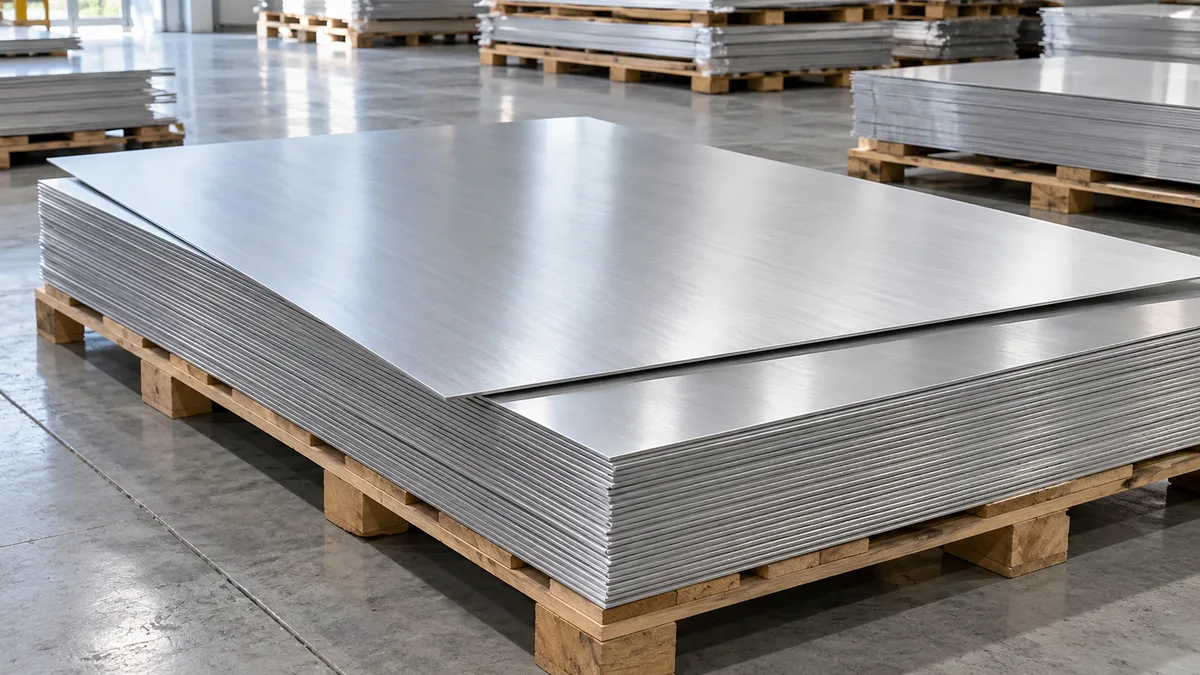
1070 sits in the 1xxx series, where the last two digits give the purity above 99 %: 1070 means at least 99.70 % aluminium. Because almost nothing is dissolved in the metal to scatter electrons, it conducts electricity and heat better than any common alloy apart from the even purer 1080, 1085 and the electrical grade 1350.
The price of that purity is strength. Annealed 1070 has a tensile strength of only about 60 – 90 MPa, and even fully hard H18 sheet barely reaches 140 MPa. 1070 cannot be heat-treated; it is strengthened only by cold rolling, which is why it is sold in O, H12, H14, H16, H18 and as-rolled H112 tempers.
Buyers select 1070 for parts that carry current or heat, that must be drawn or spun into deep shapes, or that need a bright, uniform surface after polishing or anodising. Typical examples are busbars and connector plates, capacitor and battery components, heat-spreader plates, reflector blanks and chemical-plant linings. In Europe the grade is usually ordered as EN AW-1070A (Al99.7), which has very slightly different impurity limits but is used interchangeably for most purposes.
Limits below are the Aluminum Association values for 1070, which ASTM B209 follows. EN AW-1070A (EN 573-3) uses the same 99.70 % minimum with marginally different limits on individual impurities. The actual analysis of every lot is reported on the mill test certificate.
| Element | Maximum (%) | Why it is controlled |
|---|---|---|
| Silicon (Si) | 0.20 | Main impurity with iron; affects conductivity and surface quality |
| Iron (Fe) | 0.25 | Forms intermetallic particles that lower conductivity and ductility |
| Copper (Cu) | 0.04 | Kept very low for conductivity and corrosion resistance |
| Manganese (Mn) | 0.03 | Reduces conductivity sharply even in small amounts |
| Magnesium (Mg) | 0.03 | Impurity |
| Zinc (Zn) | 0.04 | Impurity |
| Titanium (Ti) | 0.03 | Grain refiner; limited because it lowers conductivity |
| Vanadium (V) | 0.05 | Lowers conductivity; limited in conductor grades |
| Others, each | 0.03 | |
| Aluminium (Al) | 99.70 min. | By difference |
Values below are typical figures for guidance. Guaranteed minimum and maximum limits depend on the standard and thickness band (ASTM B209 or EN 485-2) and are shown on the mill certificate. Note the trade-off: each step of cold work roughly doubles yield strength over the annealed state but sharply cuts elongation.
| Temper | Tensile strength (typical) | Yield strength (typical) | Elongation (typical) | Typical use |
|---|---|---|---|---|
| O (annealed) | 65 – 90 MPa | 20 – 30 MPa | 30 – 40 % | Deep drawing, spinning, tight bends |
| H12 / H22 | 80 – 110 MPa | 55 – 80 MPa | 10 – 20 % | Moderate forming with some stiffness |
| H14 / H24 | 100 – 130 MPa | 75 – 105 MPa | 6 – 12 % | Busbar plates, panels, general fabrication |
| H18 | 125 – 145 MPa | 110 – 130 MPa | 2 – 5 % | Flat, stiff parts with no forming |
| H112 (as rolled plate) | 70 – 100 MPa | 25 – 50 MPa | 15 – 25 % | Thick plate for machined conductors and blocks |
1070 and 1070A are registered in every major system. If your drawing names a national grade, give us the designation and edition and we will supply and certify to it.
| System | Designation | Sheet and plate standard |
|---|---|---|
| Aluminum Association / ASTM | 1070 | ASTM B209 (ASME SB-209) |
| UNS | A91070 | — |
| European (EN) | EN AW-1070A / EN AW-Al99.7 | EN 485-1/-2/-4, EN 573-3 |
| German Werkstoff | 3.0275 (1070A) | DIN EN 485 |
| ISO | Al99.7 | ISO 6361, ISO 209 |
| Japan (JIS) | A1070P | JIS H4000 |
| China (GB) | 1070 / 1070A | GB/T 3880, GB/T 3190 |
National equivalents are close but not always identical in every impurity limit; where conductivity is guaranteed, state the required % IACS on the order.
Standard formats ship fastest; other widths and lengths are cut from larger sheet or ordered from the rolling mill.
1070 weighs 2.70 kg per square metre for every millimetre of thickness. Use the table for quick estimates and the plate weight calculator for exact sizes.
| Thickness (mm) | kg per m² | 1220 × 2440 mm (kg) | 1500 × 3000 mm (kg) |
|---|---|---|---|
| 0.5 | 1.35 | 4.0 | 6.1 |
| 0.8 | 2.16 | 6.4 | 9.7 |
| 1 | 2.70 | 8.0 | 12.2 |
| 1.5 | 4.05 | 12.1 | 18.2 |
| 2 | 5.40 | 16.1 | 24.3 |
| 3 | 8.10 | 24.1 | 36.5 |
| 4 | 10.8 | 32.1 | 48.6 |
| 5 | 13.5 | 40.2 | 60.8 |
| 6 | 16.2 | 48.2 | 72.9 |
| 8 | 21.6 | 64.3 | 97.2 |
| 10 | 27.0 | 80.4 | 121.5 |
| 12 | 32.4 | 96.4 | 145.8 |
| 20 | 54.0 | 160.7 | 243.0 |
| 30 | 81.0 | 241.1 | 364.5 |
| 40 | 108.0 | 321.5 | 486.0 |
| 50 | 135.0 | 401.9 | 607.5 |
O-temper 1070 can be deep drawn, spun and bent flat on itself. Even H14 accepts bend radii of about 0–1 × thickness. Work hardening during forming is modest, so multi-stage draws rarely need intermediate annealing.
Welds easily by TIG and MIG with ER1100 or ER1188 filler when conductivity must be preserved, or ER4043 for better fluidity. Resistance and friction-stir welding also work well. The weld zone anneals, which matters little because the base metal is already soft.
High purity and a solidus near 645 °C make 1070 easy to braze with Al-Si fillers. It is also a common partner in aluminium-to-copper transition joints for electrical work.
Soft and gummy: use sharp, polished, high-rake tools, high speeds and plenty of lubricant to avoid built-up edge. Harder tempers (H14, H18) machine more cleanly than O.
Responds very well, giving a clear, bright film with good reflectance. For decorative mirror finishes, 1085 and 1090 give a slightly higher brightness, but 1070 is a cost-effective choice.
Excellent resistance to atmospheric, fresh-water and many chemical environments thanks to a stable oxide film. Avoid direct contact with copper or steel in wet conditions without insulation or plating.
If the part also has to carry structural load, a better route is often a 1070 conductor bolted or clad to a stronger 6xxx alloy, or a switch to 6101 for busbars, which trades a few points of conductivity for much higher strength.
| Property | 1050 | 1060 | 1070 | 1100 |
|---|---|---|---|---|
| Aluminium minimum | 99.50 % | 99.60 % | 99.70 % | 99.00 % |
| Electrical conductivity (O, typical) | about 61 % IACS | about 62 % IACS | about 62 % IACS | about 59 % IACS |
| Tensile strength, H14 (typical) | about 110 MPa | about 100 MPa | about 100 – 130 MPa | about 125 MPa |
| Formability | Excellent | Excellent | Excellent | Excellent |
| Anodised appearance | Good | Good | Very good | Fair (copper slightly dulls the film) |
| Typical use | General sheet metal, chemical plant | Heat exchangers, battery shells | Busbars, reflectors, conductive parts | Spun ware, fin stock, general fabrication |
The differences between the pure grades are small but real. Choose 1070 when conductivity or anodised brightness is specified; choose 1050 or 1060 when availability and price come first; choose 1100 when a little more strength helps and conductivity is not critical. Conductivity figures vary with temper and impurity level, so specify a minimum % IACS where it matters.
A commercially pure, non-heat-treatable grade with at least 99.70 % aluminium. It offers very high electrical and thermal conductivity, excellent formability and corrosion resistance, but low strength.
1070 is the Aluminum Association grade used with ASTM standards; 1070A is the European EN AW grade. Both require 99.70 % aluminium minimum and differ only slightly in individual impurity limits, so they are interchangeable for most applications.
It is marginally more conductive and is often specified for that reason. For busbars that also need strength, 6101-T6 or a hard-temper 1070 plate is used, depending on the current density and mechanical loads.
About 61 – 62 % IACS in the annealed condition, falling slightly as the metal is cold-worked. If a guaranteed value is required, state it on the order so it can be tested and certified.
No. 1070 has no strengthening phase to precipitate. Strength comes only from cold work (H tempers); heating anneals it back towards the soft O temper.
Yes. Metline cuts 1070 sheet and plate to your sizes, packs it for sea or air freight and ships worldwide with an EN 10204 3.1 mill certificate.
Tell us the temper, size, quantity and destination, and any conductivity requirement. We will reply with availability, certification and a delivered price.





