Standard anodised mirror
Thin clear anodic film and seal. The default for indoor reflectors and decorative uses, with better stain resistance than unanodised bright sheet.



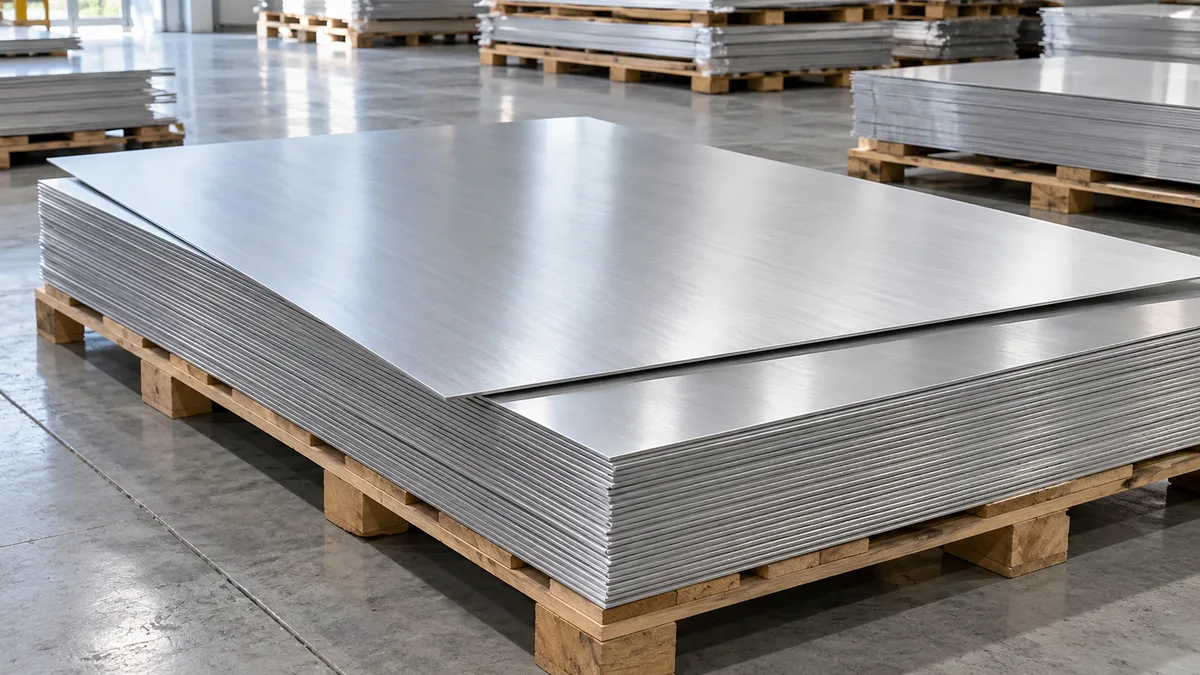
1085 mirror aluminium is 99.85 % pure aluminium that is bright-rolled, chemically brightened and anodised to a mirror surface. Standard anodised mirror sheet returns roughly 85 – 88 % of visible light, enhanced anodised grades about 90 – 95 %, and PVD-enhanced grades up to about 98 %. It is used for lighting reflectors, solar and horticultural reflectors, signage, trim and decoration. This guide explains the grades, how reflectance is measured and how to specify it.
The reflectivity of an aluminium surface depends on how smooth it is and on what is in the metal. Iron and silicon form tiny intermetallic particles that do not anodise like aluminium; after brightening and anodising they scatter light and leave a faint haze. The purer the base metal, the fewer particles, the clearer the anodic film and the brighter the mirror.
1085 allows only 0.12 % iron and 0.10 % silicon, against 0.40 % and 0.25 % in 1050. That makes it one of the most widely used bases for high-quality reflector sheet. Even purer bases (1090, 1093, 99.9 %+) exist for the most demanding optics, while 1050, 1070 and some 8xxx alloys serve decorative mirror products where cost matters more than the last few points of reflectance.
The metal is only the start. The mirror is created by a sequence of steps, each of which affects the final optical result. Understanding that sequence helps you read datasheets and choose the right grade.
Film thickness is a balance. Thicker anodic films give better wear and corrosion resistance but absorb slightly more light and can show iridescence (faint rainbow interference colours). Reflector grades therefore use thin films, and datasheets often state an iridescence class.
Three figures describe a reflector surface. Total reflectance is all the light returned, in every direction. Diffuse reflectance is the part scattered at angles away from the mirror direction. Specular reflectance is the mirror-direction part, roughly total minus diffuse. A good beam-forming reflector needs high total and high specular reflectance; a soft, glare-free luminaire may prefer more diffuse reflection.
| Grade type | Total reflectance (typical) | Diffuse share | Character | Typical use |
|---|---|---|---|---|
| Standard anodised mirror | ≈ 83 – 88 % | Up to ≈ 12 % | Bright mirror, economical | General reflectors, signage, trim, decoration |
| Enhanced anodised mirror | ≈ 90 – 95 % | ≈ 5 – 12 % | High-purity base and optimised brightening | Commercial luminaires, louvres, downlights |
| PVD-enhanced high specular | ≈ 95 – 98 % | ≤ ≈ 4 % | Very high specular reflectance, minimal loss per reflection | High-efficiency optics, LED reflectors, solar concentrators |
| Matt or semi-specular anodised | ≈ 85 – 90 % | High | Softer light, less glare | Office luminaires, troffers |
| High-diffuse white coated | ≈ 95 % and above | Mostly diffuse | Uniform, scattered light | Backlight units, panel lights, light boxes |
Indicative ranges compiled from published reflector datasheets. Values depend on the producer, test method and wavelength range, so specify the minimum values and method on your order.
Higher reflectance grades cost more, and the benefit compounds in optics with several reflections. In a reflector where light bounces three times, a 95 % surface delivers about 86 % of the light (0.95³), while an 86 % surface delivers only about 64 %. For a single bounce the difference is much smaller.
| Method | What it measures | Notes |
|---|---|---|
| DIN 5036-3 | Total and diffuse reflectance with an integrating sphere | The most common basis for reflector datasheets |
| ISO 6719 | Reflectance characteristics of anodised aluminium using integrating-sphere instruments | Used for anodised surfaces |
| ISO 7668 | Specular reflectance and specular gloss of anodic coatings at 20°, 45°, 60° or 85° | Gloss meters; mainly for clear-anodised surfaces |
| Iridescence class | Visual grading of interference colours | Grade definitions vary by producer; agree the scale on the order |
Because methods differ, a "95 %" figure from one producer may not equal "95 %" from another. When comparing offers, ask for the test method, wavelength range and whether the figure is typical or guaranteed minimum.
Thin clear anodic film and seal. The default for indoor reflectors and decorative uses, with better stain resistance than unanodised bright sheet.
A thicker oxide film for better abrasion and corrosion resistance, at a small cost in reflectance; suits trim and parts that are handled or cleaned often.
Gold, black, blue, red, bronze and other colours while keeping the mirror effect. Approve colour samples, because shades vary between process routes.
Metallic colours such as gold, rose and black, or high-reflectance optical stacks. Specify outdoor-rated coatings for exterior use.
A fine directional brush pattern on a bright base for decorative panels and appliance trim.
Coated mirror sheet that accepts printing or dye-sublimation for labels and photo panels.
| Element | Max % |
|---|---|
| Si | 0.10 |
| Fe | 0.12 |
| Cu | 0.03 |
| Mn | 0.02 |
| Mg | 0.02 |
| Zn | 0.03 |
| Ga | 0.03 |
| Ti | 0.02 |
| Others, each | 0.01 |
| Al, min. | 99.85 |
| Property | Typical value |
|---|---|
| Designation | EN AW-1085 / EN AW-Al 99.85 |
| Density | 2.70 g/cm³ |
| Tensile strength (H14 – H18) | ≈ 100 – 140 MPa |
| Yield strength (hard tempers) | ≈ 90 – 125 MPa |
| Elongation (hard tempers) | ≈ 1 – 4 % |
| Thermal conductivity | ≈ 230 W/m·K |
| Thermal expansion | ≈ 23.5 × 10⁻⁶ /K |
Composition per EN 573-3. Mechanical values are typical for mirror sheet in hard tempers and vary with temper and producer; confirm on the certificate.
Hard tempers keep the sheet flat and resist dents, which matters for optical accuracy. They also limit forming: bend radii should be at least the producer's recommendation, and tight bends can craze the anodic film or crack PVD layers. If your reflector is deep drawn, ask for a forming grade.
Luminaire reflectors, downlight cones, louvres, street-light optics, horticultural lamps, UV curing lamps and automotive lamp components.
Reflectors for solar concentrators and collectors, light pipes and daylight-guidance systems.
Nameplates, premium labels, emblems and instrument faces that are printed, embossed or stamped.
Wall and ceiling panels, bars and salons, cabinets, appliance panels and aluminium composite panels.
Façade features and display parts in anodised or PVD-coated mirror; plain bright sheet is not recommended outdoors.
Cosmetic caps and packaging, crafts and photo panels.
For lighting, 1085 or purer bases are the safe default. For indoor decoration, 1070 or 1085 colour mirror is usual. For automotive trim and low-cost decorative parts, 1050 or 1070 mirror often provides enough reflectance at lower cost.
Mirror coils are wrapped in film and packed eye-to-sky or eye-to-wall on pallets with edge protectors; sheets are interleaved or filmed and packed flat in wooden cases so they cannot slide. Desiccant and moisture barriers protect against condensation during sea freight. Every pack is labelled with grade, finish, dimensions, lot and weight, and an EN 10204 3.1 certificate with the agreed optical data accompanies the shipment.
Lighting reflectors, solar and daylighting reflectors, signage and nameplates, decorative panels, appliance trim and premium packaging: anywhere a bright, reflective surface is needed.
Standard anodised mirror sheet typically reaches about 85 – 88 % total reflectance, enhanced anodised grades about 90 – 95 %, and PVD-enhanced grades up to about 98 %. Always check the test method behind the figure.
Total reflectance is all the light returned by the surface. Diffuse reflectance is the part scattered away from the mirror direction. A low diffuse value means a sharper, more mirror-like reflection.
1085 has much lower iron and silicon, so fewer particles disturb the anodic film. The result is a clearer, brighter mirror with higher specular reflectance.
Use anodised or outdoor-rated PVD-coated mirror sheet for exterior work. Plain bright sheet will dull and stain outdoors.
Yes, within the producer's minimum bend radius. Hard tempers keep the sheet flat but limit forming, and tight bends can craze the anodic film or crack PVD layers, so ask for a forming grade for deep-drawn parts.
Yes. Metline can supply samples, slit coils and cut-to-size sheets, with protective film and the agreed optical data on the certificate.
Send the application, reflectance target, finish, sizes and quantity. We will propose a grade, arrange samples and quote a delivered price.





