Flat-plate collectors
A full-plate absorber or several fin strips are laser or ultrasonically welded to a harp or serpentine of risers. The most common use of absorber coil.



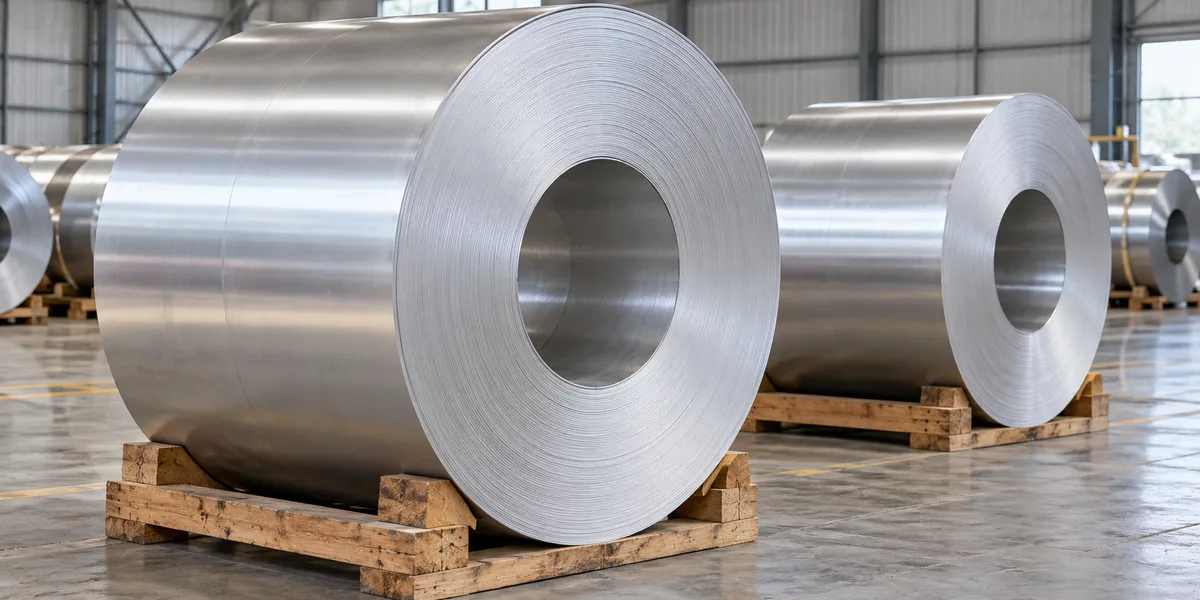
Solar absorber sheet is thin, high-purity aluminium coil, usually 1060 or 1100 at around 0.4 mm, that forms the heat-collecting plate inside flat-plate, air and PV/T solar collectors. It is supplied either bare, for manufacturers who apply their own coating, or with a selective PVD coating that absorbs about 95 % of sunlight while radiating only a few per cent of the heat back. Metline supplies both forms in coil, slit strip and cut sheet to collector makers worldwide.
In a solar thermal collector, the absorber is the dark plate under the glass. It converts sunlight into heat and passes that heat into the fluid tubes (risers) bonded to its back, or into air flowing past it. Its two jobs, absorbing radiation and conducting heat sideways to the tubes, define what the material must do.
Aluminium does the second job well. 1060 and 1100 have high thermal conductivity, low density and excellent formability, so a thin sheet spreads heat efficiently to the risers while keeping the collector light. The first job is done by the surface: bare aluminium reflects most sunlight, so the absorber is coated, either with a black paint or, in modern collectors, with a spectrally selective coating.
Metline supplies two products: bare aluminium substrate coil for coating lines and absorber makers who coat in-house, and selective-coated absorber coil ready for laser or ultrasonic welding to riser tubes. In both cases the aluminium is supplied as coil, slit strip or cut sheet; the collector itself is made by the customer.
| Supply option | Best for | Key checks | Information needed for a quote |
|---|---|---|---|
| Bare substrate coil | Coating lines, absorber and collector makers with in-house coating | Alloy, temper, thickness, width, surface cleanliness and flatness | Alloy and temper, thickness, width, coil ID/OD or weight, surface requirement |
| Selective-coated absorber coil | Collector production lines | Solar absorptance, thermal emittance, coating durability, batch test report | Size, optical targets, collector type, joining method |
Any hot surface radiates heat as infrared. A black paint absorbs sunlight well, but it is also an efficient infrared emitter, so at operating temperature it loses a large share of its heat by radiation. A selective coating is engineered to be "black" in the visible and near-infrared range of sunlight (roughly 0.3 – 2.5 µm) and "shiny" in the longer infrared range (beyond about 3 µm) where a 60 – 120 °C plate radiates.
| Surface | Solar absorptance α | Thermal emittance ε | Effect in the collector |
|---|---|---|---|
| Bare 1060 / 1100 aluminium | Low (reflects most sunlight) | Very low | Not usable as an absorber without a coating |
| Black paint (non-selective) | High, about 0.90 – 0.95 | High, about 0.85 – 0.90 | Absorbs well but loses much heat by radiation, especially at higher temperatures |
| Selective black paint | About 0.90 – 0.93 | Moderate, about 0.3 – 0.5 | Lower-cost improvement for low-temperature collectors |
| PVD selective coating | About 0.93 – 0.96 | Low, about 0.04 – 0.10 | High efficiency, particularly when the plate runs well above ambient |
Values are typical published ranges for commercial coatings; the actual α and ε of a coated batch are given on its optical test report.
PVD (physical vapour deposition) coatings are produced in roll-to-roll vacuum lines using magnetron sputtering, electron-beam evaporation or both. The usual structure is a thin infrared-reflecting base (the aluminium itself or a metal layer), a cermet absorbing layer of metal particles in a ceramic matrix, often titanium or chromium based, and a transparent anti-reflection top layer. Because the process is dry and vacuum based, it avoids the liquid chemistry and wastewater of older black chrome or black nickel electroplating.
The gain from selectivity grows with temperature difference. For a domestic hot water collector at 60 °C on a cold, sunny day, cutting emittance from about 0.9 to about 0.05 removes most of the radiative loss from the plate, which raises efficiency noticeably at mid and high operating temperatures and in low irradiance.
The weight of thin coil is easy to calculate from 2.70 kg per m² per millimetre of thickness. The table helps when planning coil weights, slit widths and line throughput.
| Thickness (mm) | Width (mm) | kg per metre | metres per tonne |
|---|---|---|---|
| 0.3 | 125 | 0.101 | 9877 |
| 0.3 | 150 | 0.121 | 8230 |
| 0.3 | 1000 | 0.810 | 1235 |
| 0.3 | 1250 | 1.013 | 988 |
| 0.4 | 125 | 0.135 | 7407 |
| 0.4 | 150 | 0.162 | 6173 |
| 0.4 | 1000 | 1.080 | 926 |
| 0.4 | 1250 | 1.350 | 741 |
| 0.5 | 125 | 0.169 | 5926 |
| 0.5 | 150 | 0.203 | 4938 |
| 0.5 | 1000 | 1.350 | 741 |
| 0.5 | 1250 | 1.688 | 593 |
| 0.6 | 125 | 0.203 | 4938 |
| 0.6 | 150 | 0.243 | 4115 |
| 0.6 | 1000 | 1.620 | 617 |
| 0.6 | 1250 | 2.025 | 494 |
Commercially pure aluminium is chosen because it combines the highest thermal conductivity of the aluminium alloys with very good formability and a clean, uniform surface for coating. Alloying elements that raise strength also lower conductivity, and an absorber does not need structural strength.
| Property | 1060 aluminium | 1100 aluminium | Copper (C11000 / Cu-ETP) |
|---|---|---|---|
| Aluminium or copper content | ≥ 99.60 % Al | ≥ 99.00 % Al (with 0.05 – 0.20 % Cu) | ≥ 99.90 % Cu |
| Thermal conductivity (typical) | About 230 W/m·K | About 220 W/m·K | About 390 W/m·K |
| Density | 2.70 g/cm³ | 2.71 g/cm³ | 8.9 g/cm³ |
| Conductivity per unit mass | High | High | About half that of aluminium |
| Formability | Excellent | Excellent | Excellent |
| Relative material cost | Low | Low | High |
Copper conducts heat better, so for the same fin efficiency a copper absorber can be thinner. Aluminium compensates with thickness: a 0.4 mm aluminium absorber performs comparably to a thinner copper sheet, at a fraction of the weight and material cost. That is why aluminium absorbers, often welded to copper or aluminium risers, now dominate flat-plate collector production.
1060 has slightly higher purity and conductivity; 1100 has a small copper addition that gives a little more strength. Both coat and weld well. Choose by the coating line's experience and the forming required.
A full-plate absorber or several fin strips are laser or ultrasonically welded to a harp or serpentine of risers. The most common use of absorber coil.
The absorber heats air flowing behind or through it for space heating and crop drying; profiled or perforated absorber sheet increases heat transfer.
Aluminium fins with a selective coating clamp around heat pipes inside glass tubes or in heat pipe manifold designs.
An aluminium thermal absorber is laminated or bonded to the back of PV cells to remove heat, raising electrical efficiency and producing warm water or air.
Larger collector fields for industrial low-temperature heat, and unglazed absorbers for swimming pools.
Facade and roof-integrated solar thermal panels where low weight is an advantage.
Compatibility with each system depends on operating temperature, stagnation temperature, joining method and the corrosion environment. In particular, aluminium should not carry the heat transfer fluid directly unless the fluid chemistry is controlled; in most collectors the fluid runs in copper or protected aluminium risers and the absorber stays dry inside the collector box.
Quality checks for absorber coil cover the substrate, the dimensions and, for coated coil, the optical properties and their durability.
| Check | Bare substrate | Coated absorber |
|---|---|---|
| Chemistry and temper | Mill certificate (EN 10204 3.1) | Mill certificate for the substrate |
| Dimensions | Thickness, width, coil size, flatness | Same, plus coating uniformity across width |
| Surface | Cleanliness, oil residue, defects | Visual coating defects, scratches, pinholes |
| Optical properties | — | Solar absorptance and thermal emittance per batch |
| Durability | — | Coating qualified to ISO 22975-3 (high temperature, condensation and humid sulphur dioxide tests) |
| Collector performance | — | Collector tested by the customer to EN ISO 9806, often for Solar Keymark certification |
ISO 22975-3 is the reference method for assessing the long-term durability of selective absorbers in vented flat-plate collectors, and it underpins absorber qualification in the Solar Keymark scheme. Ask for the coating's qualification evidence alongside the batch optical report. Export packing uses moisture-barrier wrapping, desiccant, edge protectors and eye-to-sky or eye-to-wall coil positioning on wooden pallets or cases, so that coatings and coil edges arrive undamaged.
Commercial PVD selective coatings on aluminium typically reach a solar absorptance of about 0.94 – 0.96 and a thermal emittance of about 0.04 – 0.10, depending on the coating type. The actual values for each batch are reported on its optical test certificate.
Copper conducts heat better, but aluminium is about one third of the density and much cheaper. A slightly thicker aluminium absorber gives comparable fin efficiency at lower weight and cost, which is why aluminium absorbers are now widely used in flat-plate collectors.
It balances lateral heat conduction to the risers, weldability and weight. Thinner sheet saves material but conducts less heat sideways, so riser spacing must shrink; thicker sheet adds weight and cost. Other thicknesses from about 0.3 to 0.6 mm can be supplied.
Yes. Aluminium absorber sheet is used as the thermal layer behind PV cells, laminated or bonded to the module. Specify the lamination process so the surface and temper suit it.
Both. Bare 1060 or 1100 substrate coil suits customers with their own coating lines; selective-coated coil suits collector makers who weld it directly to risers.
ISO 22975-3 assesses the durability of selective absorber surfaces under high temperature, water condensation and high humidity with sulphur dioxide, using changes in absorptance and emittance as the failure criterion, and is used for Solar Keymark absorber qualification.
Tell us the alloy, thickness, width, coating requirement and volume. We will reply with availability, test documents and a delivered price.





