Stucco (orange peel)
Fine random texture; the default for insulation jacketing, cold rooms and appliance liners.



Stucco embossed aluminium coil carries a random, orange-peel texture rolled into the surface. The pattern hides scratches and dents, cuts glare and stiffens thin sheet, which is why it is the standard skin for pipe and tank insulation jacketing, cold-room panels, truck bodies and appliance liners. Metline supplies stucco and other embossed patterns in 1xxx, 3xxx and 5xxx alloys, plain, coated or with a moisture barrier, worldwide.
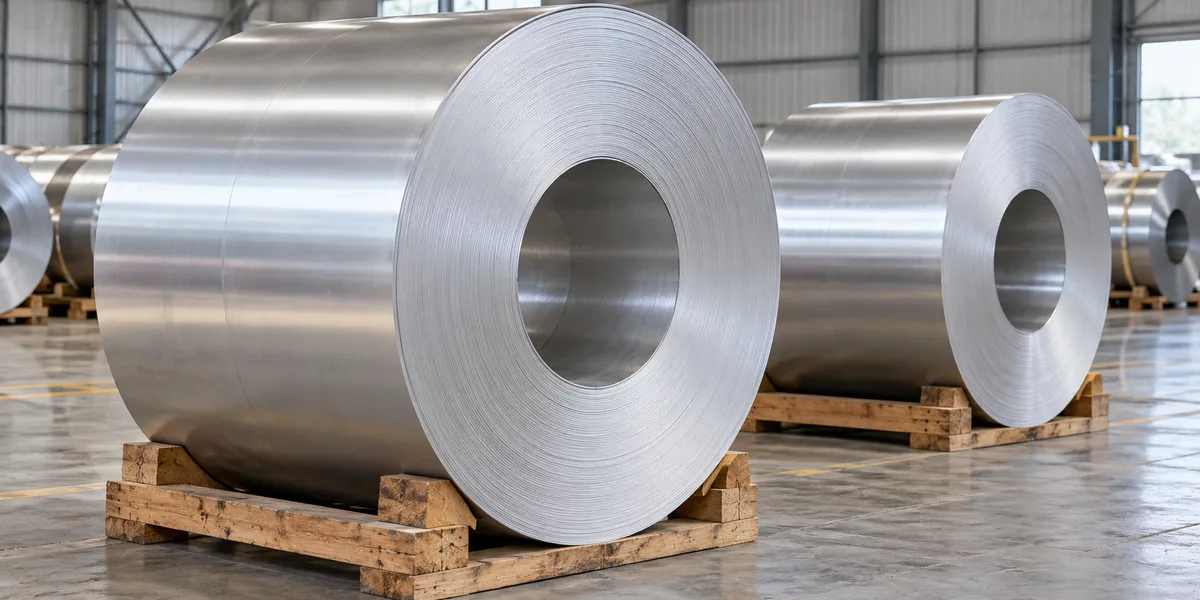
Stucco embossing is a cold-rolling operation. Flat coil passes between a hard steel roll engraved with an irregular stucco texture and a softer backing roll, which presses the pattern through the sheet so it shows on both faces. No metal is removed, so the mass per square metre stays the same as plain sheet of the same gauge.
The texture does three useful jobs. It scatters light, so a large jacketed pipe rack or tank does not glare in the sun. It disguises the small scratches and handling marks that would show on mill-finish sheet. And the slight three-dimensional ripple raises the bending stiffness of thin gauges, so jacketing and liners resist oil-canning and look flatter after installation.
Embossing also work-hardens the metal a little, which is why suppliers usually emboss from a slightly softer temper (for example H14 or H24) so the finished sheet still bends around pipe and forms into lock seams without cracking.
| Alloy | Typical tempers | Character | Typical use |
|---|---|---|---|
| 1050 / 1060 | H14, H24, H18 | Commercially pure, very formable, highest reflectivity | Light-duty jacketing, reflectors, interior panels |
| 1100 | H14, H16, H24 | Pure grade with a small copper addition, good formability | Insulation jacketing, cold-room liners |
| 3003 | H14, H16, H24 | About 20 % stronger than 1100, excellent corrosion resistance | The most common jacketing and appliance alloy |
| 3105 | H14, H24, H26 | Slightly stronger than 3003; good for coated coil | Painted embossed siding, roofing, truck bodies |
| 5052 | H32, H34 | Higher strength and best seawater resistance | Marine, offshore and high-abuse jacketing, refrigerated trailers |
| 8011 | H14, H18, H22 | Mainly foil and thin strip | Embossed foil facings for duct board and insulation |
For heavy foil gauges used on duct board and insulation facings, see embossed aluminium foil.
Final thickness tolerance is measured on the flat sheet before embossing; tell us if you need it measured otherwise.
Because embossing does not change mass per area, weight is the same as flat sheet: 2.71 – 2.73 kg per m² per mm for 3003 and 1100.
| Thickness (mm) | Thickness (in) | kg per m² (3003) | kg per linear m, 1000 mm wide |
|---|---|---|---|
| 0.30 | 0.012 | 0.82 | 0.82 |
| 0.40 | 0.016 | 1.09 | 1.09 |
| 0.50 | 0.020 | 1.36 | 1.36 |
| 0.60 | 0.024 | 1.64 | 1.64 |
| 0.70 | 0.028 | 1.91 | 1.91 |
| 0.80 | 0.031 | 2.18 | 2.18 |
| 1.00 | 0.039 | 2.73 | 2.73 |
| 1.20 | 0.047 | 3.28 | 3.28 |
Fine random texture; the default for insulation jacketing, cold rooms and appliance liners.
Regular diamond texture with a decorative look for panels, cabinets and lift interiors.
Larger dimples, used for lighting reflectors, decorative ceilings and heat shields.
Raised anti-slip ribs for flooring, steps and toolboxes; see tread plate.
Roll-formed sinusoidal profile for large tanks, walls and roofs where stiffness matters more.
Fine decorative patterns for appliances and electronics; custom rolls on request.
The biggest use of stucco embossed coil is metal jacketing over thermal insulation on pipework, vessels and tanks in refineries, power plants, chemical plants, LNG terminals and HVAC systems. The jacket keeps rain, washdown and mechanical damage out of the insulation; wet insulation loses much of its thermal performance and can cause corrosion under insulation on the steel underneath.
In North America, aluminium jacketing is specified to ASTM C1729, which sets requirements for the alloy, temper, thickness, finish and moisture retarder, with the sheet itself to ASTM B209. A typical pipe specification calls for 0.016 in (0.40 mm) stucco embossed 3003 or 1100 for smaller lines and 0.020 – 0.024 in for larger pipe and equipment, with corrugated sheet for large vertical tanks.
On delivery, check that the pattern depth is uniform across the width, that there are no oil stains, white corrosion spots or roll marks, and that the moisture barrier is fully bonded at the edges. Each lot should come with an EN 10204 3.1 mill certificate confirming alloy, temper and mechanical results.
Mainly as metal jacketing over pipe, tank and equipment insulation, and as facing for cold-room panels, refrigerator liners, truck bodies and appliance panels where a scratch-hiding, low-glare surface is wanted.
3003 in H14 or H24 temper is the most common because it combines good formability with better strength than 1100. 5052 is used for marine and high-abuse areas; 1100 and 1060 for lighter-duty work.
It makes the sheet measure thicker across the pattern peaks, but it does not add metal, so weight per square metre is the same as flat sheet of the original gauge.
A thin polysurlyn film or kraft paper laminated to the inside face. It separates the aluminium from wet insulation and steel pipe, reducing galvanic and crevice corrosion.
For most pipe insulation 0.40 mm (0.016 in) is standard; larger pipes, vessels and areas with foot traffic or mechanical risk use 0.50 – 0.80 mm (0.020 – 0.032 in). Follow your project specification or ASTM C1729.
Yes. PE and PVDF coatings are applied before or after embossing, and anodised embossed sheet is also available for appliance and decorative uses.
Send alloy, temper, thickness, width, finish and quantity. We will reply with availability, certification and a delivered price.





