5052-O
Fully annealed for deep drawing, spinning and severe forming.



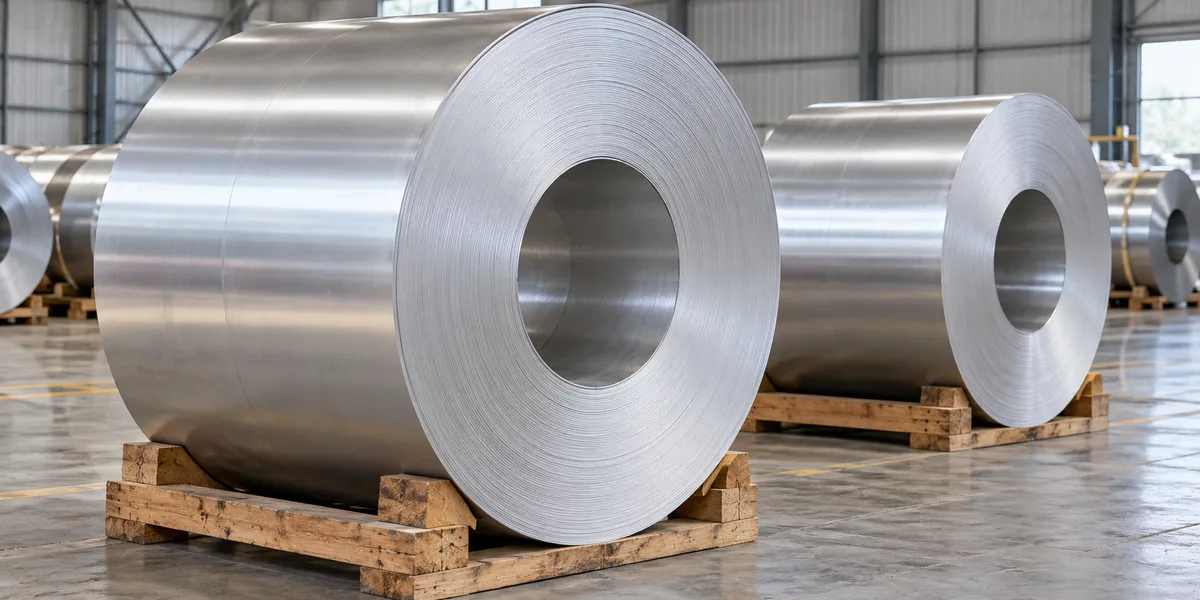
5052 aluminium coil is rolled from a 2.5 % magnesium alloy that is the strongest of the commonly used, easily formed non-heat-treatable grades, with excellent resistance to seawater and industrial atmospheres. It is the standard coil for fuel tanks, truck and marine panels, electronics housings, honeycomb core and pressure-formed parts. Metline supplies 5052 coil, slit strip and cut sheet in O to H38 tempers, to ASTM B209 and EN 485, worldwide.
5052 sits in the middle of the 5xxx family: enough magnesium (2.2 – 2.8 %) for real strength, but not so much that formability or long-term stability suffer. In H32 temper it is roughly 50 % stronger than 3003-H14 and still bends tightly.
Magnesium strengthens the aluminium by solid solution, and cold rolling adds more strength; chromium controls grain structure and improves resistance to stress corrosion. The H3x tempers used for 5052 are strain-hardened and then thermally stabilised, which prevents the gradual softening ("age softening") that unstabilised Al-Mg alloys show at room temperature.
Unlike the higher-magnesium alloys 5083 and 5456, 5052 is not prone to sensitisation, so it can be used at moderately elevated temperatures. It has very good fatigue strength for a non-heat-treatable alloy, which is why it is chosen for vibrating parts such as fuel tanks, fan blades and vehicle panels.
| Element | Minimum | Maximum |
|---|---|---|
| Silicon (Si) | — | 0.25 |
| Iron (Fe) | — | 0.40 |
| Copper (Cu) | — | 0.10 |
| Manganese (Mn) | — | 0.10 |
| Magnesium (Mg) | 2.2 | 2.8 |
| Chromium (Cr) | 0.15 | 0.35 |
| Zinc (Zn) | — | 0.10 |
| Others, each / total | — | 0.05 / 0.15 |
| Aluminium (Al) | Remainder |
Aluminum Association limits, followed by ASTM B209 and EN 573-3 (EN AW-5052 / EN AW-AlMg2.5).
| Temper | Tensile strength (typical) | Yield strength (typical) | Elongation (typical) | Fatigue strength |
|---|---|---|---|---|
| O | 195 MPa | 90 MPa | 25 % | 110 MPa |
| H32 | 230 MPa | 195 MPa | 12 % | 115 MPa |
| H34 | 260 MPa | 215 MPa | 10 % | 125 MPa |
| H36 | 275 MPa | 240 MPa | 8 % | 130 MPa |
| H38 | 290 MPa | 255 MPa | 7 % | 140 MPa |
Typical values (Aluminum Association / ASM; fatigue at 5 × 10⁸ cycles). ASTM B209 specifies, for example, 5052-H32 tensile 215 – 265 MPa with yield ≥ 160 MPa; limits vary with thickness and are shown on the certificate.
Fully annealed for deep drawing, spinning and severe forming.
Quarter-hard and stabilised; the most popular temper. Bends to about 1 – 1.5 × thickness and suits most sheet-metal work, tanks and enclosures.
Half-hard; higher strength for panels and parts with gentler bends.
Three-quarter and full hard for stiff, flat parts, springs and honeycomb foil.
| System | Designation | Product standard |
|---|---|---|
| Aluminum Association / ASTM | 5052 | ASTM B209 (ASME SB-209) |
| UNS | A95052 | — |
| Aerospace (SAE) | 5052-O / H32 / H34 | AMS 4015, AMS 4016, AMS 4017 |
| European (EN) | EN AW-5052 / EN AW-AlMg2.5 | EN 485-1/-2/-4, EN 573-3 |
| German Werkstoff | 3.3523 | DIN EN 485 |
| ISO | AlMg2.5 | ISO 6361 |
| Japan (JIS) | A5052P | JIS H4000 |
| China (GB) | 5052 | GB/T 3880 |
In Europe 5754 (AlMg3) is often stocked where 5052 would be used elsewhere; it is slightly stronger and similar in behaviour. We can supply either.
Approximate weight of a 5052 coil on a 508 mm core at 2.68 g/cm³:
| Coil width (mm) | OD 1000 mm (kg) | OD 1200 mm (kg) | OD 1500 mm (kg) |
|---|---|---|---|
| 500 | 781 | 1244 | 2096 |
| 1000 | 1562 | 2488 | 4193 |
| 1250 | 1952 | 3110 | 5241 |
| 1500 | 2343 | 3732 | 6289 |
Thickness and width tolerances for 5052 coil follow ANSI H35.2 (referenced by ASTM B209) or EN 485-4 for cold-rolled strip. Because 5052 is harder than 1xxx and 3xxx alloys, the standard tolerance bands are the same but rolling to the tighter end takes more passes, so state the tolerance you actually need rather than asking for "tight" by default.
Slit strip is supplied with burr height controlled to a fraction of the thickness and with edge camber limited per metre of length. For stamping and roll-forming lines, tell us the maximum camber and coil set your tooling can tolerate; tension levelling before slitting removes most of the residual shape from hard tempers such as H34 and H36.
| Check | How it is done | Recorded on |
|---|---|---|
| Chemistry | Spectrometer analysis of the cast | EN 10204 3.1 certificate |
| Tensile, yield, elongation | Test pieces from each lot, per ASTM B557 or EN ISO 6892-1 | EN 10204 3.1 certificate |
| Thickness and width | Micrometer and tape or laser gauge along the coil | Inspection report |
| Flatness and camber | Measured on a flat table over a set length | Inspection report on request |
| Surface | Visual check for scratches, roll marks, oil stains and corrosion | Packing list remarks |
Bend tests to the minimum radius in EN 485-2 or ASTM B209 can be added where parts are formed tightly; this is worthwhile for H34 and harder tempers, where the permitted radius rises quickly with temper.
H32 bends well across and along the rolling direction. Allow more springback than with 3003 and use generous radii for H34 and harder.
TIG and MIG with ER5356 (stronger) or ER5554 for elevated-temperature service. Avoid ER4043 where the weld will be anodised.
Gummy in soft tempers; harder tempers machine acceptably with sharp, high-rake tools and lubricant.
Anodises well with a clear, protective film; paints and powder-coats well after chromate-free conversion coating.
| Property | 3003-H14 | 5052-H32 | 5083-H111 | 6061-T6 |
|---|---|---|---|---|
| Typical tensile strength | 150 MPa | 230 MPa | 290 MPa | 310 MPa |
| Formability | Excellent | Very good | Good | Poor in T6 |
| Seawater resistance | Good | Excellent | Excellent | Fair |
| Weld strength retained | High | High | High | Low |
| Supplied in coil | Yes | Yes | Mostly plate | Limited |
Our article on the differences between 5052 and 6061 explains when each is the better choice.
H32 means strain-hardened to quarter-hard and then thermally stabilised. Stabilising prevents the slow softening at room temperature that unstabilised aluminium-magnesium alloys show.
5052 has excellent seawater resistance and is widely used on small boats and marine fittings. For large welded hull structures, 5083 or 5086 to ASTM B928 is normally specified.
No. It is non-heat-treatable; strength comes from magnesium and cold work. Annealing softens it to O temper.
Weight = width × π/4 × (OD² − ID²) × 2.68 g/cm³. A 1250 mm wide coil with 1200 mm OD on a 508 mm core weighs about 3.1 tonnes.
Usually, yes. 5052-H32 bends much more easily than 6061-T6 and resists corrosion better. 6061 is chosen when higher strength or machining is needed.
Send thickness, width, temper, coil size and destination. We will confirm availability and quote a delivered price.





